Churches vary a great deal - but can we see past all their differences to what underlies them?
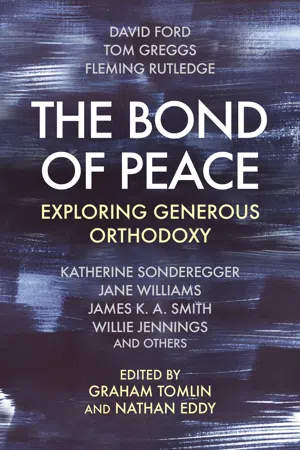
'Generous orthodoxy' is a phrase that describes a Christianity both broad and deep, rooted in the historic creeds and embracing different expressions of Christian faith. The Bond of Peace is a ground-breaking, creative and practical exploration of what generous orthodoxy really means, and how expressing it might bring about a sense of unity in the church that is badly needed in our fractured and polarised world.
Drawing together leading theologians from the UK and the USA - including David Ford, Katherine Sonderegger, Willie Jennings, Tom Greggs, JKA Smith and Jane Williams - The Bond of Peace offers reflections on how generous orthodoxy can be expressed through everything from worship and preaching to biblical theology, the arts and more.
Based around a series of lectures held at St Mellitus College, and sponsored by the McDonald Agape Foundation, this timely book is essential reading for anyone interested in how the Christian Church can bridge the gap between denominations to negotiate the challenges of our 21st century world in a united manner. It will leave you, not only with a deeper understanding of generous orthodoxy, but the practical confidence to celebrate and embrace the differences in Christian denominations so we can all live together more joyfully - through the transforming and renewing work of the Holy Spirit.
- English
- ePUB (mobile friendly)
- Available on iOS & Android
eBook - ePub
About this book
Information
1
Jesus: Reliably surprising, generously orthodox
It is appropriate that a book on generously orthodox Christian theology should begin with Jesus. If generous orthodoxy, or any other account of faith and understanding, is to have any Christian validity it must ring true with who Jesus is and what he has done and continues to do.
As this book was brought together, generous orthodoxy was initally described as an approach to theology that ‘has deep roots in the Scriptures and the great tradition of Christian orthodoxy, wants to learn from the riches of the whole church and is always expectant for the Holy Spirit who makes all things new’. That suggests something of good theology’s depth – here, scriptural depth; its length – the long tradition of Christian orthodoxy; its breadth – the riches of the whole Church; and its height – the Holy Spirit poured out from on high on all flesh. The imagery of the Spirit in Scripture in fact reaches in all directions: in spatial imagery, the wind of the Spirit blows where it will from any direction, the water of the Spirit wells up from the depths to eternal life; and, in temporal terms, the Spirit inspires the prophets and others in the past, is the foretaste of what is to come, and in the present can lead into all the truth, give all sorts of gifts, produce the fruit of ‘love, joy, peace, patience, kindness, goodness, faithfulness, gentleness and self-control’ (Galatians 5.22–23), unite us with Jesus and with each other in love and peace, and, in short, is the ultimate reality of generous abundance. As the Gospel of John says, the Spirit is given ‘without measure’ (John 3.34).
And Jesus is intrinsic to each of these elements of a generous orthodoxy.
As regards Scripture, it is not just that he is the central figure of the New Testament, and not just that the Old Testament was his own Scripture, shaping him deeply; in addition, what scholars call the intertextuality between the two is so pervasive that one simply cannot adequately understand the New Testament witness to Jesus without going deeper and deeper into the Old Testament. My favourite work of New Testament scholarship in recent years is Echoes of Scripture in the Gospels by Richard Hays. It is a profound inquiry into how the New Testament is illuminated by its multiple, rich echoes of the Old Testament in stories, imagery, terms, titles, patterns and a God-centred figural imagination.
If the Church today is to be orthodox it needs to be as deeply immersed in the Old Testament as Jesus was. The sad fact is that the Old Testament is often neglected, sometimes omitted from readings in services, and, in my experience, seldom preached on. One of the most powerful and convincing advocates of the immense importance of the Old Testament is Ellen Davis, a colleague of Richard Hays at Duke University. Her book Wondrous Depth: Preaching the Old Testament is a scholarly and passionate call to preach the Old Testament, together with some superb examples of her own sermons.1 Her more recent collection, Preaching the Luminous Word: Biblical Sermons and Homiletical Essays, has some of the best sermons I have ever read or heard.2 Best of all is her recent major work, Opening Israel’s Scriptures, which moves through the whole Old Testament/Hebrew Bible in short, wise and theologically rich chapters.3 Both Davis and Hays figure high on my list of outstanding exemplars of generous orthodoxy.
As regards the long tradition of Christian orthodoxy, for the first half millennium or so the main doctrinal debates in the Church circled around Jesus. They led to the Council of Nicaea in 325, and its decision on the full divinity of Jesus as being of one substance (homoousios) with the Father; the Council of Chalcedon (451), and its definition of the full humanity in relation to the full divinity of Jesus; and parallel developments in decisions about the Holy Spirit that together led to the orthodox doctrine of the Trinity. And, in the millennium and a half since then, Jesus has remained central to mainstream Christianity, as represented by Orthodox, Catholic, Protestant and, more recently, Pentecostal Churches.
That diversity leads into learning from the riches of the whole Church. Each of those traditions, and their numerous sub-traditions, has things to teach the others about Jesus. I suspect few of us who have been privileged to engage in any depth with the literature, the communities and the faithful members of Christian traditions other than our own would deny that there is much to be learned from them. I myself think back to my time living in Birmingham and two remarkable women, Miss Fisher and Miss Reeve, then in their seventies, who had founded Hockley Pentecostal Church there during the Second World War. They made it a place where, in an open service on Saturday evenings, people came from far and wide to take part in worship where Jesus was Lord, Saviour, healer and giver of the Holy Spirit. And, almost without fail, Miss Reeve at some point would give a prophecy, almost always touching, in a variety of biblical imagery, on the abundance of God’s love and gifts. I was intrigued by the fact that, in a tradition that did not put much emphasis on the Lord’s Supper, or Holy Communion, the imagery she used was so often that of the meal to which Jesus invites us. ‘My children, I have prepared a feast for you, and you have come, but you have only nibbled at the first course. There is so much more I have for you! Come and feast on the abundance I provide!’ Her Jesus was the very embodiment of generous and attractive love.
On a more academic note regarding the riches of the whole Church, it has been one of the many delights of my time as a university teacher to see the way in which one whose PhD I was privileged to supervise, the Catholic lay theologian Professor Paul Murray of Durham University, has in recent years pioneered the movement called Receptive Ecumenism. It is an excellent example of generous orthodoxy in practice, encouraging each Christian tradition to be hospitable towards, and learn from, the others, and I hope that it is taken up throughout the worldwide Church, as it deserves to be – and that Paul Murray is a prophet who is heeded in his own country, too.4
And, finally, there is the Holy Spirit who makes all things new. Clearly, in the New Testament, Jesus and the Holy Spirit are inseparable, from Mary’s conception of Jesus to his resurrection and ascension. It is especially significant that the Gospel of John, which I (along with most scholars) take to be the latest of the four canonical Gospels, and which I (along with some scholars) understand to have been written with knowledge of the other three, Synoptic, Gospels, both has most emphasis on the person of Jesus (most vividly in the series of ‘I am’ sayings) and also has most to say about the Holy Spirit. This Gospel, which seems to have been written out of eyewitness testimony, and out of reading and rereading the Septuagint (the Greek translation of the Jewish Hebrew Scriptures), the Synoptic Gospels and, I think (along with a few scholars), Paul’s letters too, all combined with many years of reflection, prayer and Christian living, unites Jesus and the Spirit as closely and intimately as possible – most clearly in the resurrected Jesus himself breathing the Spirit into his disciples (John 20.19–23).5
So, not only are all those marks of generous orthodoxy inseparable from Jesus, but he is utterly vital to each. Having, I hope, established that, in the rest of this chapter I want to do three things.
First, I will recommend the theology of Hans Frei, whom I consider the twentieth-century American theologian who has most generative potential for twenty-first-century Christian theology. He was one of my own teachers, and he had a great influence on numerous others too during his years as a professor at Yale.6 It is especially appropriate to focus on Frei in this book because it was he who gave fresh currency to the term ‘generous orthodoxy’ (he took it from his own teacher at Yale, Robert Calhoun).7 Frei used it to describe his own position; and many others have found it attractive. But, like other such phrases, it can be taken to mean many things, and can be used as a slogan for very different positions. I will briefly give an account of three key elements in Frei’s generously orthodox theology that I would propose as essentials.
Second, I will try to move beyond Frei’s largely synoptic focus to a consideration of the Gospel of John as perhaps the best New Testament example of generous orthodoxy in relation to Jesus.
Finally, I will supplement the term ‘generous orthodoxy’ as applied to Jesus with a phrase that I have deliberately put first ahead of that in my title: ‘reliably surprising’.
Frei and generous orthodoxy
So, first, what has Frei to contribute to twenty-first-century generous orthodoxy? Out of many possible points, I will confine myself to three, and even these will be extremely condensed.8
The first point is his approach to who Jesus is. His book The Identity of Jesus Christ sums this up well. The basic argument is as follows. The Gospels are primarily about Jesus, and they testify to his identity through telling his story in history-like, realistic narrative form. This conveys who he is through his intentional actions, interactions and what happens to him, and inseparable from this story is its conclusion in his resurrection, which is presented as God acting and Jesus appearing. The meaning of the story is found through following its characters and events in their interplay, not, for example, by finding some conceptual or moral sense that happens to be expressed in this narrative form, nor by seeking to reconstruct the history behind it by historical critical methods.
The second point is that all this unavoidably raises simultaneously the questions of historical and of theological truth, and faces readers with a decision, which is sharpest and most significant in relation to the resurrection. As Mike Higton, in his fine Foreword to the updated and expanded edition of Frei’s book, puts it:
Either Jesus really was resurrected – the Gospels are at their central point true, and their world is our world, their God our God – or they are simply a fiction, albeit a fiction that tries and fails to include our real world within itself.9
Frei allows that it is conceivable that the resurrection could be falsified, but not that it could be conclusively verified by historical critical methods, which rightly are concerned with ‘the kinds of things that happen’ and therefore not suited to something qualitatively unique and conceived as the one-off pivot on which history turns. It is true both that historical testimony is relevant to this event and person, and therefore critical historical cross-examination is appropriate, and that God is essential to the character of this event and person, and therefore, as Higton later says:
the Gospels do not, at their heart, make a claim that stands firmly within the historical critic’s territory, but one that sits awkwardly on that territory’s edge. The engagement with historical critics that Frei believes is required is governed not by some general theory of apologetics, nor by some general theory of the independence of Christian truth, but by the logic of the particular Christian claim he has in view.10
The careful, thorough case that Frei makes out for this needs to be followed in detail. His remarkable achievement is to have offered the most convincing answer I know to the question of the relationship between what is sometimes called the Jesus of history and the Christ of faith. It is backed up by his major work on hermeneutics, The Eclipse of Biblical Narrative, which describes in detail the various ways in which historians and theologians, conservatives, liberals and radicals, failed to do justice to the particularity of the Gospel narratives during the eighteenth, nineteenth and twentieth centuries.
The third point is that Frei in his Types of Christian Theology offers a map of modern theology that is better than any other I know, including those vague, largely political and generally unhelpful categories: conservative, liberal and radical. (It is one of the virtues of the description ‘generous orthodoxy’ that its wiser uses also manage to transcend those categories, enabling healthy theology to be conservative in some respects, liberal in others – liberality and generosity go together – and radical in yet others.) The strengths of Frei’s five-type continuum are many, but, for my purposes here, two are most important: it pivots around how narrative portrayal of Jesus in the Gospels is understood a...
Table of contents
- Introduction
- 1 Jesus: Reliably surprising, generously orthodox
- 2 Creeds: Boundaries or paths?
- 3 The art of hope: Imagining another world in a world that breaks our hearts
- 4 Christ’s mystery
- 5 By the word worked: How a speaking God tells us who he is
- 6 Cosmic reconciliation in Christ as the basis for generous orthodoxy
- 7 For God and for the world: A generously orthodox Church
- 8 Lessons from the mechanics of early orthodoxy
- 9 Liturgy, generosity and the mystery of worship in the Spirit: Towards a theology of worship
- 10 Devotional dogma and dogmatic worship
- 11 Remembering we were Gentiles: A generous orthodoxy from the margins
- 12 Blessing the other: Jesus, Elijah, Elisha and generous orthodoxy
- 13 Rooted and sent: Generous orthodoxy as an expression of God’s mission in the world today
Trusted by 375,005 students
Access to over 1.5 million titles for a fair monthly price.
Study more efficiently using our study tools.
Frequently asked questions
Yes, you can cancel anytime from the Subscription tab in your account settings on the Perlego website. Your subscription will stay active until the end of your current billing period. Learn how to cancel your subscription
No, books cannot be downloaded as external files, such as PDFs, for use outside of Perlego. However, you can download books within the Perlego app for offline reading on mobile or tablet. Learn how to download books offline
Perlego offers two plans: Essential and Complete
- Essential is ideal for learners and professionals who enjoy exploring a wide range of subjects. Access the Essential Library with 800,000+ trusted titles and best-sellers across business, personal growth, and the humanities. Includes unlimited reading time and Standard Read Aloud voice.
- Complete: Perfect for advanced learners and researchers needing full, unrestricted access. Unlock 1.5M+ books across hundreds of subjects, including academic and specialized titles. The Complete Plan also includes advanced features like Premium Read Aloud and Research Assistant.
We are an online textbook subscription service, where you can get access to an entire online library for less than the price of a single book per month. With over 1.5 million books across 990+ topics, we’ve got you covered! Learn about our mission
Look out for the read-aloud symbol on your next book to see if you can listen to it. The read-aloud tool reads text aloud for you, highlighting the text as it is being read. You can pause it, speed it up and slow it down. Learn more about Read Aloud
Yes! You can use the Perlego app on both iOS and Android devices to read anytime, anywhere — even offline. Perfect for commutes or when you’re on the go.
Please note we cannot support devices running on iOS 13 and Android 7 or earlier. Learn more about using the app
Please note we cannot support devices running on iOS 13 and Android 7 or earlier. Learn more about using the app
Yes, you can access The Bond of Peace by Graham Tomlin,Nathan Eddy in PDF and/or ePUB format, as well as other popular books in Theology & Religion & Christian Denominations. We have over 1.5 million books available in our catalogue for you to explore.