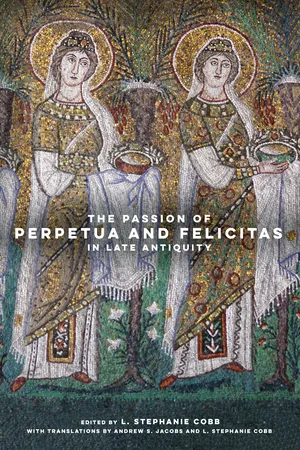
This volume gathers all available evidence for the martyrdoms of Perpetua and Felicitas, two Christian women who became, in the centuries after their deaths in 203 CE, revered throughout the Roman world. Whereas they are now known primarily through a popular third-century account, numerous lesser known texts attest to the profound place they held in the lives of Christians in late antiquity. This book brings together narratives in their original languages with accompanying English translations, including many related entries from calendars, martyrologies, sacramentaries, and chronicles, as well as artistic representations and inscriptions. As a whole, the collection offers readers a robust view of the veneration of Perpetua and Felicitas over the course of six centuries, examining the diverse ways that a third-century Latin tradition was appreciated, appropriated, and transformed as it circulated throughout the late antique world.
eBook - ePub
The Passion of Perpetua and Felicitas in Late Antiquity
- 380 pages
- English
- ePUB (mobile friendly)
- Available on iOS & Android
eBook - ePub
The Passion of Perpetua and Felicitas in Late Antiquity
About this book
Information
PART ONE
The Accounts of the Martyrdom
1
Latin Passio
The Latin Passio narrates events that took place around 203 CE. Obviously, the account itself was written after the martyrdoms it records, perhaps as early as 203 CE, but more likely between 203 and 209 CE. The text was originally written in Latin but was translated into Greek, probably within a few decades. The original Latin text is not extant. Rather, both the Latin and Greek texts stem from an earlier exemplar.
The Passio can be divided into four sections.
1. Editor’s preface (1–2)
After a liturgical opening that praises the martyrs’ examples as equal to ancient acts of faith, the editor introduces the martyrs and the historical context. This preface is preserved only in the Latin MS 1 (Monte Cassino) and the Greek MS H (Hierosolymitanus I).
2. Perpetua’s “diary” (3–10)
The central—and longest—part of the Passio purportedly contains Perpetua’s own reflections on her Christian identity, the sacrifices she makes to maintain her faith, and the visions she receives in prison. The editor asserts that this section contains Perpetua’s own words “in her own hand and from her own experience” (2.3).
3. Saturus’s vision (11–13)
As he did with Perpetua’s diary, the editor introduces Saturus’s vision by asserting the martyr’s authorship: the vision is that “which he himself wrote down” (11.1). Of the imprisoned Christians, this vision includes only Saturus and Perpetua, and it depicts events that take place after their deaths. Saturus describes their ascent to heaven, being carried by angels, and their arrival in heaven; there they enter the divine throne room, where angels lift them up to God’s face. The martyrs kiss God, and God strokes their faces. After leaving God’s presence, the martyrs encounter feuding clerics and are asked to resolve their disagreement.
4. Editor’s conclusion (14–21)
In the remaining chapters of the Passio, the editor relays information about the other Christians who had been arrested. And, finally, the narrative reaches its climax: the martyrdoms. All of the Christians, save Perpetua, took the sword without moving and in silence. But when the gladiator struck Perpetua’s clavicle, she cried out in pain. Taking the gladiator’s hand, she drew the sword to her throat, thereby accomplishing her own death. In a brief conclusion, the editor praises the martyrs’ bravery and urges Christians to read the account for their own edification. He returns to the point he made in the prologue concerning the equality of these events to those of old.
Specialized studies discuss all aspects of the Latin Passio. At least in part, the Passio provided a model of behavior for Christians who feared persecution at the hands of the Romans. It shows, especially for female Christians, the difficulties of overcoming earthly attachments to family. But in all cases it emphasizes the glorious rewards of a faithful life and a faithful death.
The Passio Perpetuae et Felicitatis is extant in nine Latin manuscripts. The modern title of the account privileges the women’s deaths, which was a theme in late ancient sermons on the martyrs. Of the six manuscripts that include a title, all read: Passio Sanctarum Perpetuae et Felicitatis. Two manuscripts carry no title at all: MS 1 and MS 5d. In MS 5c, the title/incipit is illegible. The Latin manuscripts are the following:
MS 1 (Monte Cassino 204), late eleventh century
MS 2 (Ambrosiana), twelfth century
MS 3a (St. Gallen), late ninth/early tenth century
MS 3b (Einsiedeln), twelfth century
MS P (Bibliothèque Nationale Latin 17626), late tenth century
MS 5a (Cotton Nero E.1, pt. 1), late eleventh century
MS 5b (Salisbury Cathedral 221), late eleventh century
MS 5c (British Library Cotton Otho D.viii), twelfth century
MS 5d (Canterbury Lit E. 42), early twelfth century
The Latin text that follows is that of Van Beek.
SELECTED BIBLIOGRAPHY
In addition to works cited in the General Introduction, see the following.
Bremmer, Jan N. “The Vision of Saturus in the Passio Perpetuae.” In Jerusalem, Alexandria, Rome: Studies in Ancient Cultural Interaction in Honor of A. Hilhorst, ed. Florentino García Martínez and Gerard P. Luttikhuizen, 55–73. Leiden: Brill, 2003.
Heffernan, Thomas J. Sacred Biographies: Saints and Their Biographers in the Middle Ages. New York: Oxford University Press, 1988.
Kraemer, Ross S., and Shira Lander. “Perpetua and Felicitas.” In The Early Christian World, vol. 2, ed. Philip F. Esler, 1048–68. London: Routledge, 2000.
Muehlberger, Ellen. “Perpetual Adjustment: The Passion and the Entailments of Authenticity.” JECS (forthcoming).
PASSIO SANCTARUM PERPETUAE ET FELICITATIS
I. 1Si vetera fidei exempla, et Dei gratiam testificantia et aedificationem hominis operantia, propterea in litteris sunt digesta, ut lectione eorum quasi repensatione1 rerum et Deus honoretur et homo confortetur, cur non et nova documenta aeque utrique causae convenientia et digerantur? 2Vel quia proinde et haec vetera futura quandoque sunt et necessaria posteris, si in praesenti suo tempore minori deputantur auctoritati, propter praesumptam venerationem antiquitatis. 3Sed viderint qui unam virtutem Spiritus unius Sancti pro aetatibus iudicent temporum, cum maiora reputanda sunt novitiora quaeque, ut novissimiora, secundum exuperationem gratiae in ultima saeculi spatia decretam. 4In novissimis enim diebus, dicit Dominus, effundam de Spiritu meo super omnem carnem, et prophetabunt filii filiaeque eorum; et super servos et ancillas meas de meo Spiritu effundam: et iuvenes visiones videbunt, et senes somnia somniabunt. 5Itaque et nos, qui sicut prophetias ita et visiones novas pariter repromissas et agnoscimus et honoramus, ceterasque virtutes Spiritus Sancti ad instrumentum Ecclesiae deputamus (cui et missus est idem omnia donativa administratu<ru>s in omnibus, pro<ut> unicuique distribuit Dominus) necessario et digerimus et ad gloriam Dei lectione celebramus, ut ne qua aut inbecillitas aut desperatio fidei apud veteres tantum aestimet gratiam divinitatis conversatam, sive <in> martyrum sive in revelationum dignatione, cum semper Deus operetur quae repromisit, non credentibus in testimonium, credentibus in beneficium. Et nos itaque quod audivimus et contrectavimus, annuntiamus et vobis, fratres et filioli, uti et vos qui interfuistis rememoremini gloriae Domini, et qui nunc cogniscitis per auditum communionem habeatis cum sanctis martyribus, et per illos cum Domino nostro Iesu Christo, cui est claritas et honor in saecula saeculorum. Amen.
II. 1Apprehensi sunt adolescentes catechumeni: Revocatus et Felicitas, conserva eius, Saturninus et Secundulus; inter hos et Vibia Perpetua, honeste nata, liberaliter instituta, matronaliter nupta. 2Habens patrem et matrem et fratres duos, alterum aeque catechumenum, et filium infantem ad ubera. 3Erat autem ipsa circiter annorum viginti duo. Haec ordinem totum martyrii sui iam hinc ipsa narravit, sicut conscriptum manu sua et suo sensu reliquit:
III. 1“Cum adhuc” inquit “cum prosecutoribus essemus et me pater verbis evertere cupiret et deicere pro sua affectione perseveraret: ‘Pater,’ inquam, ‘vides verbi gratia vas hoc iacens, urceolum sive aliud?’ Et dixit: ‘video.’ 2Et ego dixi ei: ‘Numquid alio nomine vocari potest quam quod est?’ Et ait: ‘non.’ ‘Sic et ego aliud me dicere non possum nisi quod sum, Christiana.’ 3Tunc pater motus hoc verbo mittit se in me, ut oculos mihi erueret, sed vexavit tantum, et profectus est victus cum argumentis diaboli. 4Tunc paucis diebus quod caruissem patre, Domino gratias egi et refrigeravi absentia illius. 5In ipso spatio paucorum dierum baptizati sumus; et mihi Spiritus dictavit non aliud petendum ab aqua nisi sufferentiam carnis. Post paucos dies recipimur in carcerem: et expavi, quia numquam experta eram tales tenebras. 6O diem asperum! Aestus validus turbarum beneficio, concussurae militum. Novissime macerabar sollicitudine infantis ibi. 7Tunc Tertius et Pomponius, benedicti diaconi qui nobis ministrabant, constituerunt praemio, uti paucis horis emissi in meliorem locum carceris refrigeraremus. 8Tunc exeuntes de carcere universi sibi vacabant: ego infantem lactabam iam inedia defectum; sollicita pro eo adloquebar matrem et confortabam fratrem, commendabam filium; tabescebam ideo quod illos tabescere videram mei beneficio. 9Tales sollicitudines multis diebus passa sum; et usurpavi ut mecum infans in carcere maneret; et statim convalui et relevata sum a labore et sollicitudine infantis, et factus est mihi carcer subito praetorium, ut ibi mallem esse quam alicubi.
IV. 1Tunc dixit mihi frater meus: “Domina soror, iam in magna dignatione es, tanta es ut postules visionem et ostendatur tibi an passio sit an commeatus.’ 2Et ego quae me sciebam fabulari cum Domino, cuius beneficia tanta experta eram, fidenter repromisi ei dicens: ‘Crastina die tibi renuntiabo.’ Et postulavi, et ostensum est mihi hoc: 3Video scalam aeream mirae magnitudinis, pertingentem usque ad caelum, et angustam, per quam nonnisi singuli ascendere possent, et in lateribus scalae omne genus ferramentorum infixum. Erant ibi gladii, lanceae, hami, machaerae, verruta, ut si quis neglegenter aut non sursum adtendens ascenderet, laniaretur et carnes eius inhaererent ferramentis. 4Et erat sub ipsa scala draco cubans mirae magnitudinis, qui ascendentibus insidias praestabat et exterrebat ne ascenderent. 5Ascendit autem Saturus prior, qui postea se propter nos ultro tradiderat (quia ipse nos aedificaverat), et tunc cum adducti sumus, praesens non fuerat. 6Et pervenit in caput scalae, et convertit se et dixit mihi: ‘Perpetua, sustineo te; sed vide ne te mordeat draco ille.’ Et dixi ego: ‘Non me nocebit, in nomine Iesu Christi.’ 7Et desub ipsa scala, quasi timens me, lente eiecit caput; et quasi primum gradum calcarem, calcavi illi caput, et ascendi. 8Et vidi spatium immensum horti et in medio sedentem hominem canum, in habitu pastoris, grandem, oves mulgentem: et circumstantes candidati milia multa. 9Et levavit caput et aspexit me et dixit mihi: “Bene venisti, tegnon.” Et clamavit ...
Table of contents
- Imprint
- Subvention
- Title
- Copyright
- Dedication
- Contents
- List of Illustrations
- Acknowledgments
- General Introduction
- Part One. The Accounts of the Martyrdom
- Part Two. The Interpretations of the Martyrdom
- Part Three. The Celebrations of the Martyrs
- Part Four. The Representations of the Martyrs
- Index
Trusted by 375,005 students
Access to over 1.5 million titles for a fair monthly price.
Study more efficiently using our study tools.
Frequently asked questions
Yes, you can cancel anytime from the Subscription tab in your account settings on the Perlego website. Your subscription will stay active until the end of your current billing period. Learn how to cancel your subscription
No, books cannot be downloaded as external files, such as PDFs, for use outside of Perlego. However, you can download books within the Perlego app for offline reading on mobile or tablet. Learn how to download books offline
Perlego offers two plans: Essential and Complete
- Essential is ideal for learners and professionals who enjoy exploring a wide range of subjects. Access the Essential Library with 800,000+ trusted titles and best-sellers across business, personal growth, and the humanities. Includes unlimited reading time and Standard Read Aloud voice.
- Complete: Perfect for advanced learners and researchers needing full, unrestricted access. Unlock 1.5M+ books across hundreds of subjects, including academic and specialized titles. The Complete Plan also includes advanced features like Premium Read Aloud and Research Assistant.
We are an online textbook subscription service, where you can get access to an entire online library for less than the price of a single book per month. With over 1.5 million books across 990+ topics, we’ve got you covered! Learn about our mission
Look out for the read-aloud symbol on your next book to see if you can listen to it. The read-aloud tool reads text aloud for you, highlighting the text as it is being read. You can pause it, speed it up and slow it down. Learn more about Read Aloud
Yes! You can use the Perlego app on both iOS and Android devices to read anytime, anywhere — even offline. Perfect for commutes or when you’re on the go.
Please note we cannot support devices running on iOS 13 and Android 7 or earlier. Learn more about using the app
Please note we cannot support devices running on iOS 13 and Android 7 or earlier. Learn more about using the app
Yes, you can access The Passion of Perpetua and Felicitas in Late Antiquity by Andrew S. Jacobs, L. Stephanie Cobb, Andrew S. Jacobs,L. Stephanie Cobb in PDF and/or ePUB format, as well as other popular books in Theology & Religion & Ancient History. We have over 1.5 million books available in our catalogue for you to explore.