Individuals, teams, and organizations are only as good as their ability to communicate effectively.Communication Skills Training offers the crucial tools you'll need to help your workshop participants master the skills that drive performance. The first book in the ATD Workshop Series offers practical, road-tested strategies and tactics for use at all levels of your organization.Built on the successful ASTD Trainer's Workshop title of the same name, this volume brings all-new content to users, including how to incorporate technology in the delivery of training programs. Communication Skills Training presents two-day, one-day, and half-day communication training programs along with relevant chapters on needs analysis, design, delivery, facilitation, and evaluation of the training event. Free tools and customization optionsThe free, ready-to-use resources (PDF) that accompany this book include downloadable presentation materials, agendas, handouts, assessments, and tools. All workshop program materials, including MS Office PowerPoint presentations and MS Word handouts, may be customized for an additional licensing fee. Browse the licensing options in the Custom Material License pricing menu. Preview a sample activity from the book.About the seriesThe new ATD Workshop Series is written for trainers by trainers, because no one knows workshops as well as the practitioners who have done it all. Each publication weaves in today's technology and accessibility considerations and provides a wealth of new content that can be used to create a training experience like no other.
- English
- ePUB (mobile friendly)
- Available on iOS & Android
eBook - ePub
Communication Skills Training
About this book
Information
Subtopic
Human Resource ManagementIndex
BusinessSECTION II
ESSENTIALS OF EFFECTIVE COMMUNICATION SKILLS TRAINING
Chapter 5
Identifying Needs for Communication Skills Training
What’s in This Chapter
• Discovering the purpose of needs analysis
• Introducing some data-gathering methods
• Determining the bare minimum needed to deliver training

Ideally, you should always carry out a needs analysis before designing and creating a workshop to address a performance gap. The cost of not identifying and carefully considering the performance requirement can be high: wasted training dollars, unhappy staff going to boring or useless sessions, increased disengagement of employees, and so forth. But the world of training is rarely ideal, and the existence of this book, which essentially provides a workshop in a box, is testament to that. This chapter describes the essential theory and techniques for a complete needs analysis to provide the fundamentals of the process and how it fits into designing learning. However, because the decision to train may already be out of your hands, the last part of this chapter provides a bare-bones list of things you need to know to train effectively even if someone just handed you this book and told you to put on a workshop.
Why Needs Analysis?
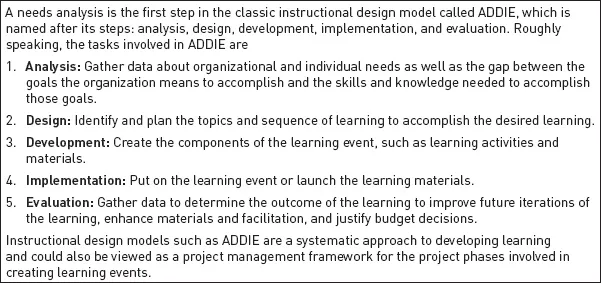
In short, as a trainer, learning professional, performance consultant, or whatever job title you hold, your role is to ensure that the employees of your organization know how to do the work that will make the organization succeed. That means you must first identify the skills, knowledge, and abilities that the employees need for optimal performance and then determine where these are lacking in the employee population to bridge that gap. A training needs analysis helps you do this (see Figure 5-1). Methods to identify this information include strategic needs analysis, structured interviews, focus groups, and surveys.
Strategic Needs Analysis
An analysis of future directions usually identifies emerging issues and trends with a major potential effect on a business and its customers over a two- to three-year period. The analysis helps a business develop goals and programs that proactively anticipate and position the organization to influence the future.
To conduct such an analysis, organizations look at issues such as expected changes within the business (for example, technology and professional requirements) and expected changes outside the company (for example, the economy, demographics, politics, and the environment).
Figure 5-1. Introducing the ADDIE Model
Results of an analysis provide a rationale for developing company and departmental goals and for making policy and budgetary decisions. From the analysis comes a summary of key change dynamics that will affect the business.
These questions often are asked in strategic needs analysis:
• What information did previous organizational analyses impart?
• Are those issues and trends still relevant?
• Do the results point to what may need to be done differently in the future?
• How has the organization performed in achieving results?
• What is the present workforce like?
• How will it change or need to change?
• What does the organization know about future changes in customer needs?
• Are customer surveys conducted, and if so, what do they reveal?
• How might the organization have to change to serve customers better?
• Is the company’s organizational structure working to achieve results?
• What are the strengths and limitations of the company?
• What are the opportunities for positive change?
• What do competitors do or say that might have implications for the organization?
• What are the most important opportunities for the future?
• What are the biggest problems?
• Is the organization in a competitive marketplace?
• How does the organization compare with competitors?
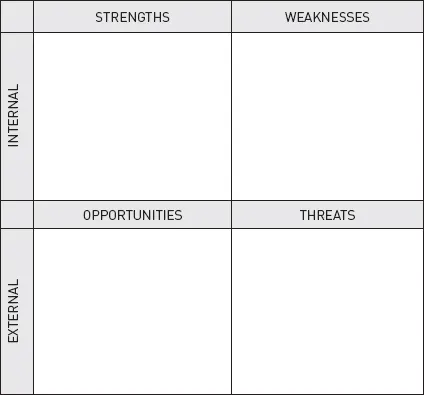
• The results can be summarized in a SWOT analysis model (strengths, weaknesses, opportunities, threats—see Figure 5-2). Action plans are then developed to increase the strengths, overcome the weaknesses, plan for the opportunities, and decrease the threats.
Figure 5-2. SWOT Analysis Model
Structured Interviews
Start structured interviews as high up in the organization as you can go, with the CEO if possible. Make sure that you include input from human resource personnel and line or operations managers and supervisors. Managers and supervisors will want to tell you what they have seen and what they consider the most pressing issues in the organization. Use Assessment 6: Learning Needs Assessment Sheet to capture your notes from the interviews.
Focus Groups
Focus groups can be set up to give people opportunities to brainstorm ideas about issues in the organization and to realize the potential of team involvement. One comment may spark another and so on. Focus groups should begin with questions that you prepare. It is important to record the responses and comments on a flipchart so everyone can see them. If that is not possible, you may simply take notes. Results of the sessions should be compiled. A needs analysis discussion form (Assessment 7) is provided in Chapter 12 to help focus group members prepare for the discussion.
Surveys
Surveys, whether paper- or web-based, gather information from a large or geographically dispersed group of employees. The advantages of surveys are speed of data collection, objectivity, repeatability, and ease of analysis.
A Note from the Author
When conducting a needs analysis around communication skills, it is important to keep in mind the various aspects of communication challenges. Here is a list of questions to ask to help guide your analysis:
• Does the organizational culture set a tone for open and honest communication?
• Has the organization conducted many employee surveys without taking action on the results?
• Are the managers skilled in handling difficult conversations?
• Do employees have a process or vehicle to communicate their concerns?
Individual Learning Needs Analysis
While identifying organizational learning needs is critical to making the best use of an organization’s training budget, analyzing individual learning needs is also important. Understanding the training group’s current skills and knowledge can help to focus the training on those areas that require most work—this also helps to avoid going over what the individuals already know, thus wasting their time, or losing them by jumping in at too advanced a level. In addition, individual learning needs analysis can uncover unfavorable attitudes about training that trainers will be better able to address if they are prepared for them. For example, some learners may see the training as a waste of time, as an interruption to their normal work, or as a sign of potentially frightening organizational change.
Many of the same methods used to gather data for organizational learning needs are used for individual learning needs analysis. Analyzing employee learning needs should be carried out in a thoughtful, sensitive, and inclusive manner. Here are potential pitfalls to avoid:
• Don’t analyze needs you can’t meet. Training needs analysis raises expectations. It sends a message to employees that the organization expects them to be competent in particular areas.
• Involve employees directly. Sometimes employees don’t see a value in participating in training. In assessing needs, trainers need to prepare employees to buy into the training. Asking useful questions and listening carefully to stated needs are excellent methods for accomplishing both of those goals. Ask these questions: “To what degree would you like to learn how to do [X] more effectively?” and “To what degree would you seriously consider participating in training to improve your competency in [X]?”
• Make the identified needs an obvious part of your training design. Trainees should be able to see that they have influenced the content and emphasis of the training session. A good practice is briefly to summarize the local trends discovered in the training needs analysis when you introduce the goals of the session.
• Don’t think of training as a “magic bullet.” Sometimes a given employee needs coaching, counseling, or consulting, which is best carried out one on one and customized to the individual and the situation. Still other times, the problem is caused by equipment or processes that need upgrading, not people who need training.
The Bare Minimum
As noted, in an ideal world, you would have gathered all this data about the needs of the organization and the employees and determined that training was the right way to connect those dots. However, even if the decision to put on this workshop has already been made, you still need a bare minimum of information to be successful:
• Who is your project sponsor (who wants to do this, provides the budget, and so on)? In fact, if you don’t have a project sponsor, stop the project. Lack of a project sponsor indicates that the project isn’t important to the business. Optimally, the project sponsor should come from the business side of the organization. If the project sponsor is the head of training, then the mentality behind the training—“build it and they will come”—is likely wrong. Even compliance training should have a functional sponsor.
• What does the sponsor want the learners to be able to do when they are done with training? How does the sponsor define measures of success? Answering these critical questions brings clarity to the sponsor’s expectations and thus to the workshop design.
• What are the objectives of the training? Use the guideline ABCD to prepare objectives: identify the Audience, describe the Behavior (what will they be able to do that they can’t do now), describe the Condition (what are the circumstances under which they need to be able to do the task, for example, will they have a job aid), and then specify to what Degree (level of quality).
• Why does the sponsor want this right now? Is something going on in the organization of which you should be aware?
• What is the budget? How much time and money will be invested in the training?
Key Points
• Needs analysis identifies the gap between what the organization needs and what the employees are able to do and then determines how best to bridge that gap.
• Methods of data gathering for needs analysis include strategic needs analysis, structured interviews, surveys, focus groups, and others.
• Sometimes, needs analysis is not an option, but some minimum information is necessary, including who wants the training, how the results wi...
Table of contents
- Cover
- Title Page
- Copyright
- The ATD Workshop Series
- Contents
- FOREWORD by Tony Bingham
- PREFACE
- INTRODUCTION: HOW TO USE THIS BOOK
- SECTION I: THE WORKSHOPS
- SECTION II: ESSENTIALS OF EFFECTIVE COMMUNICATION SKILLS TRAINING
- SECTION III—POST-WORKSHOP LEARNING
- SECTION IV—WORKSHOP SUPPORTING DOCUMENTS AND ONLINE SUPPORT
- ACKNOWLEDGMENTS
- ABOUT THE AUTHOR
- ABOUT ATD
Trusted by 375,005 students
Access to over 1.5 million titles for a fair monthly price.
Study more efficiently using our study tools.
Frequently asked questions
Yes, you can cancel anytime from the Subscription tab in your account settings on the Perlego website. Your subscription will stay active until the end of your current billing period. Learn how to cancel your subscription
No, books cannot be downloaded as external files, such as PDFs, for use outside of Perlego. However, you can download books within the Perlego app for offline reading on mobile or tablet. Learn how to download books offline
Perlego offers two plans: Essential and Complete
- Essential is ideal for learners and professionals who enjoy exploring a wide range of subjects. Access the Essential Library with 800,000+ trusted titles and best-sellers across business, personal growth, and the humanities. Includes unlimited reading time and Standard Read Aloud voice.
- Complete: Perfect for advanced learners and researchers needing full, unrestricted access. Unlock 1.5M+ books across hundreds of subjects, including academic and specialized titles. The Complete Plan also includes advanced features like Premium Read Aloud and Research Assistant.
We are an online textbook subscription service, where you can get access to an entire online library for less than the price of a single book per month. With over 1.5 million books across 990+ topics, we’ve got you covered! Learn about our mission
Look out for the read-aloud symbol on your next book to see if you can listen to it. The read-aloud tool reads text aloud for you, highlighting the text as it is being read. You can pause it, speed it up and slow it down. Learn more about Read Aloud
Yes! You can use the Perlego app on both iOS and Android devices to read anytime, anywhere — even offline. Perfect for commutes or when you’re on the go.
Please note we cannot support devices running on iOS 13 and Android 7 or earlier. Learn more about using the app
Please note we cannot support devices running on iOS 13 and Android 7 or earlier. Learn more about using the app
Yes, you can access Communication Skills Training by Maureen Orey in PDF and/or ePUB format, as well as other popular books in Business & Human Resource Management. We have over 1.5 million books available in our catalogue for you to explore.