- 376 pages
- English
- ePUB (mobile friendly)
- Available on iOS & Android
eBook - ePub
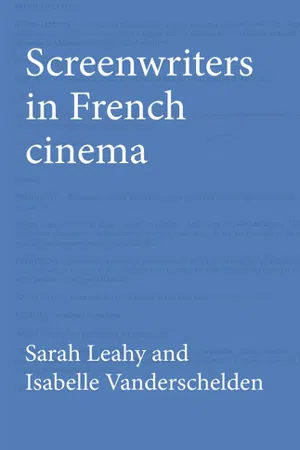
Screenwriters in French cinema
About this book
Screenwriters have been central figures in French cinema since the conversion to sound, from early French-language talkies for the domestic market to lavish literary adaptations of the notorious 'quality tradition' of the 1950s, and from the 'aesthetic revolution' of the New Wave to the contemporary popular and auteur film in the 2000s. The first English language study to address screenwriters in French cinema, this volume will be of particular interest to scholars and students of French film and screenwriting. Taking a diachronic approach, it includes case studies drawn from the early sound period to the present day in order to offer an alternative historiography of French cinema, shed light on these overlooked figures and revisit the vexed question of film authorship.
Information
Subtopic
French HistoryTable of contents
- Cover
- Half Title
- Title Page
- Copyright Page
- Dedication Page
- Contents
- List of figures
- List of tables
- Preface
- Acknowledgements
- List of abbreviations
- Introduction
- 1 Charles Spaak: dramaturge and mauvais esprit
- 2 Jacques Prévert: from reluctant author to screenwriter as myth
- 3 Henri Jeanson: spectacular dialogue
- 4 Jean Aurenche and Pierre Bost: writing the ‘tradition of quality’
- 5 The screenwriter sacrificed? The ‘screenplays’ of the New Wave auteurs
- 6 Le cinéma du samedi soir: Michel Audiard’s screenplays and cult dialogue
- 7 Screenwriting trends in popular comedy
- 8 Dialogue writing in multicultural France since 2000: exploring the words of young people
- 9 Réalisa(c)trices screenwriting the self: Noémie Lvovsky, Valeria Bruni Tedeschi, Maïwenn
- Conclusion
- References
- Index
Trusted by 375,005 students
Access to over 1.5 million titles for a fair monthly price.
Study more efficiently using our study tools.
Frequently asked questions
Yes, you can cancel anytime from the Subscription tab in your account settings on the Perlego website. Your subscription will stay active until the end of your current billing period. Learn how to cancel your subscription
No, books cannot be downloaded as external files, such as PDFs, for use outside of Perlego. However, you can download books within the Perlego app for offline reading on mobile or tablet. Learn how to download books offline
Perlego offers two plans: Essential and Complete
- Essential is ideal for learners and professionals who enjoy exploring a wide range of subjects. Access the Essential Library with 800,000+ trusted titles and best-sellers across business, personal growth, and the humanities. Includes unlimited reading time and Standard Read Aloud voice.
- Complete: Perfect for advanced learners and researchers needing full, unrestricted access. Unlock 1.5M+ books across hundreds of subjects, including academic and specialized titles. The Complete Plan also includes advanced features like Premium Read Aloud and Research Assistant.
We are an online textbook subscription service, where you can get access to an entire online library for less than the price of a single book per month. With over 1.5 million books across 990+ topics, we’ve got you covered! Learn about our mission
Look out for the read-aloud symbol on your next book to see if you can listen to it. The read-aloud tool reads text aloud for you, highlighting the text as it is being read. You can pause it, speed it up and slow it down. Learn more about Read Aloud
Yes! You can use the Perlego app on both iOS and Android devices to read anytime, anywhere — even offline. Perfect for commutes or when you’re on the go.
Please note we cannot support devices running on iOS 13 and Android 7 or earlier. Learn more about using the app
Please note we cannot support devices running on iOS 13 and Android 7 or earlier. Learn more about using the app
Yes, you can access Screenwriters in French cinema by Sarah Leahy,Isabelle Vanderschelden in PDF and/or ePUB format, as well as other popular books in Media & Performing Arts & French History. We have over 1.5 million books available in our catalogue for you to explore.