The beginning is both internal and external to the text it initiates, and that noncoincidence points to the text's vexed relation with its outside. Hence the nontrivial self-reflexivity of any textual beginning, which must bear witness to the self-grounding quality of the literary work— its inability either to comprise its inception or to externalize it in an authorizing exteriority. In a different but related way, the fact that they must begin renders our lives and our desires opaque to us; what Freud called "latency" marks not only sexuality but human thought with a self-division shaped by asynchronicity.
From Henry James's New York Edition prefaces to George Eliot's epigraphs, from Ovid's play with meter to Charles Dickens's thematizing of the ex nihilo emergence of character, from Wallace Stevens's abstract consideration of poetic origins to James Baldwin's, Carson McCullers's, and Eudora Welty's descriptions of queer childhood, writers repeatedly confront the problem of inception. Inception introduces a fundamental contingency into texts and psyches alike: in the beginning, all could have been otherwise.
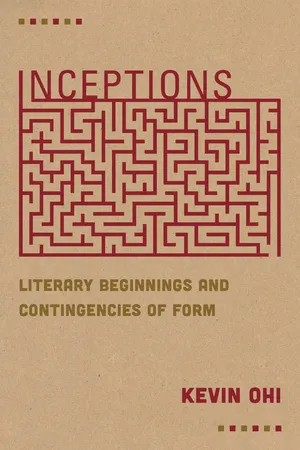
For Kevin Ohi, the act of inception, and the potential it embodies, enables us to see making and unmaking coincide within the mechanism of creation. In this sense, Inceptions traces an ethics of reading, the possibility of perceiving, in the ostensibly finished forms of lives and texts, the potentiality inherent in their having started forth.
- 336 pages
- English
- ePUB (mobile friendly)
- Available on iOS & Android
eBook - ePub
About this book
Information
Publisher
Fordham University PressYear
2021Print ISBN
9780823294633
9780823294626
eBook ISBN
9780823294640
PART I
Potentiality and Gesture
1
Revision, Origin, and the Courage of Truth
Henry James’s New York Edition Prefaces
For many, origins are suspect in part because they are, by definition, outside history. Outside it, they are also compromisingly inside it. As Gordon Teskey notes, in historical explanations, origins are inevitably provisional, having antecedents that make them “look like effects: the origin is always receding before us.”1 In Teskey’s account of Milton’s decision, unprecedented in epic poetry, to treat—and to abide within—the origin, the author of Paradise Lost confronts not a historical event but the grounds of history as such. The ethical dimension of the question of origins is perhaps to be found here, in the paradoxical topography of origination, and in what resists being thought in the grounds of possibility of language and history—in the structure, in other words, that this book terms inception. (This chapter takes origin as its central term because it is closer to the preoccupations that I chart in Henry James—and to avoid a repeated periphrastic reference translating into my own book’s vocabulary what is more properly called origin in James.) The literary work’s confrontation with inception returns to this moment of possibility—to what appears as two different forms of origin. In the beginning one finds a merger of two related but irreducible instances: the origin of the work, and of the mind that ostensibly thinks it—different origins, and curiously difficult to disentangle (because they often prove mutually originating). Origins and their structure of internal heterogeneity, instantiating a history, or a consciousness, to which they nevertheless remain exterior, rhyme with the writer’s mutually originating relation to the work.
Origins and their internal heterogeneity are repeatedly confronted by James’s late writing. Personal origins, to begin with: his return to America in The American Scene or to his younger years in the three volumes of the autobiography. And the New York Edition prefaces: written for the reissue of (some) of his works, the prefaces, which arguably initiate criticism of the novel in English, are often framed by origin stories.2 Straightforward anecdotal accounts of the origins of the works, however, are almost the exception in the prefaces, where, more often, the moment of origination is forgotten (“yielding to present research no dimmest responsive ghost of a traceable origin” [1206]), deliberately suppressed (“I recall with perfect ease the idea in which ‘The Awkward Age’ had its origin, but re-perusal gives me pause in respect to naming it.… I am half-moved to leave my small secret undivulged” [1120]), or lost in retrospect. “In the case of ‘Broken Wings’ (1900),” he writes, “I but see to-day the produced result—I fail to disinter again the buried germ” (1241). “Let it pass,” he writes of the group of stories about the writer’s life that includes “The Lesson of the Master,” “that if I am so oddly unable to say here, at any point, ‘what gave me my idea,’ I must just a trifle freely have helped myself to it from hidden stores” (1232).
The germ, at other moments, is found to have been always there. Thus, of the Tragic Muse, standing before him “a poor fatherless and motherless, a sort of unregistered and unacknowledged birth,” his “precious first moment of consciousness of the idea to which it was to give form” is present to him only as an “effect” of “some particular sharp impression or concussion”: “What I make out from furthest back is that I must have had from still further back, must in fact practically have always had, the happy thought of some dramatic picture of the ‘artist-life’ and of the difficult terms on which it is at the best secured and enjoyed, the general question of its having to be not altogether easily paid for” (1103); as he says later, “my original perception of its [my subject’s] value was quite lost in the mists of youth” (1105). Or, of “The Altar of the Dead”: “I consult memory further to no effect; so that if I should seem to have lost every trace of ‘how I came to think’ of such a motive, didn’t I, by a longer reach of reflexion, help myself back to the state of not having had to think of it? The idea embodied in this composition must in other words never have been so absent from my view as to call for an organized search. It was ‘there’—it had always, or from ever so far back, been there …” (1246). Likewise with The Wings of the Dove: “I can scarce remember the time when the situation on which this long-drawn fiction mainly rests was not vividly present to me” (1287). “The first perceived gleam of the vital spark,” he writes of “The Reverberator”; the origin is the perceiving of an origin that, presumably, precedes it (1194), so that, for example, “The Pupil” is recalled to have begun with the activation of an origin that, unnamed, is yet further back: “what it really comes to, no doubt, is that at a simple touch an old latent and dormant impression, a buried germ, implanted by experience and then forgotten, flashes to the surface as a fish, with a single ‘squirm,’ rises to the baited hook, and there meets instantly the vivifying ray” (1166). (This instance is also perhaps characteristic of a certain figural multivalence—as the seed becomes a fish, and the baited hook, not the instrument of a fish’s death but a “vivifying ray”; the fish flies free of itself as tenor, in other terms, and, caught, enlivens the idea it represents.) The glimpsing of a character—Christopher Newman of The American “rose before” him “on a perfect day of the divine Paris spring, in the great gilded Salon Carré of the Louvre”—is a “germination,” James notes in passing, that “is a process almost always untraceable” (1056). Earlier in that preface, James writes, “It had come to me, this happy, halting view of an interesting case, abruptly enough, some years before: I recall sharply the felicity of the first glimpse, though I forget the accident of thought that produced it. I recall that I was seated in an American ‘horse-car’ when I found myself, of a sudden, considering with enthusiasm, as the theme of a ‘story,’ the situation …” That situation poses questions that are, somehow, answered: “I remember well how, having entered the horse-car without a dream of it, I was presently to leave that vehicle in full possession of my answer” (1054). What is remembered is not so much the genesis as the moment when he noticed that it had occurred. “I shall not pretend to trace the steps and stages by which the imputability of a future to that young woman [Christina Light] … had for its prime effect to plant her in my little bookbinder’s path” (1098), he writes in the preface to The Princess Casamassima, of the character who first appears in Roderick Hudson.
When narratives of inception do appear, they are, at a cursory glance, deceptively simple, and present parallel accounts: of what occasioned an idea or story and, more often, of where James wrote them (locations that are rarely, if ever, the “settings” of the resulting texts). These latter are usually cast as memories of composition that come back to James as he rereads his works, and that originating scene, inaccessible, of course, to a reader, because never depicted in the text, hovers there, to be seen by the author—much like, as we will see, the inevitable new term in the revised text. There is, to my mind, no systematic account of the relation between the narratives of compositional situations and those of the germs that form the minimal ideas providing plot or character or situation. Thus, in the preface to The Portrait of a Lady, James moves from his memories of writing in Venice to a discussion of the structuring role of character in the origination of a novel—to characters’ “germinal property and authority” (1073). “There are pages of the book,” he writes, “which, in the reading over, have seemed to make me see again the bristling curve of the wide Riva, the large colour-spots of the balconied houses and the repeated undulations of the little hunchbacked bridges, marked by the rise and drop again, with the wave, of foreshortened clicking pedestrians. The Venetian footfall and the Venetian cry … come in once more at the window, renewing one’s old impression of the delighted senses and the divided, frustrated mind” (1070–1). The text, reread, calls back into view the scene of its creation—albeit with typical complication (the pages “have seemed to make me see again …”)—and that recovered scene thwarts the composition that has, of course, already occurred. At the time of composition, Venice embodies an excess that thwarts efforts to write it—too rich, and too interesting, it figures, as the limit case of the superabundant actual, the ways that the world exceeds containment by a text. Too suggestive, it overwhelms and divides the mind: Such places “are too rich in their own life and too charged with their own meanings merely to help him out with a lame phrase; they draw him away from his small question to their own greater ones; so that, after a little, he feels, while thus yearning toward them in his difficulty, as if he were asking an army of glorious veterans to help him arrest a peddler who had given him the wrong change” (1070). The multiple layers of incommensurate exchanges (the wrong change, the army of glorious veterans assigned a task demeaning to their glory, the incommensurate relation of this incommensurability to the exchange it purports to figure) thus stand in for the relation between art and life explored by these narratives of germination. (The writer in this figure is himself just such a dishonest peddler, exchanging Venice for its representation, and leaving the reader shortchanged.) In a perhaps characteristic structure, the apprehension of division is then unifying—or rather harmonizing; the “divided, frustrated” mind, remembered, is harmonized by the remembering mind—divided, therefore, between its present reading and its memory of the past—which is also to say that one’s divided attention turns out, in retrospect, to have been productive: “one’s book, and one’s literary effort were to be better for them. Strangely fertilizing, in the long run, does a wasted effort of attention often prove” (1071). The revising mind makes these discrepancies “fertilizing.” In the unrationalized interplay between these different forms of inception there is an implicit reckoning of the relation between life and art; confounding the inside and the outside of the text, the parallel narratives of origination figure that relation, and link it, I will suggest, to what James calls revision.
In the preface to Portrait of a Lady, the incommensurability of inside and out appears in the second term of what I have called an “unrationalized” relation: Turning to the origin (in a different sense) of the text, the preface explores the “germinal property and authority” of character—a discussion that, personifying character (giving it agency, and an originating power, over the mind that ostensibly imagines it), seems in various ways to depersonify the author. In the first place, the theory of fiction is given as a “quotation” from Ivan Turgenev—who sounds, in turn, remarkably like Henry James. (Turgenev, admired historical personage that he was, thus also appears as a personification of the “author’s” voice.) Notably, the origin once more disappears; as James has Turgenev remark, “As for the origins of one’s wind-blown germs themselves, who shall say, as you ask, where they come from? We have to go too far back, too far behind, to say. Isn’t it all we can say that they come from every quarter of heaven, that they are there at almost any turn of the road?” (1072–3).
This question of character leads James to the famous “house of fiction”; responding to the question of the “morality” of the work of art, James asserts that a subject is “moral” or “immoral” according to whether it is “valid” or “genuine,” or, in other terms, whether it is “sincere, the result of some direct impression or perception of life” (1074). That question links the (personified) author with the postulated, originating character insofar as the latter stands in for a locus of perception. The moral question turns out to be that of the richness of the “soil” of the author’s sensibility, “its ability to ‘grow’ with due freshness and straightness any vision of life” (1074). What James then calls the “high price of the novel as a literary form” comes from that sensibility’s individuality:
its power not only, while preserving that form with closeness, to range through all the differences of the individual relation to its general subject-matter, all the varieties of outlook on life, of disposition to reflect and project, created by conditions that are never the same from man to man (or, so far as that goes, from man to woman), but positively to appear more true to its character in proportion as it strains, or tends to burst, with a latent extravagance, its mould. (1074–5)
The “high price of the novel as a literary form” marks its value rather than its cost; the possible equivocation is matched by the slippery assimilation of novelistic form to the more specific relation of generalized reality or experience to particular forms or angles of perception. The “character” that takes on generative force in the Turgenev “quotation” becomes here the defining “character” to which the novel might remain “true”; the “latent extravagance” marks a defining quality of internal difference, and the novel, a genre that coheres insofar as it differs from itself. The novel that “conserves” its “literary form” “with closeness” appears “more true to its character in proportion as it strains, or tends to burst, with a latent extravagance, its mould.” I will note other figures that make difference into a principle of unification or coherence; for the moment, the novel’s versatility, or its inner difference, is also quasi-personifying to the degree that the burst mold also evokes a statue stepping free of its shaping material and, Galatea-like, walking forth on its own (as Maggie Verver does in a famous metaphor in The Golden Bowl).3 James’s figure in the preface ties together the originating power of “character” as an equivocal personification (equivocal because the figure is both animating and de-animating, and because of the temporal loop that produces this “character” subsequent to the originating force it then embodies) and the novel as a high-priced form of perpetual self-reinvention.
Critics (myself included) have offered detailed considerations of the “house of fiction,” which appears just after this; for the moment, I would emphasize the curious abstraction of that figure as it is set up by this framing. It isn’t just that the “direct impression or perception of life” turns out to be mediated by the angle of view, or that the angle would seem to take priority (of genesis) over the “figure” who watches (as in Deleuze’s account of Proust, it is the perspective that forms the subject rather than the other way around).4 Nor is it only that the personified view falls uncannily short of full personification (“a figure with a pair of eyes, or at least with a field-glass,” as he disorientingly phrases it).5 It is also that in the framing account, as in the extended metaphor of the “house of fiction,” James assimilates a particular fictional method (mediating views through a “center of consciousness”) within a work to an account of the difference of authorial sensibility that shapes the work itself. The choice of subject and the specifics of literary form are “as nothing,” he later writes, “without the posted presence of the watcher—without, in other words, the consciousness of the artist” (1075). In the allegory or figure here, that posted presence, of course, arrives on the scene after the house of fiction itself—to gaze out apertures, as James puts it, “pierced, or … still pierceable … by the need of the individual vision and by the pressure of the individual will.” Perspective becomes a figure through which to render choices that might include the (putatively authorial) use of particular perspectives. The indeterminacy of inside and out (of the literary text) figures, and seems a consequence of, the recursive structure of literary inception, the disappearance of the origin in a self-reflexivity at once constitutive and secondary.
This account of literary form—in his summary, the author’s “boundless freedom and his ‘moral reference’ ”—is, he then suggests, “a long way round, however, for my word about my dim first move toward ‘The Portrait’ ” (1075). That dim first move, the grasp of a single character (“an acquisition I had made, moreover, after a fashion not here to be retraced” [1075]), then raises the question of how the vivid character is “placed”—how the book containing the initiating presence of Isabel Archer comes to be generated:
One could answer such a question beautifully, doubtless, if one could do so subtle, if not so monstrous, a thing as to write the history of the growth of one’s imagination. One would describe then what, at a given time, had extraordinarily happened to it, and one would so, for instance, be in a position to tell, with an approach to clearness, how, under favour of occasion, it had been able to take over (take over straight from life) such and such a constituted, animated figure or form. The figure has to t...
Table of contents
- Cover
- Title Page
- Copyright
- Contents
- Epigraph
- Exordium
- Part I. Potentiality and Gesture
- Part II. Novels and the Beginnings of Character
- Part III. Our Stony Ancestry
- Part IV. Solitude and Queer Origins
- Acknowledgments
- Notes
- Index
- About the Author
Trusted by 375,005 students
Access to over 1.5 million titles for a fair monthly price.
Study more efficiently using our study tools.
Frequently asked questions
Yes, you can cancel anytime from the Subscription tab in your account settings on the Perlego website. Your subscription will stay active until the end of your current billing period. Learn how to cancel your subscription
No, books cannot be downloaded as external files, such as PDFs, for use outside of Perlego. However, you can download books within the Perlego app for offline reading on mobile or tablet. Learn how to download books offline
Perlego offers two plans: Essential and Complete
- Essential is ideal for learners and professionals who enjoy exploring a wide range of subjects. Access the Essential Library with 800,000+ trusted titles and best-sellers across business, personal growth, and the humanities. Includes unlimited reading time and Standard Read Aloud voice.
- Complete: Perfect for advanced learners and researchers needing full, unrestricted access. Unlock 1.5M+ books across hundreds of subjects, including academic and specialized titles. The Complete Plan also includes advanced features like Premium Read Aloud and Research Assistant.
We are an online textbook subscription service, where you can get access to an entire online library for less than the price of a single book per month. With over 1.5 million books across 990+ topics, we’ve got you covered! Learn about our mission
Look out for the read-aloud symbol on your next book to see if you can listen to it. The read-aloud tool reads text aloud for you, highlighting the text as it is being read. You can pause it, speed it up and slow it down. Learn more about Read Aloud
Yes! You can use the Perlego app on both iOS and Android devices to read anytime, anywhere — even offline. Perfect for commutes or when you’re on the go.
Please note we cannot support devices running on iOS 13 and Android 7 or earlier. Learn more about using the app
Please note we cannot support devices running on iOS 13 and Android 7 or earlier. Learn more about using the app
Yes, you can access Inceptions by Kevin Ohi in PDF and/or ePUB format, as well as other popular books in Littérature & Théorie de la critique littéraire. We have over 1.5 million books available in our catalogue for you to explore.