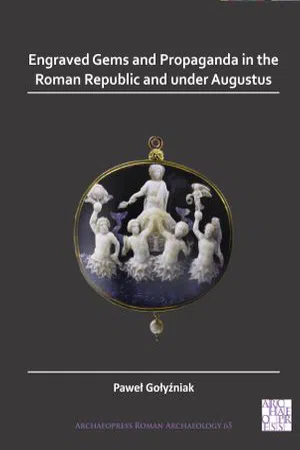
Engraved Gems and Propaganda in the Roman Republic and under Augustus deals with small, but highly captivating and stimulating artwork – engraved gemstones. Although in antiquity intaglios and cameos had multiple applications (seals, jewellery or amulets), the images engraved upon them are snapshots of people's beliefs, ideologies, and everyday occupations. They cast light on the self-advertising and propaganda actions performed by Roman political leaders, especially Octavian/Augustus, their factions and other people engaged in the politics and social life of the past. Gems can show both general trends (the specific showpieces like State Cameos) as well as the individual and private acts of being involved in politics and social affairs, mainly through a subtle display of political allegiances, since they were objects of strictly personal use. They enable us to analyse and learn about Roman propaganda and various social behaviours from a completely different angle than coins, sculpture or literature. The miniaturism of ancient gems is in inverse proportion to their cultural significance. This book presents an evolutionary model of the use of engraved gems from self-presentation (3rd-2nd century BC) to personal branding and propaganda purposes in the Roman Republic and under Augustus (until 14 AD). The specific characteristics of engraved gems, their strictly private character and the whole array of devices appearing on them are examined in respect to their potential propagandistic value and usefulness in social life. The wide scope of this analysis provides a comprehensive picture covering many aspects of Roman propaganda and a critical survey of the overinterpretations of this term in regard to the glyptic art. The aim is the incorporation of this class of archaeological artefacts into the well-established studies of Roman propaganda, as well as the Roman society in general, brought about by discussion of the interconnections with ancient literary sources as well as other categories of Roman art and craftsmanship, notably coins but also sculpture and relief.
- 619 pages
- English
- PDF
- Available on iOS & Android
eBook - PDF
Engraved Gems and Propaganda in the Roman Republic and under Augustus
About this book
Information
Subtopic
Roman Ancient HistoryIndex
HistoryTable of contents
- Cover
- Title Page
- Copyright Page
- Quotation
- Contents
- Foreword and acknowledgments
- Part I
- Introduction
- 1. Preface
- 2. State of research
- 3. Aims, methodology and structure
- Part II
- Theory
- 4. Self-presentation and propaganda – definitions and characteristics
- 5. Roman propaganda on engraved gems – general introduction
- Part III
- Evidence
- 6. Beginnings (3rd-2nd centuries BC)
- 7. Early 1st century BC
- 8. Civil War: Pompey the Great, Julius Caesar and contemporaries
- 9. Post-Caesarian and Liberators’ Civil Wars (from death of Caesar to Octavian’s sole rule: 44-27 BC)
- 10. Augustus (27 BC-AD 14)
- Part IV
- Summary and conclusions
- 11. Provenance, provenience, production and distribution of propaganda gems
- 12. Statistics
- 13. Summary and conclusions:
- Part V
- Catalogue, figures, bibliography and indices
- Catalogue
- Figures
- Figure credits
- Bibliography
- Index
- Back cover
Trusted by 375,005 students
Access to over 1.5 million titles for a fair monthly price.
Study more efficiently using our study tools.
Frequently asked questions
Yes, you can cancel anytime from the Subscription tab in your account settings on the Perlego website. Your subscription will stay active until the end of your current billing period. Learn how to cancel your subscription
No, books cannot be downloaded as external files, such as PDFs, for use outside of Perlego. However, you can download books within the Perlego app for offline reading on mobile or tablet. Learn how to download books offline
Perlego offers two plans: Essential and Complete
- Essential is ideal for learners and professionals who enjoy exploring a wide range of subjects. Access the Essential Library with 800,000+ trusted titles and best-sellers across business, personal growth, and the humanities. Includes unlimited reading time and Standard Read Aloud voice.
- Complete: Perfect for advanced learners and researchers needing full, unrestricted access. Unlock 1.5M+ books across hundreds of subjects, including academic and specialized titles. The Complete Plan also includes advanced features like Premium Read Aloud and Research Assistant.
We are an online textbook subscription service, where you can get access to an entire online library for less than the price of a single book per month. With over 1.5 million books across 990+ topics, we’ve got you covered! Learn about our mission
Look out for the read-aloud symbol on your next book to see if you can listen to it. The read-aloud tool reads text aloud for you, highlighting the text as it is being read. You can pause it, speed it up and slow it down. Learn more about Read Aloud
Yes! You can use the Perlego app on both iOS and Android devices to read anytime, anywhere — even offline. Perfect for commutes or when you’re on the go.
Please note we cannot support devices running on iOS 13 and Android 7 or earlier. Learn more about using the app
Please note we cannot support devices running on iOS 13 and Android 7 or earlier. Learn more about using the app
Yes, you can access Engraved Gems and Propaganda in the Roman Republic and under Augustus by Pawel Golyzniak in PDF and/or ePUB format, as well as other popular books in History & Roman Ancient History. We have over 1.5 million books available in our catalogue for you to explore.