A free open access ebook is available upon publication. Learn more at www.luminosoa.org. Although wartime sexual violence against men occurs more frequently than is commonly assumed, its dynamics are remarkably underexplored, and male survivors' experiences remain particularly overlooked. This reality is poignant in northern Uganda, where sexual violence against men during the early stages of the conflict was geographically widespread, yet now accounts of those incidents are not just silenced and neglectedlocally but also widely absent from analyses of the war. Based on rare empirical data, this book seeks to remedy this marginalization and to illuminate the seldom-heard voices of male sexual violence survivors in northern Uganda, bringing to light their experiences of gendered harms, agency, and justice.
eBook - ePub
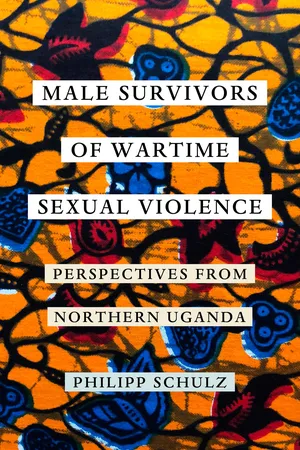
Male Survivors of Wartime Sexual Violence
Perspectives from Northern Uganda
- English
- ePUB (mobile friendly)
- Available on iOS & Android
eBook - ePub
About this book
Information
Topic
Scienze socialiSubtopic
Studi di genere1

Introduction
Male Survivors’ Experiences in Context
One night in April 1987, while Okwera was asleep, rebels of the Lord’s Resistance Army (LRA) camped against his will in his homestead in rural northern Uganda. The next day, neighbors and other community members who were concerned about the rebels’ presence in the area informed the nearby stationed government soldiers about the rebels’ whereabouts. The following day, at about four o’clock in the morning, Okwera woke up to the sound of gumboots in his compound. Suspecting either that the LRA rebels had returned or that government soldiers of the National Resistance Army (NRA) under the command of incumbent President Museveni had come to interrogate him about the rebel incident, Okwera alerted his wife. But before they were able to go into hiding, the soldiers had already surrounded the homestead. The NRA cadres forced him to open the door, but Okwera refused. Equipped with the power of their guns, a group of soldiers eventually forced their way in and began to loot, while others stood guard outside or proceeded to neighboring compounds. With a gun pressed against his back, Okwera was dragged outside, behind his kitchen hut, while his wife had to remain inside the hut with several other soldiers. The soldiers accused Okwera of “being a father to the rebels,” and after further intimidation, they ordered him to kneel down and bend over. In a testimony recorded and published by the Refugee Law Project (RLP), Okwera recalls: “My hesitation earned me a kick ‘kwara’ and a bayonet pointed in my back. Not knowing what to do, I complied. They removed my trousers and each penetrated me in turn. I could tell that those who penetrated me were three in number because each of them would do it in turn and then leave.”
Along with countless other civilian men across the entire Acholi subregion during the early phase of the war, Okwera was sexually violated by the NRA government soldiers. As he was sexually violated, his wife—who was about seven months pregnant with twins at that time—was also raped by another group of soldiers who remained with her in the hut. At that time, during his own violation, Okwera did not know about this and only found out after the soldiers had left. Three weeks later, his wife suffered a miscarriage and died soon thereafter as a result of injuries caused by the sexual assault. “It was a very traumatizing moment for the whole family,” Okwera recalled. During a conversation we had in March 2016, he explained that he felt extremely devastated, lonely and isolated for years after this.
Regarding this own sexual violation, Okwera described it as “the most painful experience ever.” But due to shame and fear, he decided to keep it to himself. He did not tell his children what had happened to him, and he felt that he could not report the violation officially, since the soldiers who committed the violence belonged to the same government that remains in power today. “We did not have any voice,” Okwera said. Although these crimes were widespread across the entire war-torn Acholi subregion—as I will demonstrate throughout this book—nobody spoke openly about it, and survivors had no actual opportunities or spaces to share their stories or narrate their testimonies. Okwera himself also did not share his experience, because he felt it was too dehumanizing and shameful.
About ten years later, in the midst of the conflict during the mid- and late 1990s, the government forced up to 95 percent of the civilian population into internally displaced persons (IDPs) camps, which according to Chris Dolan (2009) constituted their own form of “social torture.” In the camps, civilian communities were forced to live side by side in overcrowded conditions, which further strained the already ruptured social fabric of life and relationships. Rumors quickly began to spread about different stories related to the war, including about who was a victim of male rape or other humiliations. Even though Okwera began to understand that he was not alone and that others must have endured similar experiences, he still heard of only one other case, and he did not know any other survivor personally.
In 1999, after more than twelve years of silence, Okwera nevertheless eventually gathered his courage to report the violation to the Uganda Human Rights Commission (UHRC). At the time, the commission was the only institution Okwera knew of that was dealing with human rights abuses during the war. The commission, however, turned him away, arguing that the violations occurred outside the temporal and definitional scope of their mandate. Okwera felt extremely demoralized and disappointed. Even though he (at least temporarily) accepted the stigmatization that he anticipated to follow his report, he was turned away without any support. He felt he had been denied the opportunity to share this testimony, to be listened to, and to seek justice and redress. Elsewhere I have described this experience as “ethical loneliness” (Schulz 2018b), understood as “a condition undergone by persons who have been unjustly treated and dehumanized by human beings and political structures, who emerge from that injustice only to find that the surrounding world will not listen to or cannot properly hear their testimony” (Stauffer 2015: 1).
During the postencampment period and in the final stages of the LRA’s presence in northern Uganda, from about 2006, rumors and stories continued to spread within the camps and the communities about different violations and humiliations committed during the conflict. Okwera’s children became more inquisitive and wanted to know what happened to him during the war and how their mother died. “I became deeply troubled and had nightmares about that experience,” Okwera recalls. Still feeling shame and fearing stigmatization, however, he did not yet tell them about his violent ordeal. Hoping to find ways to cope, he joined a church group and regularly attended local counseling sessions as well as community events organized by different humanitarian and civil society actors. During one of these events in 2008, Okwera met staff from the Refugee Law Project (RLP). Okwera appreciated that, unlike other humanitarian agencies or service providers at that time, “they listened carefully” to what he had to say. After much consideration, various visits, and a sense of mutual trust that had begun to develop, Okwera decided to share his full testimony with them. The fact that they listened carefully, and did not further silence or ignore him, was a paramount reason Okwera broke his silence.
Despite early hesitation and even some resentments, after a long and continuous process of building trust and relationships, further catalyzed by the gradual passing of time, fellow survivors eventually shared their experiences as well, talking about tek-gungu—how male rape is locally referred to—and encouraging other male victims of sexual violations to tell their stories and support one another. Coordinated by Okwera, a support group was formed: the Men of Courage. The group is composed exclusively of and led by survivors, and primarily engages in peer counseling, income-generating economic activities, and advocacy. For Okwera, as well as for many other male survivors, being in this group enables them to exercise agency and even facilitates a sense of justice on the micro-level (chapter 5). Today Okwera has narrated his testimony on his own terms, and his account has been published by the Refugee Law Project (RLP) and is featured in two widely viewed RLP-produced video documentaries. He has articulated male survivors’ needs and demands in various forums locally, nationally, and internationally—for instance, during meetings and workshops in northern Uganda, regional conferences such as the annual Institute for African Transitional Justice (IATJ), and the global South-South Institute (SSI) on sexual violence against men and boys in Uganda (in 2013 and 2019) and Cambodia (in 2015). As of this book’s writing, he continues to coordinate the Men of Courage support group, raise awareness, and advocate for justice on behalf of male survivors.
THE CENTRAL ARGUMENT
This book is about the diverse stories, experiences, and viewpoints of not only Okwera but numerous male sexual violence survivors in northern Uganda more broadly. By centralizing their lived realities, this book seeks to broaden and deepen our understanding of the gender dynamics of armed conflicts in general, and of conflict-related sexual violence in particular. In many ways, Okwera’s narrative—and in particular his contemporary role as an advocate—is exceptional and not necessarily representative for the majority of male survivors of sexual violence in northern Uganda, or across the globe. Nevertheless, his experience and viewpoints as well as his inspiring transformation are certainly illustrative for many of the arguments I pursue throughout this book. Okwera, just as most other male sexual violence survivors in this context, experienced different and intersecting layers of gendered harms caused by the violations committed against him. As I demonstrate throughout this book, wartime sexual violence against men was widespread in northern Uganda, perpetrated by soldiers of the government army against civilian men in the early stages of the country’s civil war, during the late 1980s and early 1990s. Yet for years, and most often even decades, survivors like Okwera were silenced—by society, their communities around them, or by bodies and organizations initially designed to assist them. Due to the shame and stigma surrounding their experiences, many survivors did not reveal their experiences to anyone, and many continue to uphold this protective silence in the current postwar context. As a result, crimes of tek-gungu remain notoriously under-explored in the contemporary Acholi context, so that a persistent vacuum of assistance, support and justice for male sexual violence prevails, reflective of the overall inattentiveness to sexual violence against men globally.
At the same time, however, survivors also grapple and engage with their harmful experiences in myriad ways, thereby resisting and subverting the stereotypical image of the ever-vulnerable and inevitable passive survivor of sexual violence. As I will explore in this book, survivors form and engage in support groups, break the silence surrounding their experiences on different levels and in different spheres, and advocate for justice. Within the absence of official measures, male survivors in Acholiland therefore exercise agency on their own terms, primarily through their participation in survivors’ groups, but they also articulate demands for state-driven assistance and support, especially in form of acknowledgment of their otherwise silenced experiences. The central argument that I posit in this book thus holds that sexual violence against men can significantly impact male survivors’ masculine identities, but that survivors in the contemporary postconflict context seek to respond to, engage with, and remedy these gendered harms in various endogenous and exogenous ways.
Recognizing this heterogeneity and complexity of survivors’ experiences, this book paints a detailed and holistic picture of wartime sexual violence against men in northern Uganda by placing male survivors’ diverse lived realities under the microscope and by centralizing their perspectives. The book thereby follows feminist scholar Donna Haraway’s (1988) methodological approach of “situated knowledge(s),” whereby “diverse views from below, clearly rooted in life experiences” (Cockburn 2010: 141) can help us to construct embedded accounts of the world in all its complexities and lived realities. In light of this, the central premise of this book is the construction of a holistic narrative of survivors’ experiences in terms of gendered harms, but it is also attentive to various postviolation elements with regard to agency and justice. While in the last decade various empirical, conceptual, and political inroads have been made into recognizing men and boys as victims of sexual violence, much remains unknown about the dynamics surrounding these crimes, and about male survivors’ lived realities in particular.
This book therefore addresses a twofold gap in existing research on wartime sexual violence, and on gender and armed conflict more generally, as well as on the conflict in northern Uganda: On the one hand, although conflict-related sexual violence against men is committed more frequently than assumed, these crimes continue to be underexplored and silenced, and much remains unknown about the dynamics surrounding this type of violence. Survivors’ experiences in particular remain strikingly absent from the increasing scholarly and political engagement with this issue. On the other hand, while much has been written about the war in northern Uganda, and in particular about the horrendous atrocities committed by the LRA, human rights violations by the Ugandan army, including male-directed sexual violence, have thus far received only insufficient attention. By documenting, discussing, and analyzing crimes of sexual violence against civilian men in northern Uganda—through the eyes, voices, and experiences of male survivors directly—this book therefore engages with both of these areas of study, and thereby answers persistent questions regarding male survivors’ lived realities in conflict zones.
The book draws upon and speaks to intersecting bodies of scholarship broadly situated within International Relations (IR), including most importantly feminist IR scholarship as well as research on political violence and armed conflict. In methodological and epistemological terms, the book is also guided by ethnographic approaches to and ideals of research, as elaborated upon below, and therefore perhaps also speaks to scholars from across disciplines, beyond the boundaries of IR.
WARTIME SEXUAL VIOLENCE AGAINST MEN
Much like the IR literature more broadly, the study of armed conflict was traditionally silent on gender.1 As noted by Laura Sjoberg, “the great majority of studies seeking constitutive understandings of or causal explanations for war do not consider gender . . . as potential cases or elements” (2013: 4). Despite this neglect of gender as an analytical tool in IR and conflict studies in general, however, recent decades nevertheless witnessed an increasing utilization of gender perspectives and in particular of diverse feminist theories to elucidate the gendered dimensions of armed conflicts. Predominantly guided by feminist curiosities to comprehend, unravel, and uproot patriarchal structures and gendered inequalities within theaters of war, as Enloe (2004) puts it, a diverse set of studies increasingly seeks to examine conflict, violence, and peace building through a gender lens. As emphasized by Cockburn (2001), these interventions are much needed, as “being alert to the power relations of gender enables us to see features of armed conflict and political violence that are otherwise overlooked” (13). The underlying premise of my position taken in this book is that wars and armed conflicts cannot be fully understood without centralizing gender. Following Jill Steans, applying a gender lens to the study of armed conflict thereby means “to focus on gender as a particular kind of power relation, or to trace out the ways in which gender is central to understanding international processes” (1998: 5).
Crucially, this growing body of scholarship has convincingly documented how war is constituted by and at the same time constitutes gender. Diverse feminist approaches to theorizing war have laid open the multiple and embedded ways in which war is a gendered concept and follows a gendered logic. Among the arguably more influential insights of feminist war theorizing is the standpoint that patriarchal gender relations are among the root causes of and set “favorable conditions” for the onset of armed conflicts, positioning patriarchy (and its intersections with national and economic power) as causal in militarization and war. Feminist IR scholar Kimberly Hutchings similarly identifies a connection between gender relations, and in particular certain hegemonic and militarized conceptions of masculinities, and war. “Masculinity is linked to war because the formal, relational properties of masculinity provide a framework through which war can be rendered both intelligible and acceptable as a social practice and institution,” Hutchings writes (2008: 389). According to these diverse feminist insights, therefore, “gendering is a key cause of war as a well as a key impact” (Sjoberg 2013: 6). Much of this engagement with gender in the context of conflict and security arguably comes through a focus on sexual and gender-based violence (SGBV), widely considered a phenomenon exacerbated by war and conflict and forming the overarching focus of this book.2
At the same time, throughout most of the literature on violence and conflict, however, employing a “gender perspective” is frequently equated with feminist perspectives and is thereby (erroneously) perceived as exclusively highlighting the roles, needs, rights, and vulnerabilities of women and girls. Owing to the pervasive marginalization of women and female experiences, during conflict and beyond, such a focus is urgently needed and warranted. In scholarship and practice, however, there often seems to be a tendency to equate gender with women. Chris Dolan (2015) consequently proclaims, “If gender is a potentially powerful analytical, practical and political engine”—which it undoubtedly is—“it is one which is currently firing on only half its cylinders” (486). As a result, and despite the increasing utilization of gender lenses, specific masculinities perspectives—and careful consideration of men and their experiences as gendered—as well as queer lenses oftentimes remain missing from gender analyses of armed conflicts.
Since crimes of SGBV against men are immediately underpinned by masculinities, it is inevitable that we use a masculinity lens—namely, that we foreground the roles, structuring, and positioning of masculine identities and highlight the experiences of men and boys, or of masculine bodies and actors, as gendered. Quite generally, masculinities are socially constructed gender norms, referring to the multiple ways of “doing male.” Over the past decades, a growing body of interdisciplinary literature has begun to pay critical attention to masculinities and their relations to and positioning in the global gender order, including their roles in political and social structuring.3 Although still underresearched, the study of masculinities in recent years has also increasingly extended toward analyses of armed conflicts. Consequently, and despite a prevailing lack of systematic and holistic attention to masculinities during conflicts and transition, a “fairly substantial amount of literature has been generated over the years regarding the forms of masculinity that emerge in times of armed conflict and war” (Ní Aoláin, Haynes, and Cahn 2011: 104).
However, investigating armed conflicts through a masculinities lens and paying attention to men’s gendered experiences and roles during war must not be misappropriated toward diverting attention from women’s experiences and feminist approaches. Examinations of masculinities can therefore not be decoupled from analyses of patriarchal gender hierarchies more broadly. Rather, studies of men’s roles and experiences in (post)conflict contexts must maintain a holistic gendered focus. Caution is also required so that centralizing a masculinities perspectives does not reinforce gender binaries, which “have been remarkably consistent across time, place and culture in human social and political relations” (Sjoberg 2016: 4). Therefore, despite this study’s focus male survivors’ experiences as underpinned by masculinities, careful consider...
Table of contents
- Cover
- Title
- Copyright
- Dedication
- Contents
- List of Illustrations
- Acknowledgments
- List of Acronyms
- 1. Introduction: Male Survivors’ Experiences in Context
- 2. Conflict-Related Sexual Violence against Men: A Global Perspective
- 3. Tek-Gungu: Wartime Sexual Violence in Northern Uganda
- 4. “I used to be a strong man, but now I am not”: Gendered Vulnerabilities and Harms
- 5. Exercising Agency: Survivors’ Support Groups
- 6. Justice, Recognition, and Reparations
- 7. Toward a Survivor-Centric Approach
- Notes
- Bibliography
Trusted by 375,005 students
Access to over 1.5 million titles for a fair monthly price.
Study more efficiently using our study tools.
Frequently asked questions
Yes, you can cancel anytime from the Subscription tab in your account settings on the Perlego website. Your subscription will stay active until the end of your current billing period. Learn how to cancel your subscription
No, books cannot be downloaded as external files, such as PDFs, for use outside of Perlego. However, you can download books within the Perlego app for offline reading on mobile or tablet. Learn how to download books offline
Perlego offers two plans: Essential and Complete
- Essential is ideal for learners and professionals who enjoy exploring a wide range of subjects. Access the Essential Library with 800,000+ trusted titles and best-sellers across business, personal growth, and the humanities. Includes unlimited reading time and Standard Read Aloud voice.
- Complete: Perfect for advanced learners and researchers needing full, unrestricted access. Unlock 1.5M+ books across hundreds of subjects, including academic and specialized titles. The Complete Plan also includes advanced features like Premium Read Aloud and Research Assistant.
We are an online textbook subscription service, where you can get access to an entire online library for less than the price of a single book per month. With over 1.5 million books across 990+ topics, we’ve got you covered! Learn about our mission
Look out for the read-aloud symbol on your next book to see if you can listen to it. The read-aloud tool reads text aloud for you, highlighting the text as it is being read. You can pause it, speed it up and slow it down. Learn more about Read Aloud
Yes! You can use the Perlego app on both iOS and Android devices to read anytime, anywhere — even offline. Perfect for commutes or when you’re on the go.
Please note we cannot support devices running on iOS 13 and Android 7 or earlier. Learn more about using the app
Please note we cannot support devices running on iOS 13 and Android 7 or earlier. Learn more about using the app
Yes, you can access Male Survivors of Wartime Sexual Violence by Philipp Schulz in PDF and/or ePUB format, as well as other popular books in Scienze sociali & Studi di genere. We have over 1.5 million books available in our catalogue for you to explore.