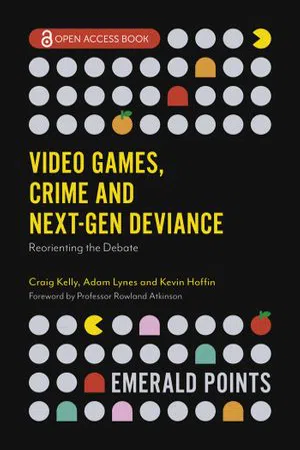
The ebook edition of this title is Open Access, thanks to Knowledge Unlatched funding, and freely available to read online. In recent decades the video games industry has grown astronomically, quickly becoming a substantial part of our everyday lives. Alongside the rise of this technology, the media, academia and, in some cases, governments, have drawn correlations between video games and serious instances of violence, focusing most notably on mass shootings. This narrow debate has distracted from our understanding of many of the harms which video games can, in some cases, cause, perpetuate or hide.Drawing upon the emerging deviant leisure perspective, this book seeks to re-orientate the debate on video games and their associated potential harms. Through the examination of culturally embedded harms such as gambling, sexual violence and addiction, together with the rise in swatting and other activities, the authors explore the notion that video games are inexplicably intertwined with aspects of deviancy.
eBook - ePub
Video Games, Crime and Next-Gen Deviance : Reorienting the Debate
- English
- ePUB (mobile friendly)
- Available on iOS & Android
eBook - ePub
Video Games, Crime and Next-Gen Deviance : Reorienting the Debate
About this book
Information
Topic
Scienze socialiSubtopic
Scienze della comunicazione1
Introduction: Reorientating the Debate
Video games have become a multi-billion-pound industry, now generating more income than any Hollywood blockbuster (Malim, 2018; Mitic, 2019). Since the early 1990s, the sale of video games has risen dramatically, and thus, as Jones (2008, p. 1) states ‘games are arguably the most influential form of popular expression and entertainment in today's broader culture’. As Hayward (2012) denotes, virtual spaces have an increasing presence within our lived reality. Thus criminology needs to give attention to video games in order for us to fully conceptualise the world we now exist within and the inherent symbolic violence (Ferrell, Hayward, & Young, 2008). Alongside this, Raymen and Smith (2019) have developed deviant leisure as a strand of criminology which propositions social scientists to increasingly consider how contemporary forms of leisure can manifest or include forms of deviancy.
Before introducing some of the main arguments put forward in this book, it is first important to provide brief yet vital definitions. Deviant leisure, the conceptual ‘toolkit’ vital in the framing for the subsequent chapters, may conjure particular images of well-known and traditional acts of deviancy (for example, certain forms of clothing linked to subcultures; certain forms of tattoos; loitering). However, this more ‘traditional’ definition of deviancy is rather narrow in scope and omits a range of potential harmful behaviours and activities (Atkinson, 2014). As noted by Atkinson (Atkinson, 2014), the limitations of conventional criminological approaches to understanding the actualities of crime and deviance are displayed -when Stan Cohen posed three simple questions:
The stuff of criminology consists of only three questions: Why are laws made? Why are they broken? What do we do or what should we do about this?
(Cohen, 1998, p. 9).
In posing these relatively straightforward questions, Cohen was highlighting the shortcomings of criminology as a discipline. Specifically, he highlights that such questions are (usually) posed by those with authority within criminal justice and crime control agencies. So too, there is an inherent shortsightedness with regard to the realities and complexities that create and perpetuate the conditions that often result in criminal behaviour. In order for us to break free of this restrained and misguided questions, we need to move beyond such orthodox notions and draw upon more critical and contemporary perspectives. Deviant leisure, as proposed by Oliver Smith and Tom Raymen, attempted to provide such solutions by drawing upon contemporary paradigms including ultrarealism and more modern critical strains of cultural criminology. In defining this new perspective, Smith (2016) – aware of the inherent restraints of criminology – posits that
‘deviant leisure’ began to orient itself toward a reconceptualisation of social deviance and an exploration of how individual, social, economic, and environmental harms are structurally and culturally embedded within many accepted and normalized forms of leisure, asserting that criminologists need to travel beyond the boundaries associated with more traditional socio-legal constructions of crime and into the realm of harm and zemiology
(Smith, 2016, p. 6).
Taking this quote into consideration, along with the previously discussed orthodox notions of deviance, a deviant leisure perspective seeks to articulate a more nuanced interpretation. One which is better suited to contemporary application was designed to ‘capture’ and deduce a wider range of harms that criminology is otherwise incapable of determining. Along with drawing upon more critical strands of criminology better suited for the realities of 21st century life, deviant leisure also puts zemiology to the fore. Zemiology, similar to the rationale behind deviant leisure, was inspired by the notion that much of criminology and relevant research is conducted, produced and maintained by ‘very powerful interests, not least the state, which produces definitions of crime through criminal law’ (Hillyard & Tombs, 2017, p. 284). Again, such a perspective is crucial in transcending the preverbal cage in which many within academia and wider society unwittingly find themselves within, unable or inhibited from perceiving notions of harm outside of the traditional notion which is constrained via legal frameworks. To summarise this brief introduction to deviant leisure, such a perspective seeks to uncover those behaviours that within a more ethical social order would be seen as the harmful acts that they actually are. More specifically, as a growing assortment of forms of ‘deviant leisure’ become culturally entrenched within the conventional and their associated harms become regularised, ‘deviant leisure scholars argue that the usual focus of criminology on legally defined crime and forms of deviance which controvert social norms and values requires some conceptual expansion (Smith, 2016, p. 10).
The following book stems from the aforementioned points as well as a short blog written by the editors in June of 2018 for the British Society of Criminology. The blog was an exasperated response to various discussions within the mainstream media following the tragic school shooting in Santa Fe High School in Texas. The blog put forth a short but critical discussion of what the authors view as the myriad and myopic positionality that video games were a mitigating factor in the exponential rise in mass murders across the pond. Crucially, however, it did not hope to just dispel such discussion but to instigate social scientists to progress past such a blinkered view and aide us in identifying, investigating and accounting for various other forms of deviancy we perceived could be identified within video games and the wider industry. The following collection is the product of our supplication, one which we hope will play at least a minor contribution towards two key objectives.
The first is for criminology and wider sociology to possibly offer nuanced understandings of the effect of video games on ever-increasing influence upon society. This being a feat, we believe only a select few academics have managed to do thus far (Atkinson & Rodgers, 2016; Atkinson & Willis, 2007, 2009; Denham & Spokes, 2019). Secondly and most hopefully, this is for wider academia and perhaps most importantly the mainstream media, to finally transition past such basic and wholly inept excuses for the loss of life through abhorrent acts of violence. Of course, by-and-large academia has increasingly progressed past such notions in the last decade, though remnants of such outdated perspectives can still be found.
It seems the media though have not nor have policymakers. As we sit down to write the first draft of the introductory chapter, both the Twittersphere and radio are giving comprehensive coverage of another bloody weekend in the United States. A weekend that, unfortunately, by the time this goes to print and is (hopefully) being read will likely be a distant memory to all but the immediate and secondary victims and of course the first responders.
The first of these shootings was on 3 August 2019 in El Paso, Texas (Beckett & Levin, 2019a). About 48 victims have been confirmed at the time of writing, 22 of which are deceased. This shooting was conducted in a Walmart close to the Cielo Vista Mall. The perpetrator, Patrick Crusius, reportedly drove around 10 hours to El Paso before opening fire on members of the public. Shortly prior to the incident, it is being reported by authorities he uploaded a manifesto online which supposedly cited that the attack was a response of the ‘Hispanic invasion of Texas’ (Beckett & Levin, 2019b). The manifesto was uploaded to the online community 8chan (now 8kun), which has frequently been linked to various acts of fringe movements ranging from far-right ideologues as well as the incel movement (Beckett & Levin, 2019b).
A few hours after the terrorist attack in El Paso, Connor Betts opened fire on a bar in Dayton, Ohio (Sewell & Seewer, 2019). Included within the nine fatalities was the perpetrator's sister (Sewell & Seewer, 2019). Another 27 people were reportedly injured. Betts was shot dead during the incident. The shootings at El Paso and Dayton marked the 250th and 251st mass shootings in 2019 (Gun Violence Archive, 2020). A quick (though not comprehensive) scour of the internet details four more mass shooting since aforementioned attack in Dayton, two of which were in Chicago, Illinois, on August 4, with a combined total of 15 victims and one fatality (Gun Violence Archive, 2020). One was in Memphis, Tennessee, with three members of the public injured and one fatality (Gun Violence Archive, 2020). Finally four people were injured in Brooklyn, New York, during a candlelight vigil (Gun Violence Archive, 2020). So far today, there have been no mass shootings reported, though it is only 9:34 a.m. in New York as we type.
Haberman, Karni and Hakim (2019) suggest that perhaps due to his close relationship to and numerous donations from the National Rifle Association, the President of the United States, Donald Trump, again did not condemn the endemic gun culture which is facilitating these devastating acts on such a regular basis (The White House, 2019). Nor did he recognise that the divisive politics which has dogged American politics in recent years may have contributed in any way as influencing any of the shootings. This is not to say that recent sociopolitical changes are the only reason for such atrocities to occur, to propose as such would be ludicrous when accounting for the rise in mass shooting over the previous decades. However, such an approach could lead to some reduction in an otherwise endemic problem which is largely American-centric. It should also be acknowledged that gun-related violence in American schools can be traced back to the 1890s (Katsiyannis, Whitford, & Ennis, 2018).
Whilst disavowing the arguably logical issues which implicate upon the regularity of such actions, President Trump held a press conference in which he offered a five-point plan to tackle the issue that he terms a ‘monstrous evil’ (The White House, 2019). The first priority in the plan was for the authorities to act upon early warning signs much quicker; importantly, he states that such agencies would need to work alongside social media companies (The White House, 2019) Second, Trump stated that the glorification of violence in society must be stopped. He stated that ‘This includes the gruesome and grizzly video-games that are now common place’, citing that troubled youths can too easily surround themselves with violent content (The White House, 2019). Third, he proposed furthering mental health support systems as that is ‘what pulls the trigger, not the gun’ (The White House, 2019). Forth, he stated extreme risk protection orders should be put in place to ensure access to firearms by dangerous individuals is limited. Finally, he stated that the Department of Justice had been instructed to propose legislation that ensured those committing mass shootings would face the death penalty ‘quickly, decisively and without years of needless delay’ (The White House, 2019).
In providing some much needed nuance and evaluation of such political rhetoric, it is important to consider that when it comes to debates on crime and punishment, it is important that we do not simply descend into populist and (supposedly) common sense arguments, built solely on emotion or gut feeling. That is not to deny the place of emotion or common sense, but rather to suggest that sometimes in the social sciences, the evidence and reality might be counterintuitive – what at first appears to be the case may not be, when we look at empirical evidence. Yet the desire to do that seems to be under attack. Recently, on both sides of the Atlantic, political arenas have been transformed into hotbeds of misinformation. What better term to capture this than the contemporary mantra of ‘alternative facts’, a phrase used by US Counsellor to President Trump, Kellyanne Conway, in a press interview on 22 January 2017, in which she defended White House Press Secretary Sean Spicer's false statement about...
Table of contents
- Cover
- Title
- Copyright
- Dedication
- Contents
- About the Editors
- About the Contributors
- Foreword: Climax culture
- Acknowledgements
- 1 Introduction: Reorientating the Debate
- 2 Social Scientists as the Architects of Their Own Defeat in the Study of Video Games
- 3 A Chronology of Video Game Deviance
- 4 Death by Swat: The Three Elements of Swatting
- 5 Addiction, Gambling and Gaming: Chasing the Digital Dragon
- 6 The Democratisation of White-collar Criminality in Video Games
- 7 Representation of LGBTQ Communities in the Grand Theft Auto Series
- 8 The Normalisation of Sexual Deviance and Sexual Violence in Video Games
- 9 ‘Gaming the System?’ The Merits, Myths and Realities in Understanding Prison Architect: Security, Rehabilitation and Violence as Represented in the World's Bestselling Carceral Video Game
- 10 Conclusion
- Index
Trusted by 375,005 students
Access to over 1.5 million titles for a fair monthly price.
Study more efficiently using our study tools.
Frequently asked questions
Yes, you can cancel anytime from the Subscription tab in your account settings on the Perlego website. Your subscription will stay active until the end of your current billing period. Learn how to cancel your subscription
No, books cannot be downloaded as external files, such as PDFs, for use outside of Perlego. However, you can download books within the Perlego app for offline reading on mobile or tablet. Learn how to download books offline
Perlego offers two plans: Essential and Complete
- Essential is ideal for learners and professionals who enjoy exploring a wide range of subjects. Access the Essential Library with 800,000+ trusted titles and best-sellers across business, personal growth, and the humanities. Includes unlimited reading time and Standard Read Aloud voice.
- Complete: Perfect for advanced learners and researchers needing full, unrestricted access. Unlock 1.5M+ books across hundreds of subjects, including academic and specialized titles. The Complete Plan also includes advanced features like Premium Read Aloud and Research Assistant.
We are an online textbook subscription service, where you can get access to an entire online library for less than the price of a single book per month. With over 1.5 million books across 990+ topics, we’ve got you covered! Learn about our mission
Look out for the read-aloud symbol on your next book to see if you can listen to it. The read-aloud tool reads text aloud for you, highlighting the text as it is being read. You can pause it, speed it up and slow it down. Learn more about Read Aloud
Yes! You can use the Perlego app on both iOS and Android devices to read anytime, anywhere — even offline. Perfect for commutes or when you’re on the go.
Please note we cannot support devices running on iOS 13 and Android 7 or earlier. Learn more about using the app
Please note we cannot support devices running on iOS 13 and Android 7 or earlier. Learn more about using the app
Yes, you can access Video Games, Crime and Next-Gen Deviance : Reorienting the Debate by Adam Lynes, Craig Kelly in PDF and/or ePUB format, as well as other popular books in Scienze sociali & Scienze della comunicazione. We have over 1.5 million books available in our catalogue for you to explore.