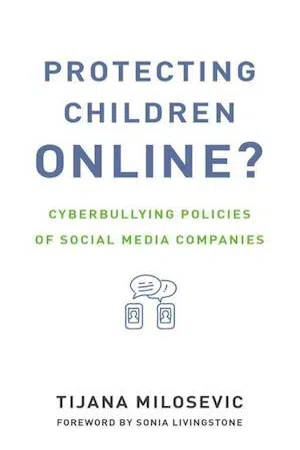
This book investigates regulatory and social pressures that social media companies face in the aftermath of high profile cyberbullying incidents. The author's research evaluates the policies companies develop to protect themselves and users. This includes interviews with NGO and social media company reps in the US and the EU. She triangulates these findings against news, policy reports, evaluations and interviews with e-safety experts. This book raises questions about the legitimacy of expecting companies to balance the tension between free speech and child protection without publicly revealing their decision-making processes. In an environment where e-safety is part of the corporate business model, this book unveils the process through which established social media companies receive less government scrutiny than start-ups. The importance of this research for law and policy argues for an OA edition to ensure the work is widely and globally accessible to scholars and decision makers.
eBook - ePub
Protecting Children Online? : Cyberbullying Policies of Social Media Companies
- English
- ePUB (mobile friendly)
- Available on iOS & Android
eBook - ePub
Protecting Children Online? : Cyberbullying Policies of Social Media Companies
About this book
Information
Subtopic
Media StudiesIndex
Social SciencesII Vagaries of Self-Regulation
4 Perils of Politics-Driven Regulation
In this chapter I offer analyses of several cyberbullying incidents that were related to suicides. Cases like these, often labeled “high-profile” cyberbullying incidents, have received significant media attention in their respective countries, and internationally as well. They illustrate and provide additional context for a discussion in this chapter about the dynamics between media, policy makers, companies, and other stakeholders that have contributed to the current regulatory culture and social media policies.
Imprecise Use of the Term “Cyberbullying”
In chapter 2, I discussed how scholars find it difficult to arrive at a precise and comprehensive definition of cyberbullying. A number of the cases I describe in this chapter exemplify how “cyberbullying” is similarly used in the media in an imprecise manner. For instance, “cyberbullying” is a term that primarily refers to peer conflict and peer aggression, but it was used in the media to label conflicts in which cyberbullying may have only been a component or where the primary issue was sextortion.
For instance, in the case of Hannah Smith, the presence of cyberbullying was impossible to prove by a posthumous police investigation. And consider that the case of 13-year-old Megan Meier in 2006, which brought significant attention to the concept of “cyberbullying” not only in the US but internationally, was not entirely based on peer conflict. It involved an adult, a mother, who pretended to be a boy on the MySpace social network, and under such guise interacted with the young girl. She committed an act of deception that was frequently labeled as “cyberbullying” in the media even though, arguably, cyberbullying was only a component of her behavior. Amanda Todd, a 15-year-old girl from Canada, committed suicide after her nude photos were exposed online, followed by bullying and slut shaming. She was led into exposing her breasts on a webcam to a 35-year-old man, who was the principal actor in this case. Although this case clearly involved an online predator, and cyberbullying per se was not at the heart of this issue but rather a consequence, the incident was frequently labeled by the media as a “cyberbullying case.” The case of Rehtaeh Parsons began with an alleged gang rape, which was photographed with a phone, only to result in cyberbullying and slut shaming after the photos were shared on social media. While cyberbullying played an important role in this case, as the girl was humiliated and harassed by her peers once the photos began to spread, the case originated as the crime of sexual offense.
Interrelated Themes in “Cyberbullying” Cases
Several interrelated themes emerged from these cases; all of them are important for understanding the context in which cyberbullying policies of social media companies are created. They all indicate what can be described as the simplified nature of the public debate around these cases and, subsequently, the punitive regulatory measures introduced to address what is sometimes imprecisely characterized as “cyberbullying.” (My research-based evidence in previous chapters argues against such approaches and instead stresses the value of educational measures aimed at cyberbullying prevention.) A number of these cases drew significant public attention to social media companies, both in general and to the platforms specifically involved; this resulted in pressures from the public and often ad hoc initiatives from dispersed regulators and policy makers, which in turn contributed to the shaping of the self-regulatory environment. In addition, social media companies have sometimes engaged in conducting investigations, such as in the case of Amanda Todd. Such examples further demonstrate an increasing role of private companies in these processes. Finally, a number of laws resulting from these cases were seriously questioned in the media coverage on the grounds of impinging on end users’ civil liberties and were sometimes characterized by legal experts as “misguided legislation.”
Summaries of the Cases
In the five cases I examine here—the death by suicide of Megan Meier and Rebecca Ann Sedwick from the US, Amanda Todd and Rehtaeh Parsons from Canada, and Hannah Smith from the UK—the themes I mention above surfaced against the backdrop of exaggerated fears over children’s use of digital technology, dignity, and children’s rights, all being topics I focus on in part I. Perhaps most importantly, these cases (especially as I present them in the context of their aftermaths) demonstrate the mechanisms that can propel social media companies into revamping their policies, just as they can strengthen the public perception that the companies are or should be liable, which can in turn influence changes in their self-organizational measures.
Megan Meier
One of the early cases that received widespread media attention, and was primarily labeled in the media as “cyberbullying,” was the case of Megan Meier, a 13-year-old girl from O’Fallon, Missouri, who committed suicide in October 2006, after interacting with her friend’s mother, Lori Drew. Drew had pretended to be a teenage boy on the social networking website MySpace (Steinhauer, 2008). Megan appeared to be an emotionally sensitive girl, who had struggled with self-esteem and weight issues and had been on anti-depression medication before the incident took place (Maag, 2007; Megan Meier Foundation, n.d.b). A person representing herself as a boy named “Josh” added Megan as a friend on MySpace and started talking to her. Megan liked the boy from the photo, even though she never talked to him over the phone or in person throughout the month of what Megan’s mother described as “innocent flirtation” (Maag, 2007). Josh told her he was home-schooled and had no phone access.
Megan’s mother, Tina Meier, who later founded the Megan Meier Foundation to address bullying, appeared in the US mainstream media to discuss her daughter’s case (Megan Meier Foundation, n.d.a). In a previous school her daughter had attended, Tina said, Megan had tried “desperately” to join popular girls, but she was teased about her weight (Maag, 2007).
Megan had been a friend of Lori Drew’s daughter, but the two had a falling out (Megan Meier Foundation, n.d.b). As the Guardian reported, Drew had been upset that Megan was “spreading lies” about her daughter and wanted to “expose her” (Glaister, 2008). The families knew each other, and Lori Drew allegedly knew Megan had been emotionally sensitive and was on medication; but once Megan switched schools, she got a new group of friends, joined the volleyball team, and lost weight, which, according to her mother, helped her become accepted in the new community (Megan Meier Foundation, n.d.b).
A germane observation in the context of dignity framework can be made about the public discussion surrounding this case. Rarely did it adopt a critical stance toward the proposition that a girl (in this case Megan), women, or people in general should derive their self-worth from their looks and popularity status. That a perceived improvement in one’s looks should result in a rise in social status is a premise that all too often remains unquestioned in the public and even an individual’s mind. According to dignity framework, every human being has dignity or internal, inherent value that does not have to be earned. Striving for social status, social influence, or ways to improve one’s appearance as a source of dignity is a classic example of what the dignity author Donna Hicks characterizes as “false dignity” (Hicks, 2011, see also chapter 3).
Motivated by apparent peer conflict between her daughter and Megan, Lori Drew opened an account under the name of “Josh Evans” on MySpace, and according to the prosecutors she “bragged” about “the prank” (Michels, 2008). Drew’s daughter, her 18-year-old employee, and another girl from the neighborhood helped her maintain the false MySpace account (Michels, 2008; Collins, 2008).
The Meier family reported that the FBI was looking into the matter after Megan’s suicide and the story was kept private, outside of media coverage, for a year. The FBI, however, according to the family’s account, could not retrieve the last message Megan had received from Josh Evans, which her parents reported to have seen by logging into the account after the suicide: “Everybody in O’Fallon knows how you are. You are a bad person and everybody hates you. Have a shitty rest of your life. The world would be a better place without you” (Megan Meier Foundation, n.d.b). When the investigation determined that Drew’s actions may have been cruel but did not break any laws (Collins, 2008), Megan’s parents decided to go public and talk to the media about the story.
Amanda Todd
Amanda Todd died by suicide in October 2012, a month after posting a nine-minute YouTube video called “My Story: Struggling, Bullying, Suicide and Self-harm.” Using flash cards, she silently described the events that resulted in her situation and followed with a plea for help (ChiaVideos, 2012). While her mental health was affected by cyberbullying, this case also involved child pornography and sexual extortion.
In 2009 and 2010, Amanda used a video chat platform to meet new people online, where she received compliments on her looks. One of the people she spoke to asked her to flash for him on camera, which she eventually did (Riley Huntley, 2012).1 According to the story Amanda tells in the video, he later found her on Facebook and threatened that he would send the photo of her bare breasts to her teachers, classmates, and family if she did not perform for him on camera again. Furthermore, he said he knew Amanda’s address, which reportedly made her increasingly anxious. Once the anonymous assaulter revealed her photos, Amanda received a notice from the police that her naked photo, constituting a criminal offense of child pornography, was circulating on the internet.
Bullying and cyberbullying ensued, not only from her classmates but also from anonymous people who had seen the photo. She transferred to a different school but then got involved with drugs and alcohol, which reflected that she’d been psychologically affected by the situation. When the assaulter resurfaced, asking for another session of nude exposure, he threatened to reveal the photo in her new school environment if she did not comply. Furthermore, he made a Facebook page, where the photo of Amanda’s flashing was the profile photo. In the confessional YouTube video, Amanda reported that she lost respect from her new classmates and was bullied, after which she started cutting herself. When she moved to yet a different school, she got involved with “an old guy friend” while his girlfriend was on vacation (Riley Huntley, 2012). Only a week later, the “old guy friend,” his girlfriend, and a group of other people came to Amanda’s school and verbally and physically abused Amanda. Bystanders captured the incident on digital cameras, resulting in yet another round of bullying and cyberbullying.
Amanda then attempted the first suicide by drinking bleach but was rescued and taken to the hospital. Her classmates and some other people ridiculed her suicide attempt on Facebook. After that, she moved to another city to live with her mother (her parents had been separated). She was cutting, was on anti-depressants, and attended counseling. A month after she posted the video on YouTube where she had told her story in silence, using flashcards, Amanda killed herself, allegedly by hanging.
Rehtaeh Parsons
Rehtaeh Parsons committed suicide at the age of 17 two years after being photographed while reportedly being raped and later bullied when the photos were disseminated to friends in school and the community. This case, which took place in Nova Scotia, Canada, received significant media attention, and was also one in which cyberbullying was conflated with child pornography. Although Rehtaeh’s parents reported the case while the girl was still alive, the Royal Canadian Mounted Police concluded that they had insufficient evidence to press charges, and media coverage to a great extent revolved around the issue of responsibility or blame of individuals involved in the incident (see e.g., “Rehtaeh Parsons, Canadian Girl …,” 2013). Following the suicide, however, the case was reopened, and the police reported to have found new information by conducting investigations into the rape allegations and the distribution of child pornography (“Rehtaeh Parsons case …,” 2013). The incident resulted in criminal prosecution of minors and in a new cyberbullying law in Nova Scotia. The online “hacktivist” and social justice group called Anonymous, which threatened to reveal the identity of the young men involved in the cyberbullying, may have contributed to the r...
Table of contents
- Cover
- Series Page
- Title Page
- Copyright Page
- Dedication
- Table of Contents
- Foreword by Sonia Livingstone
- Acknowledgments
- I: Cyberbullying, Dignity, and Children’s Rights
- II: Vagaries of Self-Regulation
- III: Policy Solutions
- Appendix A
- Appendix B
- References
- Index
Trusted by 375,005 students
Access to over 1.5 million titles for a fair monthly price.
Study more efficiently using our study tools.
Frequently asked questions
Yes, you can cancel anytime from the Subscription tab in your account settings on the Perlego website. Your subscription will stay active until the end of your current billing period. Learn how to cancel your subscription
No, books cannot be downloaded as external files, such as PDFs, for use outside of Perlego. However, you can download books within the Perlego app for offline reading on mobile or tablet. Learn how to download books offline
Perlego offers two plans: Essential and Complete
- Essential is ideal for learners and professionals who enjoy exploring a wide range of subjects. Access the Essential Library with 800,000+ trusted titles and best-sellers across business, personal growth, and the humanities. Includes unlimited reading time and Standard Read Aloud voice.
- Complete: Perfect for advanced learners and researchers needing full, unrestricted access. Unlock 1.5M+ books across hundreds of subjects, including academic and specialized titles. The Complete Plan also includes advanced features like Premium Read Aloud and Research Assistant.
We are an online textbook subscription service, where you can get access to an entire online library for less than the price of a single book per month. With over 1.5 million books across 990+ topics, we’ve got you covered! Learn about our mission
Look out for the read-aloud symbol on your next book to see if you can listen to it. The read-aloud tool reads text aloud for you, highlighting the text as it is being read. You can pause it, speed it up and slow it down. Learn more about Read Aloud
Yes! You can use the Perlego app on both iOS and Android devices to read anytime, anywhere — even offline. Perfect for commutes or when you’re on the go.
Please note we cannot support devices running on iOS 13 and Android 7 or earlier. Learn more about using the app
Please note we cannot support devices running on iOS 13 and Android 7 or earlier. Learn more about using the app
Yes, you can access Protecting Children Online? : Cyberbullying Policies of Social Media Companies by Tijana Milosevic in PDF and/or ePUB format, as well as other popular books in Social Sciences & Media Studies. We have over 1.5 million books available in our catalogue for you to explore.