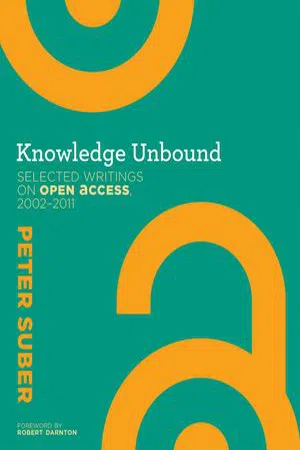
Influential writings make the case for open access to research, explore its implications, and document the early struggles and successes of the open access movement. Peter Suber has been a leading advocate for open access since 2001 and has worked full time on issues of open access since 2003. As a professor of philosophy during the early days of the internet, he realized its power and potential as a medium for scholarship. As he writes now, "it was like an asteroid crash, fundamentally changing the environment, challenging dinosaurs to adapt, and challenging all of us to figure out whether we were dinosaurs." When Suber began putting his writings and course materials online for anyone to use for any purpose, he soon experienced the benefits of that wider exposure. In 2001, he started a newsletter—the Free Online Scholarship Newsletter, which later became the SPARC Open Access Newsletter—in which he explored the implications of open access for research and scholarship. This book offers a selection of some of Suber's most significant and influential writings on open access from 2002 to 2010. In these texts, Suber makes the case for open access to research; answers common questions, objections, and misunderstandings; analyzes policy issues; and documents the growth and evolution of open access during its most critical early decade.
eBook - PDF
Knowledge Unbound
About this book
Information
Subtopic
Library & Information ScienceTable of contents
- Contents
- Foreword
- Preface
- Introduction
- Knowledge as a Public Good
- Open Access, Markets, and Missions
- What Is Open Access?
- Open Access Overview
- Removing the Barriers to Research: An Introduction to Open Access for Librarians
- The Taxpayer Argument for Open Access
- “It’s the Authors, Stupid!”
- Six Things That Researchers Need to Know about Open Access
- Trends Favoring Open Access
- Gratis and Libre Open Access
- More on the Case for Open Access
- The Scaling Argument
- Problems and Opportunities (Blizzards and Beauty)
- Open Access and the Self-Correction of Knowledge
- Open Access and the Last-Mile Problem for Knowledge
- Delivering Open Access
- The Case for OAI in the Age of Google
- Good Facts, Bad Predictions
- No-Fee Open-Access Journals
- Balancing Author and Publisher Rights
- Flipping a Journal to Open Access
- Society Publishers with Open Access Journals
- Ten Challenges for Open-Access Journals
- Funder and University Policies
- The Final Version of the NIH Public-Access Policy
- Another OA Mandate: The Federal Research Public Access Act of 2006
- Twelve Reminders about FRPAA
- An Open Access Mandate for the NIH
- The Open Access Mandate at Harvard
- A Bill to Overturn the NIH Policy
- Open Access Policy Options for Funding Agencies and Universities
- Quality and Open Access
- Open Access and Quality
- Thinking about Prestige, Quality, and Open Access
- The Debate
- Not Napster for Science
- Two Distractions
- Praising Progress, Preserving Precision
- Who Should Control Access to Research Literature?
- Four Analogies to Clean Energy
- More on the Landscape of Open Access
- Promoting Open Access in the Humanities
- Helping Scholars and Helping Libraries
- Unbinding Knowledge: A Proposal for Providing Open Access to Past Research Articles, Starting with the Most Important
- Open Access to Electronic Theses and Dissertations (ETDs)
- Open Access for Digitization Projects
- Bits of the Bigger Picture
- Analogies and Precedents for the FOS Revolution
- Thoughts on First and Second-Order Scholarly Judgments
- Saving the Oodlehood and Shebangity of the Internet
- What’s the Ullage of Your Library?
- Can Search Tame the Wild Web? Can Open Access Help?
- Glossary
- Index
Trusted by 375,005 students
Access to over 1.5 million titles for a fair monthly price.
Study more efficiently using our study tools.
Frequently asked questions
Yes, you can cancel anytime from the Subscription tab in your account settings on the Perlego website. Your subscription will stay active until the end of your current billing period. Learn how to cancel your subscription
No, books cannot be downloaded as external files, such as PDFs, for use outside of Perlego. However, you can download books within the Perlego app for offline reading on mobile or tablet. Learn how to download books offline
Perlego offers two plans: Essential and Complete
- Essential is ideal for learners and professionals who enjoy exploring a wide range of subjects. Access the Essential Library with 800,000+ trusted titles and best-sellers across business, personal growth, and the humanities. Includes unlimited reading time and Standard Read Aloud voice.
- Complete: Perfect for advanced learners and researchers needing full, unrestricted access. Unlock 1.5M+ books across hundreds of subjects, including academic and specialized titles. The Complete Plan also includes advanced features like Premium Read Aloud and Research Assistant.
We are an online textbook subscription service, where you can get access to an entire online library for less than the price of a single book per month. With over 1.5 million books across 990+ topics, we’ve got you covered! Learn about our mission
Look out for the read-aloud symbol on your next book to see if you can listen to it. The read-aloud tool reads text aloud for you, highlighting the text as it is being read. You can pause it, speed it up and slow it down. Learn more about Read Aloud
Yes! You can use the Perlego app on both iOS and Android devices to read anytime, anywhere — even offline. Perfect for commutes or when you’re on the go.
Please note we cannot support devices running on iOS 13 and Android 7 or earlier. Learn more about using the app
Please note we cannot support devices running on iOS 13 and Android 7 or earlier. Learn more about using the app
Yes, you can access Knowledge Unbound by Peter Suber in PDF and/or ePUB format, as well as other popular books in Languages & Linguistics & Library & Information Science. We have over 1.5 million books available in our catalogue for you to explore.