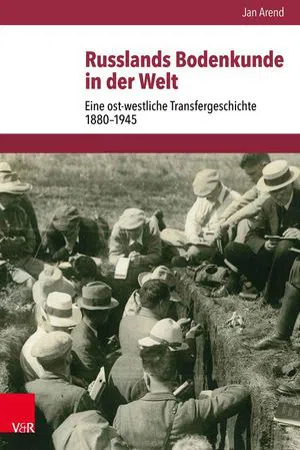
In the summer of 1914, the Russian agricultural scientist and soil scientist Konstantin Glinka sent a manuscript to Berlin. It contained the first presentation of Russian Soil Science, an early ecology doctrine of the soil, based on black soil research, to a foreign readership. This was the beginning of a success story: the Russian soil science was successful in the interwar period in Europe and the United States. After 1945, she became a classic of modern agricultural and environmental sciences. Jan Arend tells the story of knowledge transfer from east to west. It follows scientists, manuscripts and terms - from the black earth provinces of the Russian Empire to the podiums of international conferences to the cabinets of American agricultural planners and land estimators in Nazi Germany.
eBook - PDF
Russlands Bodenkunde in der Welt : Eine ost-westliche Transfergeschichte 1880–1945
- 315 pages
- English
- PDF
- Available on iOS & Android
eBook - PDF
Russlands Bodenkunde in der Welt : Eine ost-westliche Transfergeschichte 1880–1945
About this book
Information
Subtopic
European HistoryIndex
HistoryTable of contents
- Title Page
- Copyright
- Table of Contents
- Body
- Einleitung
- 1. Das Setting
- 2. Bodenkundliche Praktiken: Klassifikation, Kartierung, Feldforschung
- 3. Die Begründer: Vasilij Dokǔcaev und die russische bodenkundliche Schule
- 4. Der »Sender«: Glinkas Lehrbuch der russischen Bodenkunde für das Ausland
- 5. Wissenstransfer I: Die russische Bodenkunde auf den Kongressen der Internationalen Bodenkundlichen Gesellschaft
- 6. Wissenstransfer II: Die Verhandlung von Ideen der russischen Bodenkunde in Expertengemeinschaften der USA und Deutschlands
- 7. Der Zusammenbruch der Austauschbeziehungen
- Schluss: Wie die russische Bodenkunde »klassisch« wurde
- Dank
- Abkürzungen
- Bildnachweis
- Quellen- und Literaturverzeichnis
- Register
Trusted by 375,005 students
Access to over 1.5 million titles for a fair monthly price.
Study more efficiently using our study tools.
Frequently asked questions
Yes, you can cancel anytime from the Subscription tab in your account settings on the Perlego website. Your subscription will stay active until the end of your current billing period. Learn how to cancel your subscription
No, books cannot be downloaded as external files, such as PDFs, for use outside of Perlego. However, you can download books within the Perlego app for offline reading on mobile or tablet. Learn how to download books offline
Perlego offers two plans: Essential and Complete
- Essential is ideal for learners and professionals who enjoy exploring a wide range of subjects. Access the Essential Library with 800,000+ trusted titles and best-sellers across business, personal growth, and the humanities. Includes unlimited reading time and Standard Read Aloud voice.
- Complete: Perfect for advanced learners and researchers needing full, unrestricted access. Unlock 1.5M+ books across hundreds of subjects, including academic and specialized titles. The Complete Plan also includes advanced features like Premium Read Aloud and Research Assistant.
We are an online textbook subscription service, where you can get access to an entire online library for less than the price of a single book per month. With over 1.5 million books across 990+ topics, we’ve got you covered! Learn about our mission
Look out for the read-aloud symbol on your next book to see if you can listen to it. The read-aloud tool reads text aloud for you, highlighting the text as it is being read. You can pause it, speed it up and slow it down. Learn more about Read Aloud
Yes! You can use the Perlego app on both iOS and Android devices to read anytime, anywhere — even offline. Perfect for commutes or when you’re on the go.
Please note we cannot support devices running on iOS 13 and Android 7 or earlier. Learn more about using the app
Please note we cannot support devices running on iOS 13 and Android 7 or earlier. Learn more about using the app
Yes, you can access Russlands Bodenkunde in der Welt : Eine ost-westliche Transfergeschichte 1880–1945 by Jan Arend in PDF and/or ePUB format, as well as other popular books in History & European History. We have over 1.5 million books available in our catalogue for you to explore.