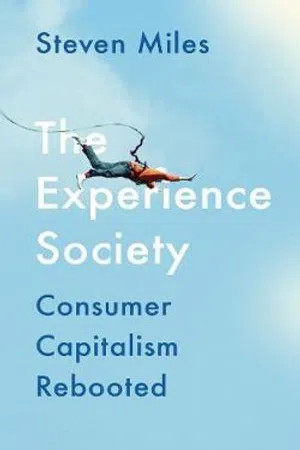
Airbnb, gaming, escape rooms, major sporting events: contemporary capitalism no longer demands we merely consume things, but that we buy experiences. This book is concerned with the social, cultural and personal implications of this shift.The technologically-driven world we live in is no closer to securing the utopian ideal of a leisure society. Instead, the pursuit of leisure is often an attempt to escape our everyday existence. Exploring examples including sport, architecture, travel and social media, Steven Miles investigates how consumer culture has colonised 'experiences', revealing the ideological and psycho-social tensions at the heart of the 'experience society'.The first critical analysis of the experience economy by a UK sociologist sheds light on capitalism's ever more sophisticated infiltration of the everyday.
- English
- ePUB (mobile friendly)
- Available on iOS & Android
eBook - ePub
The Experience Society : How Consumer Capitalism Reinvented Itself
About this book
Trusted by 375,005 students
Access to over 1.5 million titles for a fair monthly price.
Study more efficiently using our study tools.
Information
Subtopic
Consumer BehaviourIndex
Business1
Introducing the Experience Society
Experience is the new ideological terrain of consumer society. We live in a world in which consumption is less and less about the ‘using up’ and ‘laying to waste’ of products and more and more about the maximisation of the moment; about the ephemera of an experience planted in the human imagination. The success of consumer capitalism has long depended on its ability to reinvent itself. This can at least in part be described as a transition from the consumption of needs to the consumption of wants. In this book, I will argue that this process has graduated onto the consumption of experiences. This is not, in itself, a revelation. Many commentators have considered the role of experience in the reproduction of the so-called ‘experience economy’ (Sundbo and Sørensen, 2013). However, what has tended to be neglected in this discussion is the ideological dimensions of this process and what it tells us about what it really means to be a citizen of a consumer society. The Experience Society seeks to understand an ever more sophisticated reimagineering of capitalism and hence, of an ideological process in which what and how we consume as citizens of a consumer society actively defines who and what it is we are. The experience society brings us closer to a sense of belonging to a world where such a sense feels harder to come by. And yet it simultaneously takes that belonging completely out of our grasp. In The Experience Society I will hence argue that the acceleration of forms of experiential consumption necessitate nothing less than a root and branch reconsideration of the social scientific significance of what it means to consume.
Ideology Reimagined
The ideological foundations that underpin consumer capitalism and the role it plays in forging a political imaginary have long been a matter of fascination. In a neoliberal context it can be argued that the values of the market and of private property have come to be absolute and that democracy has effectively been reinvented as the ability to consume. What this represents is a shift of liberty from the political to the economic where the market determines who wins and who loses (Brown, 2015). The all-powerful nature of a neoliberal rationality inevitably produces an unequal society and a form of citizenship that is defined above all by the access, or otherwise, to consumption, for it is consumption that defines the ‘good life’. There is an irony here. That is, the more neoliberalism reconstructs human beings as forms of human capital as Brown suggests, the more it questions the value of the individual as an arbiter of his or her own future; the more he or she looks to consumption as a means of finding him or herself, and the more his or herself is lost.
I want to present the argument here that consumption is essentially a psycho-social phenomenon. Herein lies its power. What I mean by that is that its effects are not purely sociological or purely psychological in nature, as academic boundaries insist on implying, but they constitute a complex interaction of the two. This is a position that has been hinted at in the literature (see e.g. Gabriel and Lang, 2016) but one that has rarely been executed or fully explored. That consumption is the phenomenon by which the individual consumer, regardless of his or her ability (or the extent of their resources) to consume, comes to belong to the society in which he or she lives (see Bauman, 1998), a process that in turn mediates, to put this in a somewhat old-fashioned way, the relationship between structure and agency. The consumer society coerces consumers into behaving in particular ways. It ties them to the society in which they live while convincing them that the arena of consumption not only constitutes a ‘natural’ state of affairs but can also provide them with the sense of belonging and freedom that other aspects of social life simply cannot.
It’s in the above light that Uusitalo (1998) contends that consumption reflects a combination of the universal need to establish difference alongside the parallel need to establish strong identifying relationships. What’s important here, given the time at which Uusitalo was writing and the penchant at the time for discussing the fragmented nature of post-modern identities, is the recognition that reality is fundamentally mediated. This in turn hints at Baudrillard’s (1991) vision of hyper-reality and the sense that the world of social interaction is at best of a quasi-nature (see also Thompson, 1990). The work of Baudrillard is prescient in this context insofar as he identifies the emergence of a society driven by a consumer logic: an age of simulation and simulacra in which nothing is real or authentic. As Stebbins (2009) recognises, in Baudrillard’s world how we consume becomes more important than how we produce, in the sense that society is geared up to produce goods to meet the ‘ideological genesis of needs’ (Baudrillard, 1991). Baudrillard thus discusses the triumph of a signifying culture in which culture, previously determined, is now free floating and determining: the product of a cynical parody of media images (see also Featherstone, 1991). Most crucial perhaps, for Baudrillard at least, is the point that it is via advertising and marketing that the consumer society is fuelled, and not least by the relentless promotion of the idea that through it happiness and satisfaction can be achieved. The point here is that such happiness is not about any kind of deep inner enjoyment, but about the visibility of attained enjoyment through the shared display of signs and consumption. This then is a kind of ‘enforced happiness’ contrived by the market to ensure that the consumer is constantly reminded about his or her own needs and how these needs can be met through the opportunity to consume.
The transition to which I refer is one in which the self is commodified. But in a way that is far more intense than it would have been in the past. I will deal with this issue most directly in Chapter 2, but my point is that in order to achieve the above sense of happiness, however partial it might be, a conjoining of intense subjectivism alongside a simultaneous objectivism takes place (Illouz, 2007). This amounts to a reaching within the self, but only through the predefined routes that consumer capitalism provides. In many senses, this process and the feelings it engenders can be said to have been accentuated in the past 20 or so years, not least in light of the emergence of digital mediation and social media. What I’m identifying here is a tension; a tension between a society that at least on the surface demands that you belong, alongside an analogous intensification of selfhood. The point here is that this isn’t just the product of a new technologically driven economic order that perpetuates consumption in ever new forms, but of a broader process of ideological evolution (see Jameson, 1991).
It is important to remember that consumption isn’t solely about the freedom of choice or indeed about the expression of fragmented identities. As Uusitalo (1998) notes, consumption has come to play an increasingly key role in the structuring of society in a world in which the integrative power of work (and indeed class) has apparently been diminished. Such trends are part of a broader process in which the success of capitalism is entirely dependent upon its ability to reinvent itself. Modernity was all about the thirst for progress, about the ability of human beings to create a world in their own guise: an instrumental world that would be capable of serving the common interest. But modernity failed. That ambition was never met and what arguably emerged instead was a fragmentary and a highly divided world in which belonging came to be defined by the ability to consume (see Bauman, 1998) and by capitalism’s ability to reboot by reinventing how people consumed.
Uusitalo (1998) points out that in a post-industrial society production and consumption are dissolving into each other so that, in effect, products become indistinguishable from their marketing. It’s in a similar way that consumers have become indistinguishable from their experiences. The changing nature of consumption is not something that can be contained. It has a fundamental impact on how we experience society and how society, at least symbolically, experiences us. But the concern here is that the new kind of bonds that this society creates are inevitably partial. What we consume and how we consume it in an experience society may bring us together, but it does this in a momentary fashion and in that moment we are bonded above all to the economic system that defines us. It is this process that I argue sits at the heart of social change today.
The amplification of experience could be said to reflect a long-term transition in the consumers’ relationship to consumption from that of a process of self-production rather than one of self-distinction (Uusitalo, 1998); something that was long ago identified by Marx (1989: 94) who, far from focusing solely on consumption as distribution and exchange, saw consumption as a form of self-restoration: ‘The individual produces an object, and by consuming it, returns to himself, but returns as a productive and self-reproducing individual.’ For Marx, it was the combination of commodity fetishism and alienated labour that constituted the ideology of capitalism. The working classes were unwilling to engage in revolution because they were more caught up in ‘a nexus of false ideas’. Thus Heath and Potter (2005: 23) describe a state of affairs in which the working classes came to be preoccupied with incremental gains, as opposed to revolution, and as a result were simply ‘redecorating the cage in which they were imprisoned’. It was in this context, argue Heath and Potter (2005), that Marxism came to rethink the notion of ideology, not least through the work of Gramsci (2005), who argued that capitalism wilfully created a false consciousness through a complete cultural hegemony, a world of cultural products which as long as they existed would simply serve to reflect and reinforce bourgeois ideologies. Heath and Potter’s (2005) critique of Marxist approaches is interesting here insofar as it highlights some of the tensions that exist around the role of consumption in social change. If the problem with capitalism was that it exploited the working classes and in the process created poverty and suffering why shouldn’t culture and indeed forms of popular consumption provide a way out in this regard?
It was precisely the failure of the capitalist system to provide the workers with goods that gave them the reason to overthrow the system in the first place. Thus the critique of consumerism comes perilously close to criticising capitalism for satisfying the workers too much. They’re stuffed, they can’t be bothered to go out and overthrow the system anymore. But this poses the question: why would they want to? (Heath and Potter, 2005: 33)
There is something to be said for this argument. But perhaps what it does neglect is the psycho-social dimension of consumption. In his work Adorno (1991a) basically argues that exchange value has come to supplant use value. The working classes effectively desire the very deceptions that consumption depends upon even though they are transparent to them. We can knowingly consume a product precisely because we do not feel duped by it; we desire it despite the duping (Cremin, 2011). The way we seek to go about defining ourselves through consumption has certainly changed through time, and this book is thus concerned with the way this has helped to intensify the ideological power of consumer capitalism. Indeed, as Salecl (2011) has argued, in a world characterised by a need for constant self-improvement, in a world in which the orthodoxy of choice remains largely unspoken, and unreal and yet assumed, we become the victims of a way of self-perception in which we are, perhaps regrettably, the masters of our own fate. We feel that we can ‘choose’.
In today’s society which glorifies choice and the idea that choice is always in people’s interests, the problem is not just the scale of choice available but the manner in which choice is represented. Life choices are described in the same terms as consumer choices: we set out to find the right life as we would the right kind of wallpaper or hair conditioner ... the problem is that the idea of rational choice, transferred from the domain of economics, has been glorified as the only kind of choice we have. (Salecl, 2011: 8)
This sense of choice is not just about goods or services; it’s about the ability to choose our selves given that, as the sports brand Adidas put it, ‘Impossible is Nothing’. As citizens of a consumer society we live in a whirlwind of perpetual choice, whether it be in education, health, housing or countless other realms. But the ability to choose is transmuted into an ideology of the self-made (wo)man so that we convince ourselves that life is about a series of options and potential transformations, despite the fact that the society in which we live legislates against this. One author that has sought to understand the impact of social change on the self is Elemer Hankiss (2006), who argues that the syncretic civilisation of the consumer age constitutes an age of paradox in which we are experiencing the apotheosis of the human personality and its simultaneous annihilation:
It is the Me Age and the Age of the No-Self at the same time. Seen from one angle, it is the age of triumphant self-actualization, of radical individualism, an age when the human person has become the object of cult and the ultimate source of values. Yet, from the opposite angle, we witness the self’s destruction. (Hankiss, 2006: 197–8)
The problem for Hankiss is that at a time of rapid social change when the individual is bewildered by a sense of uncertainty and self-blame, his or her responsibility for self-direction is intensified, thereby diluting any sense of freedom they might ‘experience’ along the way. In an increasingly (apparently) godless world, where traditional sources of purpose and meaning are in rapid decline, he or she becomes the ultimate, perhaps the only, arbiter of his or her own meaning. The implications of this for our understanding of the experience society is the increased value of time so that our experience of the world is lived through precious moments of intensity. Indeed,
hundreds of millions of people … are looking for an ultimate source of life and meaning in the moment. And consumer civilization provides them, around the clock, with myriad intense and significant moments (or at least with the illusion that they experience these significant moments) … Consumer civilization, for its part, offers people some help. It makes them feel the beauty of the moment, and the serenity of eternity, and it generates in them the illusion that these two, the moment and the eternity, unite in a beautiful harmony. (Hankiss, 2006: 214)
Hankiss goes as far as to describe this as an age of experience, a world without transcendence where everything needs to be experienced to the full: a necessity if people’s existential fears and anxieties are to be assuaged or if they are to be ‘dazzled and immunized’ against the growing fears of the emerging civilisation. It’s here that the human imagination steps in. By focusing on the impossibility of the ‘good life’, the currency that consumption provides becomes essential and that life is defined by the resources we need in order to reassure ourselves that we belong (see Tuan, 1998). Consumption is thus our escape into a world better imagined. In a sense then, the world of commodified experience in which we find ourselves so readily immersed today is the product of a long-term historical process in which the self has become increasingly separated from the world, despite a feeling of the polar opposite. We are independent and yet isolated to the extent that we are obliged to define our own worlds. It’s this paradox that ensures consumption plays such a pivotal role in the world in which we live, however much our cultural capital leads us to deny as much. Robert David Sack (1992) thus argues that the glittering realm of consumption appears to offer us a world ‘without constraints and without responsibility’, a disorienting world in which the consequences of our actions are obscured through our emphasis on a front stage without a back stage to prop it up. The world of experience is both an escape and a means of propping up the self; of legitimising its morality, in Sack’s (1992) terms, and of giving it a voice and a kind of stability which it effectively took away from us in the first place. The consumption of experience gives and it takes away.
What is Experience?
So what is experiential consumption and how has it become so important to how the consumer relates to the society in which he or she lives? There has been a tradition in cultural and consumer studies of critically engaging with products that may or may not tell us something insightful about the relationship between a consumer artefact, consumption and social change (see Du Gay et al., 1996; Miller and Woodward, 2012). Clearly there is an experience, or indeed experiences, involved in consuming such products that, not least insofar as how we consume them, may serve to connect us to the world around us. For example, today we do not consume an iPhone solely on the basis of its functional attributes and quality. We do so, at least partly, because the ownership of the iPhone says something about our discernment as consumers, and more importantly implies that we belong in the same ways as those around us who are also consuming the iPhone, belong. The power of the iPhone lies at least partly in its symbolism: what its ownership says about its owner. This provides us with a form of capital that in turn appeases the jagged edges that would otherwise appear in our social relations should we ‘choose’ to consume an ‘inferior’ brand. The added value that such products embody in version after version after updated version, have long been at the heart of how consumer capitalism reinvents itself.
Nobody actually needs the choice of thousands of car models or indeed, as Miller and Woodward (2012) point out, the apparently endless range of styles of jeans that the market makes available to them. However, this form of commodity exchange is limited in the sense that at least consumers’ need for products is finite. Someone may have 200 pairs of training shoes in their collection. They are less likely to own 200 iPhones. The process that this implies is also fairly primitive and steeped in historical precedence. But the emergence of a world of digital consumption and a world that is increasingly deterritorialised in the sense that how you consume is less and less determined by the physical space in which you consume, have arguably created a space for a radically different kind of consumption, one in which experience is much more at the heart of why and how we consume. Airbnb, gaming, escape rooms, Premier League football, craft beer, the revitalisation of live comedy and music, celebrity restaurants, themed restaurants, theme parks, Amazon, eBay, all-in holidays, cruise ships, box sets, Netflix (and possibly chill).These are all examples of experiential forms of consumption in which the power of the product to impact upon your life is intensified by your ability as a consumer to effectively add your own value, to bring the product to life through the narrative that you and apparently only you can bring to it. Let me offer a further example. At the time of writing, and from a mere £162, you can buy a ticket to Mamma Mia! The Party: ‘Created by ABBA’s Björn Ulvaeus, Mamma Mia! The Party is a new and unique entertainment experience that puts you in the heart of the action. Over the course of more than five hours, you’ll enjoy a spectacular show, a three-course gourmet Mediterranean meal and an ABBA disco all in one unforgettable evening’ (Mamma Mia!, 2019). Such an event is characterised by many of the key dimensions of an experience society. The event is explicitly about self-gifting. The consumer isn’t simply an observer but an active participant, in this case in an escapist world of music-driven nostalgia. This is experience manufactured. And it is more than escape. It is in essence a process of self-illusory validation.
The emergence of experience as an essential characteristic of how people consume is not accidental. It is at least partly the product of an economic strategy. Indeed, for Pine and Gilmore (1999) the future health of the economy depends on the effective...
Table of contents
- Cover
- Title
- Copyright
- Contents
- 1 Introducing the Experience Society
- 2 Consumption, Identity, Experience
- 3 Leisure and Tourism
- 4 Work Experience
- 5 Technologies of Self
- 6 Space, Place and the Architecture of Experience
- 7 The Spectacle of Sport
- 8 The Coffee Shop Experience
- 9 Consumer Capitalism Rebooted
- References
- Index
Frequently asked questions
Yes, you can cancel anytime from the Subscription tab in your account settings on the Perlego website. Your subscription will stay active until the end of your current billing period. Learn how to cancel your subscription
No, books cannot be downloaded as external files, such as PDFs, for use outside of Perlego. However, you can download books within the Perlego app for offline reading on mobile or tablet. Learn how to download books offline
Perlego offers two plans: Essential and Complete
- Essential is ideal for learners and professionals who enjoy exploring a wide range of subjects. Access the Essential Library with 800,000+ trusted titles and best-sellers across business, personal growth, and the humanities. Includes unlimited reading time and Standard Read Aloud voice.
- Complete: Perfect for advanced learners and researchers needing full, unrestricted access. Unlock 1.5M+ books across hundreds of subjects, including academic and specialized titles. The Complete Plan also includes advanced features like Premium Read Aloud and Research Assistant.
We are an online textbook subscription service, where you can get access to an entire online library for less than the price of a single book per month. With over 1.5 million books across 990+ topics, we’ve got you covered! Learn about our mission
Look out for the read-aloud symbol on your next book to see if you can listen to it. The read-aloud tool reads text aloud for you, highlighting the text as it is being read. You can pause it, speed it up and slow it down. Learn more about Read Aloud
Yes! You can use the Perlego app on both iOS and Android devices to read anytime, anywhere — even offline. Perfect for commutes or when you’re on the go.
Please note we cannot support devices running on iOS 13 and Android 7 or earlier. Learn more about using the app
Please note we cannot support devices running on iOS 13 and Android 7 or earlier. Learn more about using the app
Yes, you can access The Experience Society : How Consumer Capitalism Reinvented Itself by Steven Miles in PDF and/or ePUB format, as well as other popular books in Business & Consumer Behaviour. We have over 1.5 million books available in our catalogue for you to explore.