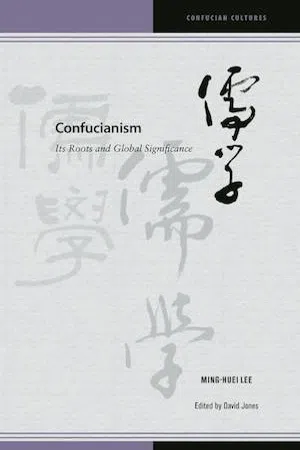
In Confucianism: Its Roots and Global Significance, English language readers get a rare opportunity to read the work in a single volume of one of Taiwan's most distinguished scholars. Although Lee Ming-huei has published in English before, the corpus of his non-Chinese writings is in German. Readers of this volume will discover the hard-mindedness and precision of thinking associated with German philosophy as they enter into Lee's discussions of Confucianism. Progressing through the book, they will be constantly reminded that all philosophy should be truly comparative. The work is divided into three parts: Classical Confucianism and Its Modern Re-Interpretations, Neo-Confucianism in China and Korea, and Ethics and Politics. The interrelated ideas and arguments presented here contribute significantly to the Confucian project in English-speaking countries across the world.
- English
- ePUB (mobile friendly)
- Available on iOS & Android
eBook - ePub
Confucianism : Its Roots and Global Significance
About this book
Information
Topic
Theology & ReligionSubtopic
Asian ReligionsPART I
Classical Confucianism and Its Modern Reinterpretations
CHAPTER 1
Mou Zongsan’s Interpretation of Confucianism
Some Hermeneutical Reflections
mou zongsan 牟宗三 (1909–1995) played a significant role in the development of “Contemporary New Confucianism.” This chapter narrows his role more specifically and hermeneutically reflects on his interpretation of Confucianism, which is characterized by the influence of Western philosophy, especially that of the German philosopher Immanuel Kant (1724–1804). In his interpretation, Mou employs not only Kant’s philosophical terminology such as “thing-in-itself,” “intellectual intuition,” and “autonomy,” but also his philosophical framework of “appearance” and “thing-in-itself.” Mou even views this framework as the common model for all philosophical thinking. His interpretation of Confucianism, however, has encountered criticisms on two fronts. On one hand, he has been reproached for distorting Kant’s “original” philosophy, and, on the other hand, he has been criticized for reading too much Kant into Confucianism.
Mou’s Interpretation of Confucianism
As a reaction to the challenge of Western culture, “Contemporary New Confucianism” arose in China at the beginning of the twentieth century. In view of the variety of its contents and directions, it should be regarded more as an intellectual movement than as a school. The initiators of this movement primarily include Liang Shuming 梁漱溟 (1893–1988) and Xiong Shili 熊十力 (1885–1968), with Zhang Junmai, Tang Junyi, Xu Fuguan, Mou Zongsan, and perhaps Qian Mu 錢穆 (1895–1990) as their followers.1 Characteristic of this movement is its attempt to integrate some ingredients of Western culture with the Confucian tradition, insofar as these ingredients can facilitate China’s modernization and promote the further development of Chinese culture. This attempt is often based on the philosophical reconstruction of the Chinese tradition in terms of Western ideas. The efforts of the New Confucians are similar in many ways to those of the Fathers of the Church in developing early Christian theology. In this respect, Mou Zongsan deserves special attention for his philosophical achievements; an analysis of Mou’s interpretation of Confucianism and the hermeneutical problems involved in his reconstruction of Confucian philosophy are of special cultural significance and philosophical purport.
Mou’s reconstruction of Confucianism is characterized by his appropriation of Kant’s philosophical framework and concepts, and is one of the earliest instances of what has come to be known in the West as comparative philosophy—however, instead of moving from the West to the East, the intellectual movement here is from China to the West.2 Strictly speaking, Mou may be considered unqualified to be a Kant specialist because of his lack of acquaintance with the German language. Nevertheless, as occasionally is the case, this disadvantage is offset by his genius for philosophical thinking and his diligence in researching—sometimes a “disadvantage” can be transformed into its opposite. On the basis of English versions, he translated Kant’s three Critiques and Grundlegung zur Metaphysik der Sitten into Chinese. To these Chinese versions he appended his commentaries, which are not only philological but also philosophical-interpretative. He often interprets Kant’s philosophy by contrasting it with Chinese philosophy, especially with Confucian philosophy.
Kant’s influence on Mou’s interpretation of Confucianism can best be considered from two perspectives: the framework of philosophical thinking and moral philosophy. In the first place, Mou appropriated Kant’s philosophical framework of “appearance” and “thing-in-itself.” For Mou this framework can serve as the common model for all philosophical thinking. In 1975 he published Appearance and Thing-in-Itself (Xianxiang yu wuzishen 現象與物自身), where he thoroughly discussed Kant’s distinction. In this book, he interpreted Kant’s concept of “thing-in-itself ” not as a usual epistemological concept but as one with value-connotation. He did so even though he realized Kant had never clearly expressed this thought. In this regard, Mou shows his Confucian (and New Confucian) roots. In Mou’s view, an epistemological concept of “thing-in-itself ” is not sufficient to support Kant’s transcendental distinction between appearance and thing-in-itself since the “thing-in-itself ” in this sense lies always beyond human knowledge. In order to solve this problem, Mou appealed to the thesis that human beings are indeed finite but have access to the infinite, which is a common conviction of Confucianism, Daoism, and Buddhism. As revealed in his Intellectual Intuition and Chinese Philosophy (Zhide zhijue yu Zhongguo zhexue 智的直覺與中國哲學) (1971), he found this access in the “intellectual intuition” of human beings.
It is generally known that Kant ascribes intellectual intuition only to God. But on a full analysis of the relevant sections of the Critique of Pure Reason, Mou came to the conclusion that Kant’s philosophical system logically implies the possibility of ascribing intellectual intuition also to humans, although it is contrary to Kant’s own expressions. This is a viewpoint Johann G. Fichte (1762–1814) also advocated. It is here that Mou found a key to the comparison between Kantian and Chinese philosophy. Therefore a “transcendent” or “noumenal” metaphysics, which is impossible for Kant, is possible for Chinese philosophy. In such a metaphysical structure Mou found the proper place for Confucian metaphysics. According to Mou, Confucian metaphysics is founded on liangzhi 良知 (original knowing) or benxin 本心 (original mind), which is a type of intellectual intuition of the moral and therefore free subject. In this sense, the “thing-in-itself ” has a practical connotation, because it is a horizon that discloses itself through liangzhi. So Mou views Confucian metaphysics as a “moral metaphysics,” which is different from Kant’s “metaphysics of morals” inasmuch as the latter means a metaphysical (a priori) explanation of morals.
This point brings us to the second perspective of moral philosophy. In the introduction to his epoch-making work Heart-Mind as Reality and Human Nature as Reality (Xinti yu xingti 心體與性體), Mou critically examined Kant’s system of moral philosophy. Mou agreed with Kant’s view that the essence of morality lies in the “autonomy” of the moral subject (will). In the concept of “autonomy,” Mou found the key not only to interpret the doctrines of Confucianism, but also to classify the systems within Confucianism. At the same time, however, he curiously pointed out that the whole meaning of Kant’s insight in this respect cannot be fully developed within the framework of his own moral philosophy. The reason for this is that Kant presupposes a dualist standpoint between the rational and the emotional deportment in the moral agent. Kant’s strict separation of the rational from the emotional means the moral subject can function only as a principium dijudicationis (the principle of the appraisal of the action) and not at the same time as a principium executionis (the principle of its performance). In other words, the moral subject in Kant lacks the power of self-realization, which means there is a narrowing of the “autonomy” of the moral subject as its moral self-legislation. For Mou, it is because of this narrowing and the deprivation of intellectual intuition in humans that Kant is not in a position to establish a moral metaphysics. In its place Mou saw the prototype of moral metaphysics in Confucianism.
Thus, in Mencius’ theory of xin 心 (heart-mind) as moral subject, Mou found a more suitable philosophical-anthropological framework for Kant’s concept of “autonomy” because this theory is based on an a priori universalism as well as a unity of the rational and the emotional. On the basis of Mencius’ philosophical anthropology, Wang Yangming advanced the thesis of the unity of moral subject and moral law (xin ji li 心即理) as well as that of the unity of moral knowledge and action (zhi xing he yi 知行合一). The first of these theses means that liangzhi as moral subject is the last resort for moral legislation, whereas the second means that liangzhi functions not only as the principium dijudicationis, but also as the principium executionis of the moral good.
In both characteristics of Mencius’ moral philosophy—that is, the ethics of autonomy and the philosophical-anthropological unity of the rational and the emotional—Mou finds the criteria for the grouping of different systems within Confucianism. In his classification, he identifies Confucius, Mencius, the author(s) of the Doctrine of the Mean (Zhongyong 中庸), and the commentators of the Book of Changes (Yijing 易經) in the mainstream of pre-Qin Confucianism. Xunzi 荀子 (ca. 298–238 BCE) is then considered as a representative of another stream of Confucianism because he established an ethics of heteronomy. For the same reason, Mou excluded the Han Confucians from the mainstream of Confucianism because they appealed to what Kant called “theological ethics,” which made their ethics heteronomous in nature.
In his Heart-Mind as Reality and Human Nature as Reality and From Lu Xiangshan to Liu Jishan (Cong Lu Xiangshan dao Liu Jishan 從陸象山到劉蕺山) (1979), Mou propounds a new classification of the Song-Ming Neo-Confucians. In his opinion, the early Northern Song dynasty Confucians, such as Zhou Dunyi 周敦頤 (1017–1073), Zhang Zai 張載 (1020–1077), and Cheng Hao 程顥 (1032–1085), belong to the aforementioned mainstream. Here we see something novel compared to the traditional view, since the thought of Cheng Hao and his brother Cheng Yi 程頤 (1033–1107) formerly were not distinguished from each other. According to Mou, Song-Ming Neo-Confucianism developed into three systems: (1) that of Lu Xiangshan 陸象山 (1139–1193) and Wang Yangming, (2) that of Hu Hong 胡宏 (1106–1161) and Liu Jishan 劉蕺山 (1578–1645), and (3) that of Cheng Yi and Zhu Xi. The first two systems lead to a moral philosophy that is founded on the autonomy of the moral subject. The difference between them consists only in their approaches. The first system starts subjectively from a philosophical-anthropological thesis on the human heart-mind, whereas the second one starts objectively from ontological assertions about Tian 天 (Heaven). In any event, Mou regards these systems together in the mainstream of Confucianism. In contrast, the third system is excluded from the mainstream, although through his comprehensive philosophical system, Zhu Xi has exerted tremendous influence on the subsequent development of Confucianism. The reason for this lies in Mou’s judgment that this system is essentially intellectualistic and therefore based on the heteronomy of the moral subject.
Mou and His Critics
In the Chinese-speaking community, M...
Table of contents
- Half-title Page
- Title Page
- Contents
- Series Editors’ Preface
- Editor’s Foreword
- Acknowledgments
- Introduction
- PART I: Classical Confucianism and Its Modern Reinterpretations
- PART II: Neo-Confucianism in China and Korea
- PART III: Ethics and Politics
- Bibliography
- Index
- About the Author
- About the Editor
- By the Same Author
- Copyright
Trusted by 375,005 students
Access to over 1.5 million titles for a fair monthly price.
Study more efficiently using our study tools.
Frequently asked questions
Yes, you can cancel anytime from the Subscription tab in your account settings on the Perlego website. Your subscription will stay active until the end of your current billing period. Learn how to cancel your subscription
No, books cannot be downloaded as external files, such as PDFs, for use outside of Perlego. However, you can download books within the Perlego app for offline reading on mobile or tablet. Learn how to download books offline
Perlego offers two plans: Essential and Complete
- Essential is ideal for learners and professionals who enjoy exploring a wide range of subjects. Access the Essential Library with 800,000+ trusted titles and best-sellers across business, personal growth, and the humanities. Includes unlimited reading time and Standard Read Aloud voice.
- Complete: Perfect for advanced learners and researchers needing full, unrestricted access. Unlock 1.5M+ books across hundreds of subjects, including academic and specialized titles. The Complete Plan also includes advanced features like Premium Read Aloud and Research Assistant.
We are an online textbook subscription service, where you can get access to an entire online library for less than the price of a single book per month. With over 1.5 million books across 990+ topics, we’ve got you covered! Learn about our mission
Look out for the read-aloud symbol on your next book to see if you can listen to it. The read-aloud tool reads text aloud for you, highlighting the text as it is being read. You can pause it, speed it up and slow it down. Learn more about Read Aloud
Yes! You can use the Perlego app on both iOS and Android devices to read anytime, anywhere — even offline. Perfect for commutes or when you’re on the go.
Please note we cannot support devices running on iOS 13 and Android 7 or earlier. Learn more about using the app
Please note we cannot support devices running on iOS 13 and Android 7 or earlier. Learn more about using the app
Yes, you can access Confucianism : Its Roots and Global Significance by Ming-huei Lee in PDF and/or ePUB format, as well as other popular books in Theology & Religion & Asian Religions. We have over 1.5 million books available in our catalogue for you to explore.