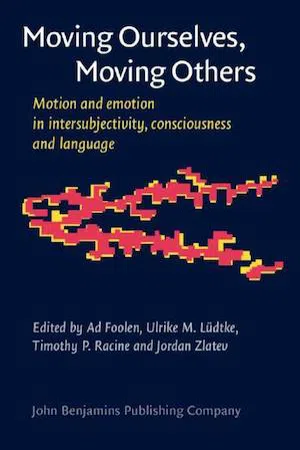
The close relationship between motion (bodily movement) and emotion (feelings) is not an etymological coincidence. While moving ourselves, we move others; in observing others move – we are moved ourselves. The fundamentally interpersonal nature of mind and language has recently received due attention, but the key role of (e)motion in this context has remained something of a blind spot. The present book rectifies this gap by gathering contributions from leading philosophers, psychologists and linguists working in the area. Framed by an introducing prologue and a summarizing epilogue the volume elaborates a dynamical, active view of emotion, along with an affect-laden view of motion – and explores their significance for consciousness, intersubjectivity, and language. As such, it contributes to the emerging interdisciplinary field of mind science, transcending hitherto dominant computationalist and cognitivist approaches.
eBook - PDF
Moving Ourselves, Moving Others : Motion and Emotion in Intersubjectivity, Consciousness and Language
- 502 pages
- English
- PDF
- Available on iOS & Android
eBook - PDF
Moving Ourselves, Moving Others : Motion and Emotion in Intersubjectivity, Consciousness and Language
About this book
Information
Subtopic
LinguisticsTable of contents
- Table of contents
- Introduction
- Prologue
- PartI Consciousness
- Fundamental and inherently interrelated aspects of animation
- Could moving ourselves be the link between emotion and consciousness?
- Visual perception and self-movement
- Emotion regulation through the ages
- Moving others matters
- Neurons, neonates and narrative
- Intersubjectivity in the lifeworld
- Primates, motion and emotion
- Reaching, requesting and reflecting
- Intuitive meaning
- Relational emotions in semiotic and linguistic development
- The relevance of emotion for language and linguistics
- From pre-symbolic gestures to language
- The challenge of complexity
- (E)motion in the XVIIth century
- Metaphor and subjective experience
- Epilogue
- Index
Trusted by 375,005 students
Access to over 1.5 million titles for a fair monthly price.
Study more efficiently using our study tools.
Frequently asked questions
Yes, you can cancel anytime from the Subscription tab in your account settings on the Perlego website. Your subscription will stay active until the end of your current billing period. Learn how to cancel your subscription
No, books cannot be downloaded as external files, such as PDFs, for use outside of Perlego. However, you can download books within the Perlego app for offline reading on mobile or tablet. Learn how to download books offline
Perlego offers two plans: Essential and Complete
- Essential is ideal for learners and professionals who enjoy exploring a wide range of subjects. Access the Essential Library with 800,000+ trusted titles and best-sellers across business, personal growth, and the humanities. Includes unlimited reading time and Standard Read Aloud voice.
- Complete: Perfect for advanced learners and researchers needing full, unrestricted access. Unlock 1.5M+ books across hundreds of subjects, including academic and specialized titles. The Complete Plan also includes advanced features like Premium Read Aloud and Research Assistant.
We are an online textbook subscription service, where you can get access to an entire online library for less than the price of a single book per month. With over 1.5 million books across 990+ topics, we’ve got you covered! Learn about our mission
Look out for the read-aloud symbol on your next book to see if you can listen to it. The read-aloud tool reads text aloud for you, highlighting the text as it is being read. You can pause it, speed it up and slow it down. Learn more about Read Aloud
Yes! You can use the Perlego app on both iOS and Android devices to read anytime, anywhere — even offline. Perfect for commutes or when you’re on the go.
Please note we cannot support devices running on iOS 13 and Android 7 or earlier. Learn more about using the app
Please note we cannot support devices running on iOS 13 and Android 7 or earlier. Learn more about using the app
Yes, you can access Moving Ourselves, Moving Others : Motion and Emotion in Intersubjectivity, Consciousness and Language by Ad Foolen, Timothy P. Racine, Ulrike M. Lüdtke in PDF and/or ePUB format, as well as other popular books in Languages & Linguistics & Linguistics. We have over 1.5 million books available in our catalogue for you to explore.