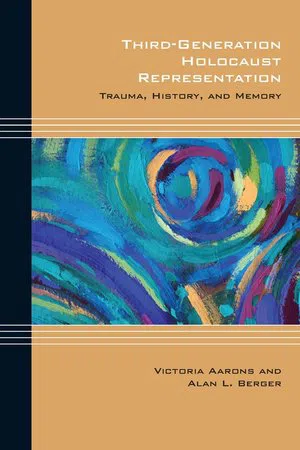
Victoria Aarons and Alan L. Berger show that Holocaust literary representation has continued to flourish—gaining increased momentum even as its perspective shifts, as a third generation adds its voice to the chorus of post-Holocaust writers. In negotiating the complex thematic imperatives and narrative conceits of the literature of these writers, this bold new work examines those structures, ironies, disjunctions, and tensions that produce a literature lamenting loss for a generation removed spatially and temporally from the extended trauma of the Holocaust. Aarons and Berger address evolving notions of "postmemoryâ€?; the intergenerational transmission of trauma; inherited memory; the psychological tensions of post-Holocaust Jewish identity; tropes of memory and the personalized narrative voice; generational dislocation and anxiety; the recurrent antagonisms of assimilation and alienation; the imaginative reconstruction of the past; and the future of Holocaust memory and representation.
eBook - PDF
Third-Generation Holocaust Representation : Trauma, History, and Memory
- 274 pages
- English
- PDF
- Available on iOS & Android
eBook - PDF
Third-Generation Holocaust Representation : Trauma, History, and Memory
About this book
Information
Subtopic
Jewish Literary CriticismIndex
LiteratureTable of contents
- Contents
- Acknowledgments
- Chapter 1. On the Periphery: The “Tangled Roots” of Holocaust Remembrance for the Third Generation
- Chapter 2. The Intergenerational Transmission of Memory and Trauma: From Survivor Writing to Post-Holocaust Representation
- Chapter 3. Third-Generation Memoirs: Metonymy and Representation in Daniel Mendelsohn’s The Lost
- Chapter 4. Trauma and Tradition: Changing Classical Paradigms in Third-Generation Novelists
- Chapter 5. Nicole Krauss: Inheriting the Burden of Holocaust Trauma
- Chapter 6. Refugee Writers and Holocaust Trauma
- Chapter 7. “There Were Times When It Was Possible to Weigh Suffering”: Julie Orringer’s The Invisible Bridge and the Extended Trauma of the Holocaust
- Notes
- Bibliography
- Index
Trusted by 375,005 students
Access to over 1.5 million titles for a fair monthly price.
Study more efficiently using our study tools.
Frequently asked questions
Yes, you can cancel anytime from the Subscription tab in your account settings on the Perlego website. Your subscription will stay active until the end of your current billing period. Learn how to cancel your subscription
No, books cannot be downloaded as external files, such as PDFs, for use outside of Perlego. However, you can download books within the Perlego app for offline reading on mobile or tablet. Learn how to download books offline
We are an online textbook subscription service, where you can get access to an entire online library for less than the price of a single book per month. With over 1.5 million books across 990+ topics, we’ve got you covered! Learn about our mission
Look out for the read-aloud symbol on your next book to see if you can listen to it. The read-aloud tool reads text aloud for you, highlighting the text as it is being read. You can pause it, speed it up and slow it down. Learn more about Read Aloud
Yes! You can use the Perlego app on both iOS and Android devices to read anytime, anywhere — even offline. Perfect for commutes or when you’re on the go.
Please note we cannot support devices running on iOS 13 and Android 7 or earlier. Learn more about using the app
Please note we cannot support devices running on iOS 13 and Android 7 or earlier. Learn more about using the app
Yes, you can access Third-Generation Holocaust Representation : Trauma, History, and Memory by Victoria Aarons, Alan L. Berger in PDF and/or ePUB format, as well as other popular books in Literature & Jewish Literary Criticism. We have over 1.5 million books available in our catalogue for you to explore.