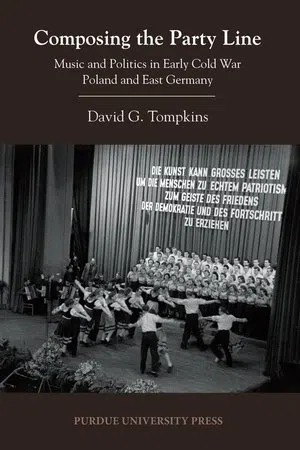
Examines the exercise of power in the Stalinist music world as well as the ways in which composers and ordinary people responded to it. A comparative inquiry into the relationship between music and politics in the German Democratic Republic and Poland from the aftermath of World War II through Stalin's death in 1953, concluding with the slow process of de-Stalinization in the mid-to-late 1990s.This book examines the exercise of power in the Stalinist music world as well as the ways in which composers and ordinary people responded to it. It presents a comparative inquiry into the relationship between music and politics in the German Democratic Republic and Poland from the aftermath of World War II through Stalin's death in 1953, concluding with the slow process of de-Stalinization in the mid- to late-1950s. The author explores how the Communist parties in both countries expressed their attitudes to music of all kinds, and how composers, performers, and audiences cooperated with, resisted, and negotiated these suggestions and demands. Based on a deep analysis of the archival and contemporary published sources on state, party, and professional organizations concerned with musical life, Tompkins argues that music, as a significant part of cultural production in these countries, played a key role in instituting and maintaining the regimes of East Central Europe. As part of the Stalinist project to create and control a new socialist identity at the personal as well as collective level, the ruling parties in East Germany and Poland sought to saturate public space through the production of music. Politically effective ideas and symbols were introduced that furthered their attempts to, in the parlance of the day, engineer the human soul. Music also helped the Communist parties establish legitimacy. Extensive state support for musical life encouraged musical elites and audiences to accept the dominant position and political missions of these regimes. Party leaders invested considerable resources in the attempt to create an authorized musical language that would secure and maintain hegemony over the cultural and wider social worlds. The responses of composers and audiences ran the gamut from enthusiasm to suspicion, but indifference was not an option. This title was made Open Access by libraries from around the world through Knowledge Unlatched.
eBook - PDF
Composing the Party Line : Music and Politics in Early Cold War Poland and East Germany
- 314 pages
- English
- PDF
- Available on iOS & Android
eBook - PDF
Composing the Party Line : Music and Politics in Early Cold War Poland and East Germany
About this book
Information
Subtopic
PoliticsTable of contents
- 9781557536754_frontcover
- 9781557536754_contents
- 9781557536754_backcover
Trusted by 375,005 students
Access to over 1.5 million titles for a fair monthly price.
Study more efficiently using our study tools.
Frequently asked questions
Yes, you can cancel anytime from the Subscription tab in your account settings on the Perlego website. Your subscription will stay active until the end of your current billing period. Learn how to cancel your subscription
No, books cannot be downloaded as external files, such as PDFs, for use outside of Perlego. However, you can download books within the Perlego app for offline reading on mobile or tablet. Learn how to download books offline
Perlego offers two plans: Essential and Complete
- Essential is ideal for learners and professionals who enjoy exploring a wide range of subjects. Access the Essential Library with 800,000+ trusted titles and best-sellers across business, personal growth, and the humanities. Includes unlimited reading time and Standard Read Aloud voice.
- Complete: Perfect for advanced learners and researchers needing full, unrestricted access. Unlock 1.5M+ books across hundreds of subjects, including academic and specialized titles. The Complete Plan also includes advanced features like Premium Read Aloud and Research Assistant.
We are an online textbook subscription service, where you can get access to an entire online library for less than the price of a single book per month. With over 1.5 million books across 990+ topics, we’ve got you covered! Learn about our mission
Look out for the read-aloud symbol on your next book to see if you can listen to it. The read-aloud tool reads text aloud for you, highlighting the text as it is being read. You can pause it, speed it up and slow it down. Learn more about Read Aloud
Yes! You can use the Perlego app on both iOS and Android devices to read anytime, anywhere — even offline. Perfect for commutes or when you’re on the go.
Please note we cannot support devices running on iOS 13 and Android 7 or earlier. Learn more about using the app
Please note we cannot support devices running on iOS 13 and Android 7 or earlier. Learn more about using the app
Yes, you can access Composing the Party Line : Music and Politics in Early Cold War Poland and East Germany by David G. Tompkins in PDF and/or ePUB format, as well as other popular books in Politics & International Relations & Politics. We have over 1.5 million books available in our catalogue for you to explore.