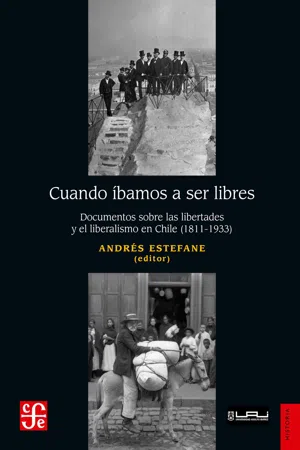
En Chile "no hay liberalismo, todos son conservadores", afirmaban los editores de un periódico obrero de Iquique a inicios del siglo XX. "No habiendo elecciones, no hay para qué buscar ideas liberales" había dicho otro publicista, en Copiapó, cinco décadas antes.Aunque la trayectoria de los liberales chilenos resulte opaca y en algunos pasajes hasta superflua, no sucede lo mismo con la historia del problema de las libertades y las reflexiones sobre el liberalismo como promesa de emancipación. Esa historia y dichas reflexiones han sido parte de discusiones sustantivas que desbordan los límites con que usualmente se dibuja el campo liberal. Cuando íbamos a ser libres reúne y contextualiza una serie de documentos escritos en Chile entre 1811 y 1933 que da cuenta de los proteicos usos de la libertad como concepto político-filosófico y del liberalismo como corriente político-ideológica. Se trata de una compilación que visibiliza autorías y asuntos generalmente desestimados en las reconstrucciones canónicas, y ese criterio permite demostrar que la defensa de las libertades no ha sido patrimonio exclusivo del liberalismo y que esta corriente tiene una historia más disputada de lo que se sostiene.Mirando de reojo el presente, Cuando íbamos a ser libres reinstala preguntas ineludibles para sociedades que vuelven a pensar sus libertades mientras la intervención gubernamental se expande al amparo de las crisis en curso.
eBook - ePub
Cuando íbamos a ser libres
Documentos sobre las libertades y el liberalismo en Chile (1811-1933)
- 478 pages
- English
- ePUB (mobile friendly)
- Available on iOS & Android
eBook - ePub
Cuando íbamos a ser libres
Documentos sobre las libertades y el liberalismo en Chile (1811-1933)
About this book
Information
Index
HistoryTable of contents
- Portada
- Portadilla
- Créditos
- Índice
- Presentación, Andrés Estefane
- Documentos
- Bibliografía
Trusted by 375,005 students
Access to over 1.5 million titles for a fair monthly price.
Study more efficiently using our study tools.
Frequently asked questions
Yes, you can cancel anytime from the Subscription tab in your account settings on the Perlego website. Your subscription will stay active until the end of your current billing period. Learn how to cancel your subscription
No, books cannot be downloaded as external files, such as PDFs, for use outside of Perlego. However, you can download books within the Perlego app for offline reading on mobile or tablet. Learn how to download books offline
Perlego offers two plans: Essential and Complete
- Essential is ideal for learners and professionals who enjoy exploring a wide range of subjects. Access the Essential Library with 800,000+ trusted titles and best-sellers across business, personal growth, and the humanities. Includes unlimited reading time and Standard Read Aloud voice.
- Complete: Perfect for advanced learners and researchers needing full, unrestricted access. Unlock 1.5M+ books across hundreds of subjects, including academic and specialized titles. The Complete Plan also includes advanced features like Premium Read Aloud and Research Assistant.
We are an online textbook subscription service, where you can get access to an entire online library for less than the price of a single book per month. With over 1.5 million books across 990+ topics, we’ve got you covered! Learn about our mission
Look out for the read-aloud symbol on your next book to see if you can listen to it. The read-aloud tool reads text aloud for you, highlighting the text as it is being read. You can pause it, speed it up and slow it down. Learn more about Read Aloud
Yes! You can use the Perlego app on both iOS and Android devices to read anytime, anywhere — even offline. Perfect for commutes or when you’re on the go.
Please note we cannot support devices running on iOS 13 and Android 7 or earlier. Learn more about using the app
Please note we cannot support devices running on iOS 13 and Android 7 or earlier. Learn more about using the app
Yes, you can access Cuando íbamos a ser libres by Andrés Estefane, Susana Gasmuri, Juan Luis Ossa, Francisco Rengifo, Claudio Robles in PDF and/or ePUB format, as well as other popular books in History & Latin American & Caribbean History. We have over 1.5 million books available in our catalogue for you to explore.