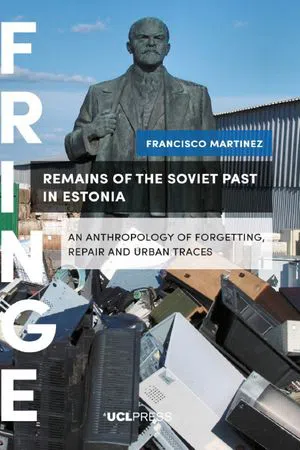
What happens to legacies that do not find any continuation? In Estonia, a new generation that does not remember the socialist era and is open to global influences has grown up. As a result, the impact of the Soviet memory in people's conventional values is losing its effective power, opening new opportunities for repair and revaluation of the past. Francisco Martinez brings together a number of sites of interest to explore the vanquishing of the Soviet legacy in Estonia: the railway bazaar in Tallinn where concepts such as 'market' and 'employment' take on distinctly different meanings from their Western use; Linnahall, a grandiose venue, whose Soviet heritage now poses diffi cult questions of how to present the building's history; Tallinn's cityscape, where the social, spatial and temporal co-evolution of the city can be viewed and debated; Narva, a city that marks the border between the Russian Federation, NATO and the European Union, and represents a place of continual negotiation of belonging; and the new Estonian National Museum in Raadi, an area on the outskirts of Tartu, that has been turned into a memory field.
- 285 pages
- English
- PDF
- Available on iOS & Android
eBook - PDF
Remains of the Soviet Past in Estonia
About this book
Information
Subtopic
SociologyIndex
Social SciencesTable of contents
- Cover
- Half-title
- Title page
- Copyright information
- Epigraphs
- Preface: Departure and Arrival
- Acknowledgements
- Contents
- List of figures
- Introduction: The politics of the old
- 1. The past as a rotting place
- 2. Reframing the Soviet inheritance through repair
- 3. Anything works, one just needs the right adaptor
- 4. Spending time with buildings
- 5. Tallinn 2017 chronotope
- 6. Narva, a centre out there
- 7. A memory-constructing space in Tartu
- 8. Children of the New East
- Conclusion: The past is not what it used to be
- Epilogue: A global Subbotnik
- Notes
- References
- Index
- Back-cover
Trusted by 375,005 students
Access to over 1.5 million titles for a fair monthly price.
Study more efficiently using our study tools.
Frequently asked questions
Yes, you can cancel anytime from the Subscription tab in your account settings on the Perlego website. Your subscription will stay active until the end of your current billing period. Learn how to cancel your subscription
No, books cannot be downloaded as external files, such as PDFs, for use outside of Perlego. However, you can download books within the Perlego app for offline reading on mobile or tablet. Learn how to download books offline
Perlego offers two plans: Essential and Complete
- Essential is ideal for learners and professionals who enjoy exploring a wide range of subjects. Access the Essential Library with 800,000+ trusted titles and best-sellers across business, personal growth, and the humanities. Includes unlimited reading time and Standard Read Aloud voice.
- Complete: Perfect for advanced learners and researchers needing full, unrestricted access. Unlock 1.5M+ books across hundreds of subjects, including academic and specialized titles. The Complete Plan also includes advanced features like Premium Read Aloud and Research Assistant.
We are an online textbook subscription service, where you can get access to an entire online library for less than the price of a single book per month. With over 1.5 million books across 990+ topics, we’ve got you covered! Learn about our mission
Look out for the read-aloud symbol on your next book to see if you can listen to it. The read-aloud tool reads text aloud for you, highlighting the text as it is being read. You can pause it, speed it up and slow it down. Learn more about Read Aloud
Yes! You can use the Perlego app on both iOS and Android devices to read anytime, anywhere — even offline. Perfect for commutes or when you’re on the go.
Please note we cannot support devices running on iOS 13 and Android 7 or earlier. Learn more about using the app
Please note we cannot support devices running on iOS 13 and Android 7 or earlier. Learn more about using the app
Yes, you can access Remains of the Soviet Past in Estonia by Francisco Martinez in PDF and/or ePUB format, as well as other popular books in Social Sciences & Sociology. We have over 1.5 million books available in our catalogue for you to explore.