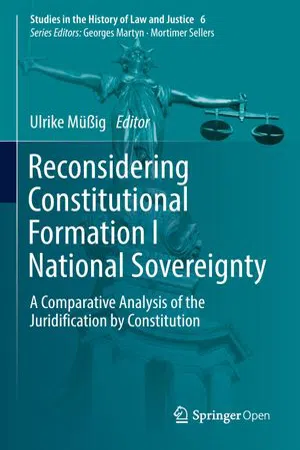
This open access book can be downloaded from link.springer.comLegal studies and consequently legal history focus on constitutional documents, believing in a nominalist autonomy of constitutional semantics. Reconsidering Constitutional Formation in the late 18th and 19th century, kept historic constitutions from being simply log-books for political experts through a functional approach to the interdependencies between constitution and public discourse. Sovereignty had to be 'believed' by the subjects and the political élites. Such a communicative orientation of constitutional processes became palpable in the 'religious' affinities of the constitutional preambles. They were held as 'creeds' of a new order, not only due to their occasional recourse to divine authority, but rather due to the claim for eternal validity contexts of constitutional guarantees. The communication dependency of constitutions was of less concern in terms of the preamble than the constituents' big worries about government organisation. Their indecisiveness between monarchical and popular sovereignty was established through the discrediting of the Republic in the Jacobean reign of terror and the 'renaissance' of the monarchy in the military resistance against the French revolutionary and later Napoleonic campaigns. The constitutional formation as a legal act of constituting could therefore defend the monarchy from the threat of the people (Albertine Statute 1848), could be a legal decision of a national constituent assembly (Belgian Constitution 1831), could borrow from the old liberties (Polish May Constitution 1791) or try to remain in between by referring to the Nation as sovereign (French September Constitution 1791, Cádiz Constitution 1812). Common to all contexts is the use of national sovereignty as a legal starting point. The consequent differentiation between constituent and constituted power manages to justify the self-commitment of political power in legal terms. National sovereignty is the synonym for the juridification of sovereignty by means of the constitution. The novelty of the constitutions of the late 18th and 19th century is the normativity, the positivity of the constitutional law as one unified law, to be the measure for the legality of all other law. Therefore ReConFort will continue with the precedence of constitution. (www.reconfort.eu)
- 296 pages
- English
- PDF
- Available on iOS & Android
eBook - PDF
About this book
Information
Subtopic
Law Theory & PracticeIndex
LawTable of contents
- Acknowledgements
- Contents
- Contributors
- Juridification by Constitution. National Sovereignty in Eighteenth and Nineteenth Century Europe
- National Sovereignty in the Belgian Constitution of 1831. On the Meaning(s) of Article 25
- The Omnipotence of Parliament in the Legitimisation Process of ‘Representative Government’ under the Albertine Statute (1848–1861)
- The Sovereignty Issue in the Public Discussion in the Era of the Polish 3rd May Constitution (1788–1792)
- Appendix
- About the Authors
- Index
Trusted by 375,005 students
Access to over 1.5 million titles for a fair monthly price.
Study more efficiently using our study tools.
Frequently asked questions
Yes, you can cancel anytime from the Subscription tab in your account settings on the Perlego website. Your subscription will stay active until the end of your current billing period. Learn how to cancel your subscription
No, books cannot be downloaded as external files, such as PDFs, for use outside of Perlego. However, you can download books within the Perlego app for offline reading on mobile or tablet. Learn how to download books offline
Perlego offers two plans: Essential and Complete
- Essential is ideal for learners and professionals who enjoy exploring a wide range of subjects. Access the Essential Library with 800,000+ trusted titles and best-sellers across business, personal growth, and the humanities. Includes unlimited reading time and Standard Read Aloud voice.
- Complete: Perfect for advanced learners and researchers needing full, unrestricted access. Unlock 1.5M+ books across hundreds of subjects, including academic and specialized titles. The Complete Plan also includes advanced features like Premium Read Aloud and Research Assistant.
We are an online textbook subscription service, where you can get access to an entire online library for less than the price of a single book per month. With over 1.5 million books across 990+ topics, we’ve got you covered! Learn about our mission
Look out for the read-aloud symbol on your next book to see if you can listen to it. The read-aloud tool reads text aloud for you, highlighting the text as it is being read. You can pause it, speed it up and slow it down. Learn more about Read Aloud
Yes! You can use the Perlego app on both iOS and Android devices to read anytime, anywhere — even offline. Perfect for commutes or when you’re on the go.
Please note we cannot support devices running on iOS 13 and Android 7 or earlier. Learn more about using the app
Please note we cannot support devices running on iOS 13 and Android 7 or earlier. Learn more about using the app
Yes, you can access Reconsidering Constitutional Formation I National Sovereignty: A Comparative Analysis of the Juridification by Constitution (Volume 6.0) by in PDF and/or ePUB format, as well as other popular books in Law & Law Theory & Practice. We have over 1.5 million books available in our catalogue for you to explore.