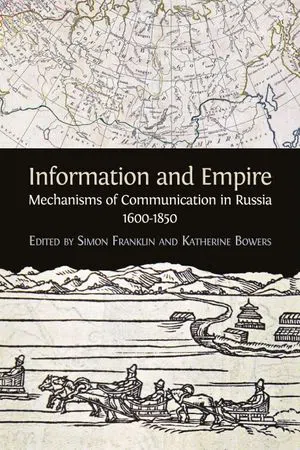
"From the mid-sixteenth to the mid-nineteenth century Russia was transformed from a moderate-sized, land-locked principality into the largest empire on earth. How did systems of information and communication shape and reflect this extraordinary change? Information and Mechanisms of Communication in Russia, 1600-1850 brings together a range of contributions to shed some light on this complex question. Communication networks such as the postal service and the gathering and circulation of news are examined alongside the growth of a bureaucratic apparatus that informed the government about its country and its people. The inscription of space is considered from the point of view of mapping and the changing public 'graphosphere' of signs and monuments. More than a series of institutional histories, this book is concerned with the way Russia discovered itself, envisioned itself and represented itself to its people. Innovative and scholarly, this collection breaks new ground in its approach to communication and information as a field of study in Russia. More broadly, it is an accessible contribution to pre-modern information studies, taking as its basis a country whose history often serves to challenge habitual Western models of development. It is important reading not only for specialists in Russian Studies, but also for students and non-Russianists who are interested in the history of information and communications."
eBook - PDF
About this book
Information
Subtopic
African American HistoryIndex
HistoryTable of contents
- Contents
- Acknowledgments
- Notes on Contributors
- Introduction
- 1. Early Mapping: The Tsardom in Manuscript
- 2. New Technology and the Mapping of Empire: The Adoption of the Astrolabe
- 3. Muscovy and the European Information Revolution: Creating the Mechanisms for Obtaining Foreign News
- 4. How Was Western Europe Informed about Muscovy? The Razin Rebellion in Focus
- 5. Communication and Obligation: The Postal System of the Russian Empire, 1700–1850
- 6. Information and Efficiency: Russian Newspapers, ca.1700–1850
- 7. What Was News and How Was It Communicated in Pre-Modern Russia?
- 8. Bureaucracy and Knowledge Creation: The Apothecary Chancery
- 9. What Could the Empress Know About Her Money? Russian Poll Tax Revenues in the Eighteenth Century
- 10. Communication and Official Enlightenment: The Journal of the Ministry of Public Education, 1834–1855
- 11. Information in Plain Sight: The Formation of the Public Graphosphere
- 12. Experiencing Information: An Early Nineteenth-Century Stroll Along Nevskii Prospekt
- Selected Further Reading
- List of Figures
- Index
Trusted by 375,005 students
Access to over 1.5 million titles for a fair monthly price.
Study more efficiently using our study tools.
Frequently asked questions
Yes, you can cancel anytime from the Subscription tab in your account settings on the Perlego website. Your subscription will stay active until the end of your current billing period. Learn how to cancel your subscription
No, books cannot be downloaded as external files, such as PDFs, for use outside of Perlego. However, you can download books within the Perlego app for offline reading on mobile or tablet. Learn how to download books offline
Perlego offers two plans: Essential and Complete
- Essential is ideal for learners and professionals who enjoy exploring a wide range of subjects. Access the Essential Library with 800,000+ trusted titles and best-sellers across business, personal growth, and the humanities. Includes unlimited reading time and Standard Read Aloud voice.
- Complete: Perfect for advanced learners and researchers needing full, unrestricted access. Unlock 1.5M+ books across hundreds of subjects, including academic and specialized titles. The Complete Plan also includes advanced features like Premium Read Aloud and Research Assistant.
We are an online textbook subscription service, where you can get access to an entire online library for less than the price of a single book per month. With over 1.5 million books across 990+ topics, we’ve got you covered! Learn about our mission
Look out for the read-aloud symbol on your next book to see if you can listen to it. The read-aloud tool reads text aloud for you, highlighting the text as it is being read. You can pause it, speed it up and slow it down. Learn more about Read Aloud
Yes! You can use the Perlego app on both iOS and Android devices to read anytime, anywhere — even offline. Perfect for commutes or when you’re on the go.
Please note we cannot support devices running on iOS 13 and Android 7 or earlier. Learn more about using the app
Please note we cannot support devices running on iOS 13 and Android 7 or earlier. Learn more about using the app
Yes, you can access Information and Empire by in PDF and/or ePUB format, as well as other popular books in History & African American History. We have over 1.5 million books available in our catalogue for you to explore.