In January 1995, four Latin American countries, Argentina, Brazil, Uruguay and Paraguay joined their destinies within a common and ambitious enterprise called MERCOSUR. MERCOSUR, the Common Market of the South, represents an important economic integration area that generates a GDP of $US 600 billion, providing a market of 200 million people spread over an area of 12 million square km. Initially, MERCOSUR performance has been more than successful, as intra-MERCOSUR trade has increased significantly. However, the elimination of intra-MERCOSUR tariffs will not be efficient if at the same time the sharp variability of nominal exchange rates artificially affects the relative prices of different products. The question as to the choice of the optimal exchange rate system to be adopted among MERCOSUR countries becomes critical if MERCOSUR states attempt to go further along the path of increasing their trade flows of goods and services. The study contributes to filling this gap by providing some alternative answers to this issue. The analysis has been based on three pillars: a theoretical review of exchange rate systems; a review of the European experience; and an analysis of the Latin American experience.
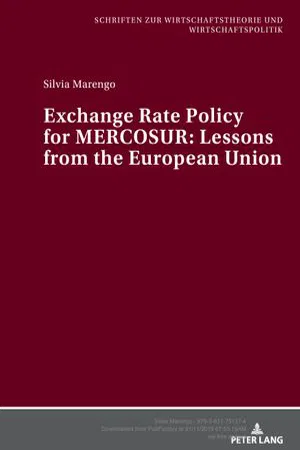
eBook - PDF
Exchange Rate Policy for MERCOSUR:- Lessons from the European Union (Volume 9.0)
- 250 pages
- English
- PDF
- Available on iOS & Android
eBook - PDF
Exchange Rate Policy for MERCOSUR:- Lessons from the European Union (Volume 9.0)
About this book
Information
Subtopic
Economic TheoryIndex
EconomicsTable of contents
- Cover
- LIST OF TABLES
- LIST OF FIGURES
- LIST OF CHARTS
- 1. CHAPTER 1: OVERVIEW
- 2. CHAPTER 2: A THEORETICAL APPROACH
- 3. CHAPTER 3: LESSONS FROM THE EUROPEAN EXPERIENCE: THE EMS AS AN INSTRUMENT TO ACHIEVE PRICE AND EXCHANGE RATE STABILITY
- 4. CHAPTER 4: THE LATIN AMERICAN EXPERIENCE
- 5. CHAPTER 5: CONCLUSIONS AND ECONOMIC POLICY RECOMMENDATIONS
- 6 REFERENCES
Trusted by 375,005 students
Access to over 1.5 million titles for a fair monthly price.
Study more efficiently using our study tools.
Frequently asked questions
Yes, you can cancel anytime from the Subscription tab in your account settings on the Perlego website. Your subscription will stay active until the end of your current billing period. Learn how to cancel your subscription
No, books cannot be downloaded as external files, such as PDFs, for use outside of Perlego. However, you can download books within the Perlego app for offline reading on mobile or tablet. Learn how to download books offline
Perlego offers two plans: Essential and Complete
- Essential is ideal for learners and professionals who enjoy exploring a wide range of subjects. Access the Essential Library with 800,000+ trusted titles and best-sellers across business, personal growth, and the humanities. Includes unlimited reading time and Standard Read Aloud voice.
- Complete: Perfect for advanced learners and researchers needing full, unrestricted access. Unlock 1.5M+ books across hundreds of subjects, including academic and specialized titles. The Complete Plan also includes advanced features like Premium Read Aloud and Research Assistant.
We are an online textbook subscription service, where you can get access to an entire online library for less than the price of a single book per month. With over 1.5 million books across 990+ topics, we’ve got you covered! Learn about our mission
Look out for the read-aloud symbol on your next book to see if you can listen to it. The read-aloud tool reads text aloud for you, highlighting the text as it is being read. You can pause it, speed it up and slow it down. Learn more about Read Aloud
Yes! You can use the Perlego app on both iOS and Android devices to read anytime, anywhere — even offline. Perfect for commutes or when you’re on the go.
Please note we cannot support devices running on iOS 13 and Android 7 or earlier. Learn more about using the app
Please note we cannot support devices running on iOS 13 and Android 7 or earlier. Learn more about using the app
Yes, you can access Exchange Rate Policy for MERCOSUR:- Lessons from the European Union (Volume 9.0) by Silvia Marengo in PDF and/or ePUB format, as well as other popular books in Economics & Economic Theory. We have over 1.5 million books available in our catalogue for you to explore.