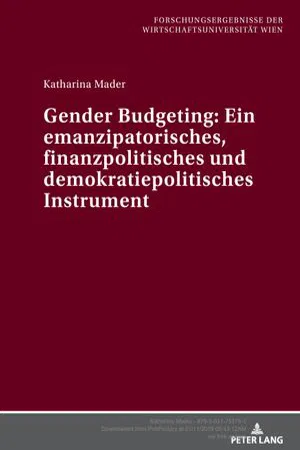
In den letzen Jahren rückten vielfältige Gender Budgeting-Initiativen in den öffentlichen Fokus, die das Ziel hatten, die Gleichstellung von Frauen und Männern zu fördern. Ihnen wird ein großes emanzipatorisches und demokratisches Potential zugeschrieben. Während der Demokratisierungsanspruch zwar häufig betont wird, stellen die Definition und Präzisierung von Demokratie bzw. Demokratisierung bislang weitgehend unbehandelte Bereiche dar. Daher zielt die Arbeit darauf ab, die theoretische Fundierung von Gender Budgeting zu vertiefen und damit einen Beitrag zu einer geschlechtergerechten und emanzipatorischen Demokratisierung der Finanzpolitik zu leisten. Mit Hilfe einer Qualitativen Inhaltsanalyse wird eine Untersuchung feministisch-demokratietheoretischer Überlegungen vorgenommen, um daraus einen Kriterienkatalog zu entwickeln. Dieser wird anschließend in den Budgetprozess integriert, um ein Modell eines feministisch-demokratischen Budgetprozesses beispielhaft anhand des Wiener Budgetkreislaufes zu entwerfen.
eBook - PDF
Gender Budgeting: Ein emanzipatorisches, finanzpolitisches und demokratiepolitisches Instrument (Volume 31.0)
- 198 pages
- English
- PDF
- Available on iOS & Android
eBook - PDF
Gender Budgeting: Ein emanzipatorisches, finanzpolitisches und demokratiepolitisches Instrument (Volume 31.0)
About this book
Information
Subtopic
Economic TheoryIndex
EconomicsTable of contents
- Cover
- Abbildungs- und Tabellenverzeichnis
- 1 Einleitung
- 2 Begriffsklärungen und -abgrenzungen
- 3 Budgets und die Forderung nach Demokratisierung der Finanz- und Wirtschaftspolitik
- 4 Demokratieverständnis und -konzept für Gender Budgeting: Ein Kriterienkatalog feministischer Demokratietheorien
- 5 Integration feministischer Demokratiekriterien in den Wiener Budgetprozess
- 6 Fazit und weiterer Forschungsbedarf
- Literatur
Trusted by 375,005 students
Access to over 1.5 million titles for a fair monthly price.
Study more efficiently using our study tools.
Frequently asked questions
Yes, you can cancel anytime from the Subscription tab in your account settings on the Perlego website. Your subscription will stay active until the end of your current billing period. Learn how to cancel your subscription
No, books cannot be downloaded as external files, such as PDFs, for use outside of Perlego. However, you can download books within the Perlego app for offline reading on mobile or tablet. Learn how to download books offline
Perlego offers two plans: Essential and Complete
- Essential is ideal for learners and professionals who enjoy exploring a wide range of subjects. Access the Essential Library with 800,000+ trusted titles and best-sellers across business, personal growth, and the humanities. Includes unlimited reading time and Standard Read Aloud voice.
- Complete: Perfect for advanced learners and researchers needing full, unrestricted access. Unlock 1.5M+ books across hundreds of subjects, including academic and specialized titles. The Complete Plan also includes advanced features like Premium Read Aloud and Research Assistant.
We are an online textbook subscription service, where you can get access to an entire online library for less than the price of a single book per month. With over 1.5 million books across 990+ topics, we’ve got you covered! Learn about our mission
Look out for the read-aloud symbol on your next book to see if you can listen to it. The read-aloud tool reads text aloud for you, highlighting the text as it is being read. You can pause it, speed it up and slow it down. Learn more about Read Aloud
Yes! You can use the Perlego app on both iOS and Android devices to read anytime, anywhere — even offline. Perfect for commutes or when you’re on the go.
Please note we cannot support devices running on iOS 13 and Android 7 or earlier. Learn more about using the app
Please note we cannot support devices running on iOS 13 and Android 7 or earlier. Learn more about using the app
Yes, you can access Gender Budgeting: Ein emanzipatorisches, finanzpolitisches und demokratiepolitisches Instrument (Volume 31.0) by Katharina Mader in PDF and/or ePUB format, as well as other popular books in Economics & Economic Theory. We have over 1.5 million books available in our catalogue for you to explore.