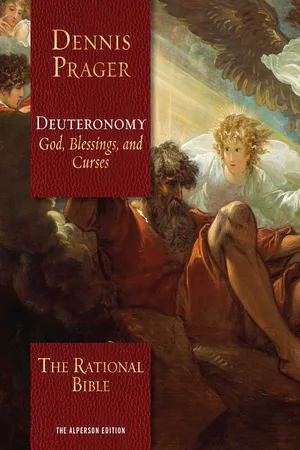
Is the Bible, the most influential book in world history, still relevant?
Why do people dismiss it as being irrelevant, irrational, immoral, or all of these things?
This explanation of the Book of Deuteronomy, the fifth book of the Bible, will demonstrate how it remains profoundly relevant—both to the great issues of our day and to each individual life.
Do you doubt the existence of God because you think believing in God is irrational? This book will cause you to reexamine your doubts.
The title of this commentary is The Rational Bible because its approach is entirely reason-based. The reader is never asked to accept anything on faith alone. In Dennis Prager’s words, “If something I write is not rational, I have not done my job.”
The Rational Bible is the fruit of Prager’s forty years of teaching to people of every faith and no faith at all. On virtually every page, you will discover how the text relates to the contemporary world in general and to you on a personal level.
His goal: to change your mind—and, as a result, to change your life.
Frequently asked questions
Yes, you can cancel anytime from the Subscription tab in your account settings on the Perlego website. Your subscription will stay active until the end of your current billing period. Learn how to cancel your subscription.
No, books cannot be downloaded as external files, such as PDFs, for use outside of Perlego. However, you can download books within the Perlego app for offline reading on mobile or tablet. Learn more here.
Perlego offers two plans: Essential and Complete
Essential is ideal for learners and professionals who enjoy exploring a wide range of subjects. Access the Essential Library with 800,000+ trusted titles and best-sellers across business, personal growth, and the humanities. Includes unlimited reading time and Standard Read Aloud voice.
Complete: Perfect for advanced learners and researchers needing full, unrestricted access. Unlock 1.4M+ books across hundreds of subjects, including academic and specialized titles. The Complete Plan also includes advanced features like Premium Read Aloud and Research Assistant.
Both plans are available with monthly, semester, or annual billing cycles.
We are an online textbook subscription service, where you can get access to an entire online library for less than the price of a single book per month. With over 1 million books across 1000+ topics, weāve got you covered! Learn more here.
Look out for the read-aloud symbol on your next book to see if you can listen to it. The read-aloud tool reads text aloud for you, highlighting the text as it is being read. You can pause it, speed it up and slow it down. Learn more here.
Yes! You can use the Perlego app on both iOS or Android devices to read anytime, anywhere ā even offline. Perfect for commutes or when youāre on the go. Please note we cannot support devices running on iOS 13 and Android 7 or earlier. Learn more about using the app.
Yes, you can access The Rational Bible: Deuteronomy by Dennis Prager in PDF and/or ePUB format, as well as other popular books in Theology & Religion & Biblical Studies. We have over one million books available in our catalogue for you to explore.
This is the last of the five books of the Torah, the most influential body of literature in history. Deuteronomy is particularly significant because it is, in effect, Mosesās last will and testament to Israel and, for that matter, to the world.
The name Deuteronomy comes from the Greek words for āsecond lawā or āsecond teachingā (deuteros = second; nomos = law). Moses himself describes this book as a āsecond teachingā (Deuteronomy 17:18), which is how ancient Jews referred to the book. It is the āsecond teachingā because it is Mosesās review of many of the laws found in the previous books of the Torah (as well as additional laws and teachings).
Just about every aspect of lifeāreligion, morality, happiness, anger, judgmentāis contained in Deuteronomy. And the most important document of the Bible, the Ten Commandments, is repeated here.
As there is virtually no narrative in Deuteronomyāonly laws and beliefsāit is not necessary to read Deuteronomy straight through. I therefore suggest that general readers (as opposed to students of the Bible) first look for subject headings that interest them and proceed from there.
WHY MOSES INTRODUCED NEW LAWS AND NEW IDEAS
1.1 These are the words that Moses addressed to all Israel
Deuteronomy consists of three final addresses given by Moses to the Israelites. In addition to reviewing laws and giving new laws, he offered his perspective on the peopleās travels and travails. Deuteronomy is, therefore, composed overwhelmingly of Mosesās words. But due to Mosesās uniquely close relationship with GodāāNever again did there arise in Israel a prophet like Moses whom the Lord singled out face to faceā (Deuteronomy 34:10)āthese words can be regarded as having divine approval for inclusion in the Torah.
As to why Moses gave new commandments in Deuteronomy, the Bible commentator Nachmanides (Ramban, 1194ā1270, Spain and Israel) explained: āThe reason the new commandments were not mentioned in earlier books⦠is that perhaps these commandments, though incumbent on the individual wherever he might be, were not actually practiced until they entered the land. Moses did not mention them until it was time for the generations of those who left Egypt to take possession of the land.ā
Thus, for example, Moses introduced certain offerings to be brought to the Temple with the words, āWhen you enter the land which I am giving you to settle inā¦ā (Numbers 15:2, emphasis added). So, then, my understanding of Deuteronomy is that it consists of Mosesās words (except when God is directly quoted). No matter when or how it was written, it has the divine imprimatur, and is therefore part of the Torah.
DID MOSES WRITE EVERY WORD OF DEUTERONOMY?
on the other side of the Jordan
The words āon the other side of the Jordan [River]ā have presented scholars, both modern and medieval, with an obvious question. The medieval Bible scholar Ibn Ezra (1089ā1167, Spain) posed the question this way: If Moses wrote every word in the Torah, why would he use the phrase āon the other side of the Jordanā? That implied that Moses was writing from inside the Jordan River, i.e., Israelānot āthe other side.ā But Moses was never in Israel.
Citing Ibn Ezra, the British Jewish theologian Louis Jacobs wrote: āThis expression makes sense only to someone writing in Israel, which Moses never entered. This would appear to suggest some parts of the Torah were written after Moses. Ibn Ezra appears to accept this, but because it is a very radical departure from the tradition [that Moses wrote the Torah], he remarks on it only by hint.ā1
There are two ways of dealing with the dilemma cited by Ibn Ezra.2 One is that Moses could simply have written whatever God instructed him to write, including writing of the Canaanites in the past tense (āAnd the Canaanite was then in the landāāGenesis 12:6), as well as details of his own death and burial. The other is to accept that Joshua or someone else wrote some of the Torahās words after Mosesās death.
As I write in the introduction, I am not concerned with the who or how of the Torahās composition. I am concerned that it be regarded as a divine document. That is what matters.
āthrough the wilderness, in the Arabah near Suph, between Paran and Tophel, Laban, Hazeroth, and Di-zahab.
1.2 It is eleven days from Horeb to Kadesh-barnea by the Mount Seir route.ā
The Hebrew Bible uses Horeb interchangeably with Mount Sinai.
Kadesh-barnea is at the entrance to the southern border of Canaan. Moses stated that it takes only eleven days to get there from Sinai. The reason he did so is obvious. In the words of the ancient rabbinic commentary Sifre, āHad Israel been worthy, they could have entered the Land within eleven days; but they were sadly found wanting, and they drew upon themselves the punishment of forty yearsā wandering.ā
1.3 It was in the fortieth year, on the first day of the eleventh month, that Moses addressed the Israelites in accordance with the instructions that the Lord had given him for them,
1.4 after he had defeated Sihon king of the Amorites, who dwelt in Heshbon, and King Og of Bashan, who dwelt at Ashtaroth [and] Edrei.
The Hebrew of this verse is ambiguous: Is Moses or God credited with defeating Sihon? This English translation spells āheā with a lowercase āh,ā meaning the translators believe the reference is to Moses. In any case, Moses mentions these victories to remind the Israelites of all that God did for them.
The Torahās description of the defeat of Sihon and Og is in the Book of Numbers, the book immediately preceding Deuteronomy (Numbers 21:21ā35; see also Numbers 32:33). Although Moses alludes to this victory yet again in Deuteronomy 3, the story of the conquest of Canaan is related in the Book of Joshua, the biblical book immediately following Deuteronomy.
ON THE NEED TO EXPLAIN THE TORAH
1.5 On the other side of the Jordan, in the land of Moab, Moses undertook to expound this Teaching.
The most revered Jewish Bible commentator, Rashi (1040ā1105, France), wrote that the meaning of āexpound this Torah (āTeachingā)ā here and in Deuteronomy 27:8 was that Moses had the Torah translated into seventy languages. āSeventy nationsā is the traditional way of referring to all the worldās nations.3 In other words, Jews are obligated to bring the Torah to the world. And since the worldās nations will relate only to a text that is perceived as rational, it is imperative to explain (āexpoundā) the Torahāand its laws. The entire premise of this commentary, The Rational Bibleāthat the Torah is to be explained to the world if there is any chance of goodness prevailing on Earthāis not some idiosyncratic view of mine, but the normative view of Jews going back thousands of years.
The related question of whether one should seek rational explanations for all the Torahās laws is the subject of three extended essays:
āDo People Need to Understand Religious Rituals?ā (Numbers 19:2).
āDo All of the Torahās Laws Have Reasons?ā (Deuteronomy 4:1).
āWhat Does It Mean to Be āWise in the Eyes of the Nationsā?ā (Deuteronomy 4:6).
It is also the subject of the commentary to Deuteronomy 27:8.
MOSESāS FIRST ADDRESS
He said:
This marks the beginning of Mosesās first address, which lasts until Deuteronomy 4:40.
1.6 The Lord our God spoke to us at Horeb, saying: You have stayed long enough at this mountain.
1.7 Start out and make your way to the hill country of the Amorites and to all their neighbors in the Arabah, the hill country, the Shephelah, the Negeb, the seacoast, the land of the Canaanites, and the Lebanon, as far as the Great River, the river Euphrates.
1.8 See, I place the land at your disposal. Go, take possession of the land that the Lord swore to your fathers, Abraham, Isaac, and Jacob, to assign to them and to their heirs after them.
As noted on a number of occasions, the purpose of taking possession of the Promised Land was to enable the Israelites to build a society that would be a ālight unto the nationsā (Isaiah 49:6). Therefore, if the Israelites engaged in immoral behavior, they too would be dispossessed (see, for example, Leviticus 18:28).
1.9 Thereupon I said to you, āI cannot bear the burden of you by myself.
Moses said, āI said to you at that timeā (italics added), even though most of the people he was addressing were not alive at the time he was discussing. Moses spoke this way throughout his address, mixing past, present, and future generations, because he was addressing every generation who will ever read Deuteronomy.
In the words of Bible scholar Richard Elliott Friedman (professor of Jewish Studies at the University of Georgia): āThe concept of a ānationā or āpeopleā is a fluid one, crossing lines of generations. Like a river, which is constantly being made up of new molecules of water yet is always the same river⦠so a people retains its identity even though its individual members are constantly changing over time.ā4
1.10 The Lord your God has multiplied you until you are today as numerous as the stars in the sky.ā
āNumerous as the stars in the skyā is an expression, not a literal statement. See the commentary to Genesis 22:17.
1.11 May the Lord, the God of your fathers, increase your numbers a thousandfold, and bless you as He promised you.ā
Although Moses asserted that the Israelitesā great numbers became a burden, he nonetheless asked God to continue to increase their numbers. Despite his periodic exasperation and anger with the Israelites, Moses remained their great advocate.
1.12 How can I bear unaided the trouble of you, and the burden, and the bickering!
Of all the problems the Israelites presented to Moses, it was their constant arguing (ābickeringā here) and complaining that most angered him. Anyone who lives with a querulous individual at home or at work can well understand Moses.
ESSAY: A GOOD SOCIETY IS UNATTAINABLE WITHOUT WISDOM
1.13 Pick from each of your tribes men who are wise, discerning, and experienced, and I will appoint them as your heads.ā
In Mosesās recounting, God did not tell him to pick good men to be leaders. Wouldnāt being a good person be one of the major attributes, if not the major attribute, one would seek in a leader? While the Torah takes for granted that a leader should be a good person, goodness is not sufficient. That is why all three traits listed here concern wisdom. There is an extraordinarily important lesson hereāone of the most important in the Torah and in life: A good society is unattainable without wisdom.
That is why God told Moses to choose wise men rather than good men. There have always been people who were personally goodāindividuals who had good intentions and even a kindly dispositionāwho enabled evil to prevail.
Let me offer two examples, one personal and one global.
I have interviewed recovering drug and alcohol addicts, many of whom told me one reason they continued their drug or alcohol use was that their family enabled them. People who enable addicts often hurt them. This damage is done by people with good and loving intentions.
Quite aside from addiction, parents who coddle or spoil their children donāt necessarily lack goodness or good intentions; they lack wisdom.
In the global sphere, the most obvious modern example of the devastating effects of good intentions without wisdom has been communism, which killed about one hundred million innocent people, non-combatants all, and enslaved a billion more. Communist tyrants had tens of millions of supporters within their countries and around the world. Most communist leaders were power-hungry, cruel, and evil people, and many of their supporters were immoral sycophants. But a significant number of people supported communism because they thought it would make a better world.
For many of its supporters, communism was rooted in a desire to do good. The many millions of people all over the world who supported communism did not think they were supporting unprecedented levels of mass murder and torture, or the near-total deprivation of the most fundamental human rights for a substantial percentage of humanity. They thought they were supporting the creation of a beautiful future for humanity. They were convinced the moral arc of history was bending in their direct...