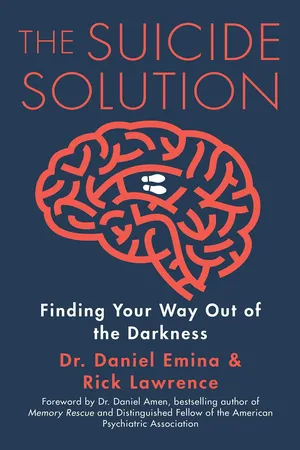
The Suicide Solution
eBook - ePub

The Suicide Solution

Finding Your Way Out of the Darkness

  1. 208 pages
  2. English
  3. ePUB (mobile friendly)
  4. Available on iOS & Android
eBook - ePub

The Suicide Solution

Finding Your Way Out of the Darkness

About this book

This is a book for people who are struggling to find their way out of a cave of anxiety, depression, and suicidal thoughts—and for anyone who cares for someone who’s been lost in that cave.

Suicide is now the leading cause of death among young adults 18-34, and the fourth-leading cause of death among the middle-aged.

Just as a computer’s hardware determines its foundational capabilities and its software determines how it interfaces with the world, humans’ hardware is tied to our biology and our software dictates how we relate to others and ourselves. Together, these parts of our identity determine our functionality, limitations, and possibilities.

We become the story we have decided to live inside. When Jesus said, “I have come to set captives free,” He meant that He came to “de-bug” our programming. Jesus invites us to partner with Him to bring to the surface and then move past our debilitating bugs.

This book is a conversation between a minister and a psychiatrist. Informed by the clinical realities of anxiety, depression, and suicide, the authors draw from the transformational relational strategies of Jesus to chart a path into life and freedom.
Frequently asked questions

Yes, you can cancel anytime from the Subscription tab in your account settings on the Perlego website. Your subscription will stay active until the end of your current billing period. Learn how to cancel your subscription.
No, books cannot be downloaded as external files, such as PDFs, for use outside of Perlego. However, you can download books within the Perlego app for offline reading on mobile or tablet. Learn more here.
Perlego offers two plans: Essential and Complete
  • Essential is ideal for learners and professionals who enjoy exploring a wide range of subjects. Access the Essential Library with 800,000+ trusted titles and best-sellers across business, personal growth, and the humanities. Includes unlimited reading time and Standard Read Aloud voice.
  • Complete: Perfect for advanced learners and researchers needing full, unrestricted access. Unlock 1.4M+ books across hundreds of subjects, including academic and specialized titles. The Complete Plan also includes advanced features like Premium Read Aloud and Research Assistant.
Both plans are available with monthly, semester, or annual billing cycles.
We are an online textbook subscription service, where you can get access to an entire online library for less than the price of a single book per month. With over 1 million books across 1000+ topics, we’ve got you covered! Learn more here.
Look out for the read-aloud symbol on your next book to see if you can listen to it. The read-aloud tool reads text aloud for you, highlighting the text as it is being read. You can pause it, speed it up and slow it down. Learn more here.
Yes! You can use the Perlego app on both iOS or Android devices to read anytime, anywhere — even offline. Perfect for commutes or when you’re on the go.
Please note we cannot support devices running on iOS 13 and Android 7 or earlier. Learn more about using the app.
Yes, you can access The Suicide Solution by Daniel Emina,Rick Lawrence in PDF and/or ePUB format, as well as other popular books in Theology & Religion & Mental Health in Psychology. We have over one million books available in our catalogue for you to explore.

PART ONE PREFACE IT’S A HARDWARE/SOFTWARE PROBLEM

Every fourteen minutes, someone dies by suicide in the United States. It’s the tenth leading cause of death overall and the second leading cause of death for those ten to thirty-four years of age.1 Soon, if this nasty trajectory perpetuates, suicide will eclipse “unintentional injury” as the #1 killer of teenagers. Since 1999, suicide has increased by 33 percent, decreasing our overall life expectancy, while deaths from cancer during the same period have dropped by 27 percent.2 More broadly, average life expectancy in the U.S. has declined for three straight years—fed by a higher death rate among “working-age” Americans between twenty-five and sixty-four, whose deaths are linked primarily to drug overdoses, suicides, and alcohol-related diseases. The United States is the only wealthy country in the world that is experiencing this trend.3
Half of all Americans will struggle with a mental health issue at some point in their lives, according to a large epidemiological study. Anxiety disorders (28 percent), depression (21 percent), impulse control disorders (25 percent), and substance use disorders (15 percent) are the most common. Half of all these conditions start by age fourteen, and 75 percent start by age twenty-four.4
I (Daniel) have worked at the Amen Clinics for close to a decade. During this intense season of research and practice, the boundaries of my training in psychiatry have expanded far beyond what I learned in my years as a general psychiatry resident and during my child and adolescent psychiatry fellowship. At the Amen Clinics, we approach treatment with a foundational belief that each person is born with a purpose. We see brain health as a vital part of achieving this purpose. We believe that if your brain works right, you work right. We leverage our lessons from neuroimaging (SPECT scans), combined with a functional medicine approach, to shift the focus from “mental health issues” to “brain health issues.” This shift has been transformative. It reframes our approach to treating serious psychological dysfunctions, including suicide, from the perspective of “fault-based” to “medical condition–based.” If suicidal ideation is predictable and treatable, then we can intervene to prevent its consequences the same way we intervene in the processes that lead to high blood pressure, diabetes, or obesity. In other words, we can “flatten the curve” of the suicidality epidemic.
In the Old Testament, the people of God constructed a Temple to house the presence of God; we who live under the “New Covenant” offer our own bodies as “the temple of the Holy Spirit.” Paul reminds us: “Don’t you realize that your body is the temple of the Holy Spirit, who lives in you and was given to you by God?” (1 Corinthians 6:19). We are caretakers of the New Temple, and the stability of our “housing” is determined by our hardware and software. Corruption in either one, resulting in brain illness, compromises the foundation of the house. And God wants the house that He lives in to stand in the face of struggle and disappointment and trauma: “Though the rain comes in torrents and the floodwaters rise and the winds beat against that house, it won’t collapse because it is built on bedrock” (Matthew 7:25).
I (Rick) have been studying, teaching, and living by the practices and priorities of Jesus for decades. I’m the general editor of Jesus-Centered Bible, host of the podcast Paying Ridiculous Attention to Jesus, and the author of more than thirty books and curricula, all focusing on the “most-known, least-known” person in human history. In 2013, Time magazine’s editors named Jesus “the most significant person in history.” He is Messiah to millions and “great teacher” or “spiritual leader” to millions more. But Jesus would describe Himself differently. His mission on Earth, of course, was to sacrifice His Son-of-God life to pay the price for our sin and build a bridge back to make it possible for us to have an intimate relationship with God. But more broadly, He came to restore our fundamental humanity—our created-in-the-image-of-God wholeness.
At the beginning of His ministry, He gathered a large crowd on the side of a hill in Galilee and painted for them an epic canvas of what a full, healthy life actually looked like. “The Beatitudes,” the prelude to what we now call “The Sermon on the Mount” (Matthew 5 and 6), is a series of eight broad blessings, all beginning with “Blessed are those who…” But these “blessings” are actually carefully chosen markers for building and maintaining a healthy, stable temple of the Holy Spirit. Over the next two chapters, He switched from a wide-angle to a telephoto lens—pinpointing what health looks like in relationships, self-care, finances, self-esteem, and spiritual maturity. To close out this thundering, poetic invitation into the “abundant life,” Jesus revealed what sort of fruit a life infected by the “standards and practices” of His home culture, the Kingdom of God, produces:
That is why I tell you not to worry about everyday life—whether you have enough food and drink, or enough clothes to wear. Isn’t life more than food, and your body more than clothing? Look at the birds. They don’t plant or harvest or store food in barns, for your heavenly Father feeds them. And aren’t you far more valuable to him than they are? Can all your worries add a single moment to your life? And why worry about your clothing? Look at the lilies of the field and how they grow. They don’t work or make their clothing, yet Solomon in all his glory was not dressed as beautifully as they are. And if God cares so wonderfully for wildflowers that are here today and thrown into the fire tomorrow, he will certainly care for you. Why do you have so little faith?
So don’t worry about these things, saying, “What will we eat? What will we drink? What will we wear?” These things dominate the thoughts of unbelievers, but your heavenly Father already knows all your needs. Seek the Kingdom of God above all else, and live righteously, and he will give you everything you need. (Matthew 6:25–33)
A healthy temple, then, is characterized by trust, not anxiety. A pervading sense of well-being in the face of need. A determination to hope that “leavens” circumstantial darkness. And peace, peace, peace of… mind.
Jesus invites us to love Him with “all [our] heart, soul, mind, and strength” (Mark 12:30)—and “all” translates to hardware and software restored into wholeness. Healthy brains beget healthy minds. And a healthy brain—like a healthy body or healthy spiritual life or healthy psychology—is the product of a fitness mentality. The function of our brain is not fixed; it constantly changes in the context of biological influences, psychological influences, social influences, and spiritual influences.
Depression, anxiety, and suicide can be related to our traumas, our learned way of thinking, or our genetic risks. And at Amen Clinics, we’ve discovered other contributors—head injuries, exposure to mold or environmental toxins, severe gut-health issues, and even infectious diseases such as Lyme or toxoplasmosis. These factors compromise the function of a brain, leading to symptoms like depression, anxiety, memory problems, focus problems, and suicidality.
It only makes sense that the One who created our biology and our psychology is the most qualified to offer us tech support when bugs infect our brain. Redemption is broader and deeper than a ticket to Heaven; Jesus intends to first surface what has caused us to be stuck in patterns of self-destruction, then restore our operating system to wholeness.
We begin by focusing on how our hardware and software work together to create healthy wholeness and what happens when something goes awry with either—or both.

CHAPTER 1 AN ESSENTIAL GUIDE TO THE STUCK BRAIN

What We Know about the Biological and Psychological Triggers for Suicide and Why Some Are More Vulnerable to Them Than Others
Imagine your brain is a car making its way down a rutted dirt road after a heavy rain. Your tires bounce in and out of potholes and slide side-to-side on the muddy route. It’s a rough ride; sometimes your steering wheel has a mind of its own. Let’s say the potholes represent the expected ups and downs we all experience on life’s messy roads—disappointments, painful experiences, stress, loneliness, and even trauma.
Driving that car through the muddy ruts is challenging. You’re trying to avoid the worst of the hazards and keep the momentum going as your suspension takes a beating. And then, just ahead, you see a wide rut filled with water—so you slow down to avoid damaging your car as you drive into it. But the hole is so deep that your car high-centers and your tires lose traction. It feels like a chasm, not a rut. You “gun” your engine in an attempt to vault out of it, but the squealing tires quickly dig a deeper hole. The harder you try, the deeper you sink. You try to reverse out of the hole, but that doesn’t work either. Soon you are hopelessly stuck. With no way out and no one who can (or will) help, you consider abandoning your car altogether.
This is what it’s like to “drive” a brain that finds itself stuck in a psychological pothole. It’s a desperate feeling—frustrating and frightening and (eventually) hopeless. However, if we understand better how our car (or brain) gets stuck in the first place, we can learn how to avoid or navigate the deeper potholes on our rutted roads and keep moving through life’s obstacles toward our destination. And even when we do get stuck, we can learn how to move past hopelessness to embrace strategies that will help us get unstuck. But before we explore the mechanics of a stuck brain, three stories will help us to put “skin” on the dangers facing those who know firsthand what happens when your car can’t make it out of a pothole.

Julia’s* Story

For years, my (Rick’s) wife and I traveled a pitted road with a close friend (let’s call her Julia) whose husband was psychologically abusive and controlling. As she grew to trust us, and as she came to know Jesus more deeply through our relationship, Julia shared more details about her reality and pleaded with us for advice. We were, of course, alarmed by her situation, but we knew she’d have to choose her own way out of it—we could not decide for her. We told her the truth: that she was living in an abusive situation that was not likely to get better, but we couldn’t determine when “too much was too much.” So for a long time, she wavered between making the best of a horrible situation and getting out altogether. Finally, one day while her husband was at work, she franticly packed her things and readied her young daughter to move into a friend’s basement apartment. After a month there, we found her a house-sitting arrangement that guaranteed her safety for another six months.
At first, Julia seemed to be moving toward independence in her life—she started a job search, kept up her devotional reading and Bible study, and tried to recover from years of tension and fear. But slowly, our contact with her inexplicably decreased—she became distant and “fuzzy” in her interactions with us. At the end of those six months, she made the decision to move back into her home with her husband, telling us only after she was back with him again. And then, a few weeks later, she showed up on our doorstep with an armload of her journals and other personal papers. She said she wanted us to have them so that others would know “the true me” after she was gone. It was time to intervene:
“Julia, are you thinking of ending your life?” I asked.
Her eyes filled with tears and she gave me a slight nod.
“Do you have a plan you’ve worked out?”
Again, a slight nod.
“Can you please tell me your plan?”
In a soft, matter-of-fact voice, she described her strategy and timeline. I told her we needed to get her some help, right then. She looked perplexed, as if in a trance. I told her we’d like to take her to a hospital emergency room for her own safety. She nodded in agreement. I asked if I could have her phone, and she gave it to me. That seemed to startle her awake:
“I have to call my husband and tell him,” she said.
I gently deferred: “How about you call him after we have you checked in at the hospital?”
We knew that if she called him first, he would prevent her from getting the help she needed. He was a violent man with a short fuse.
So we took Julia to the hospital, got her checked in, and then I gave her phone back (her husband had been trying to contact her the whole time). She called right away, explained where she was, and got off the phone. By the time he came rushing into the ER waiting room, she had already been admitted. The hospital staff understood the situation, and they told her husband he could not visit her yet. So he sat across the waiting room and glared at us, seething over our “betrayal.”
For the next few months, our friend was treated first in a hospital setting and then in an outpatient facility. We tried to visit, but her husband threatened us with violence, and the tension he generated was so thick that Julia grew to dread our check-ins. Eventually, we lost all contact.
From the snippets we’ve heard from others who know her, she now lives like a captive in her own home, occasionally venturing out for “work release.” Over the years, we’ve seen her out in public two or three times. Once, when she was not with her husband, she reached out to embrace my wife and daughter with tears in her eyes, hesitantly grateful to reconnect. But after a few awkward moments, she retreated back inside her vacant shell. Perhaps she has now made peace with the hell she lives in; perhaps the experience has diminished her husband’s abusive behavior. Or maybe she murdered her soul so the rest of her could survive. In the season of our close friendship, we helped to push and pull her car out of the deep rut she’d fallen into, but once she was free, the “pull of the rut” was too strong, and she shifted into reverse, backing into her familiar “stuckness.”
Julia has lost her way—“confused and helpless, like [a] sheep without a shepherd” (Matthew 9:36). But Jesus understands the psychology of stuckness (“If the light you think you have is actually darkness, how deep that darkness is!” Matthew 6:23), and He is determined to invite those who are captive to it into freedom.

Zane’s* Story

My (Daniel’s) friend Zane is a social worker and a counseling patient who knows “how deep the darkness” can get. His journey out of captivity into freedom has been long and frightful. In his own words, this is what it feels like to follow Jesus out of the valley of the shadow of death.
As someone who dealt with intermittent suicidal ideations for roughly twenty years, one of the most powerful words for me has been “survivor.” There were days I had to tell myself: If I get through the day and don’t take my life then that is a victory. If I don’t go buy that gun, if I don’t use that knife, if I don’t jerk that steering wheel into oncoming traffic, if I don’t hang myself, if I don’t put that hose in my car’s tailpipe, if I don’t go into the garage and start the car, if I don’t jump off that cliff or overpass, if I don’t swallow all those pills, then that is a victory.
I was determined to make it out: I am a survivor and I am going to one day tell people how I survived and...

Table of contents

  1. Cover
  2. Title Page
  3. Foreword
  4. Introduction
  5. Part One Preface: It’s a Hardware/Software Problem
  6. Part Two Preface: Out of the Valley
  7. Epilogue: First Things Last
  8. Appendix A: Help & Resources
  9. Appendix B: Self-Assessments Recommended by Amen Clinics
  10. Acknowledgments
  11. About the Authors
  12. Notes
  13. Copyright