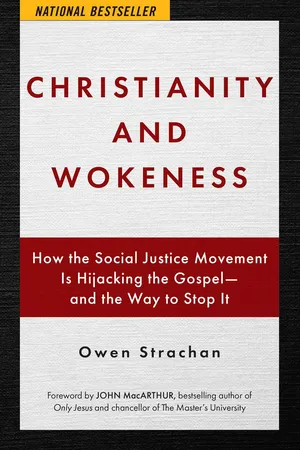
Christianity and Wokeness
eBook - ePub

Christianity and Wokeness

How the Social Justice Movement Is Hijacking the Gospel - and the Way to Stop It

  1. 224 pages
  2. English
  3. ePUB (mobile friendly)
  4. Available on iOS & Android
eBook - ePub

Christianity and Wokeness

How the Social Justice Movement Is Hijacking the Gospel - and the Way to Stop It

About this book

In a world that is "woke," how many Christians are actually awake? This short, theologically sound primer is a resource for pastors, ministry leaders, community leaders, and other thinking Christians that explains carefully and clearly what Critical Race Theory and wokeness truly are, what the Bible teaches about race and ethnicity, why wokeness is distinct from Christianity and should be rejected, and how the church can work for unity based in the gospel of grace.

Owen Strachan is a respected Reformed theologian and thought leader who can help Christians:
  • Better understand Critical Race Theory, something very few do;
  • Understand the high stakes—for the church and society at large—of wokeness as a movement;
  • Think through America’s complex past with nuance and sensitivity;
  • Study how God has made humanity one through the imago Dei;
  • Grasp the beauty of the biblical doctrine of ethnicity and “race”; and
  • Be ready to work for unity in perilous times

Frequently asked questions

Yes, you can cancel anytime from the Subscription tab in your account settings on the Perlego website. Your subscription will stay active until the end of your current billing period. Learn how to cancel your subscription.
At the moment all of our mobile-responsive ePub books are available to download via the app. Most of our PDFs are also available to download and we're working on making the final remaining ones downloadable now. Learn more here.
Perlego offers two plans: Essential and Complete
  • Essential is ideal for learners and professionals who enjoy exploring a wide range of subjects. Access the Essential Library with 800,000+ trusted titles and best-sellers across business, personal growth, and the humanities. Includes unlimited reading time and Standard Read Aloud voice.
  • Complete: Perfect for advanced learners and researchers needing full, unrestricted access. Unlock 1.4M+ books across hundreds of subjects, including academic and specialized titles. The Complete Plan also includes advanced features like Premium Read Aloud and Research Assistant.
Both plans are available with monthly, semester, or annual billing cycles.
We are an online textbook subscription service, where you can get access to an entire online library for less than the price of a single book per month. With over 1 million books across 1000+ topics, we’ve got you covered! Learn more here.
Look out for the read-aloud symbol on your next book to see if you can listen to it. The read-aloud tool reads text aloud for you, highlighting the text as it is being read. You can pause it, speed it up and slow it down. Learn more here.
Yes! You can use the Perlego app on both iOS or Android devices to read anytime, anywhere — even offline. Perfect for commutes or when you’re on the go.
Please note we cannot support devices running on iOS 13 and Android 7 or earlier. Learn more about using the app.
Yes, you can access Christianity and Wokeness by Owen Strachan in PDF and/or ePUB format, as well as other popular books in Theology & Religion & Religion, Politics & State. We have over one million books available in our catalogue for you to explore.

CHAPTER 1 How Wokeness Is Entering the Culture

The Bible is authoritative on everything of which it speaks. Moreover, it speaks of everything.
—Cornelius Van Til
In a famous training session captured on video in 2016, a speaker named Ashleigh Shackelford opposed “racism” in memorable fashion.1 Standing before a room of women, many of them white, Shackelford bluntly told them that “all white people are racists.” Not only that, but she pronounced that they had no real hope of changing: “No, you’re always going to be racist, actually,” she said. “Even when you’re on a path to be a better human being.”
This video went viral. It shocked many and seemed like an outlier a few years ago. In truth, it laid out the core program of the system I call “wokeness.” In this system, there is no grace and no love. There is only grievance, resentment, and condemnation. Shackelford revealed as much in her next comments: “I believe all white people are born into not being human.” She saved her toughest words for last: white people, she said, grow up “to be demons.”
This is strong water even in leftist circles. Yet while Shackelford said some things that her peers might not say (at least, not out loud), her core argument is not at all unusual in woke circles.2 According to standard woke ideology, in general terms “white” people are racist, the historic oppressors of others, and thus as a collective unit, “white” people are guilty.3 As Shackelford made clear, there is no real solution for this guilt; there is only acknowledgement of it, ongoing awareness of it, and the undertaking of certain works to oppose one’s nature as a “white” person.4
What exactly was transpiring in this strange video? Wokeness was advancing. The movement loosely called “wokeness” is now making many inroads into secular society. It is also infiltrating the Church, with many social media users being pulled to affirm wokeness through hashtags, social media statements, and other means. Such action may at first blush seem to fit with a compassionate response to cultural trends, including clashes with police and unrest in different places. Many evangelical leaders argue just this: They claim that wokeness is the way forward for the Church. As we shall see, however, wokeness is a major threat to the Christian faith.
In watching the video mentioned above, and in observing many trends within Christian circles, I could not help but think of a nearly one-hundred-year-old book. In 1923, liberal Christianity was gaining major popularity. Liberalism retained the vocabulary of traditional Christianity but changed the meaning of the terms. Salvation was not primarily about personal salvation, but social change. Man’s core problem was not his own sin, but societal brokenness, political corruption, and economic oppression. Christianity was modified by Harry Emerson Fosdick and the liberal Protestants to remake the public order, not rescue the damned sinner. A hundred years ago, this ideology was entering churches, seminaries, and sound Christian organizations with impunity. Amidst a great uproar, theologian J. Gresham Machen wrote:
[W]hat the liberal theologian has retained after abandoning to the enemy one Christian doctrine after another is not Christianity at all, but a religion which is so entirely different from Christianity as to belong in a distinct category.5
Machen famously defined liberalism not as a different form of Christianity, but as a different thing altogether. Though it used similar terms and sounded like traditional faith, liberal Christianity was “not Christianity at all,” Machen argued. The long tail of twentieth century theology has shown clearly that he was right.
Today, the Church faces a new challenge. Like liberal Protestantism, which denied the historic truthfulness of the faith, supernatural miracles, and a sin-cleansing atonement for individual sinners, wokeness is not merely a different form of Christianity, a remixed version that fits fluidly with conservative evangelical faith. Built on Critical Race Theory (CRT), wokeness uses theological language and even the very system of Christian theology, albeit without any need for grace and God. Wokeness per Machen is thus in a “distinct category” from sound biblical doctrine. Wokeness, in the clearest terms, is not Christianity at all.
In what follows, we will show this by defining what wokeness is not, addressing what it is, and examining what a related discipline called “intersectionality” argues. Our study is not an exhaustive overview of wokeness, CRT, or intersectionality.6 Rather, it is a critique of a late twentieth- and early twenty-first century intellectual and social movement. Though I will touch on tension points and offer critique in places, in this chapter (and Chapter 2), I will generally describe it, rather than deconstruct it.

What Wokeness Is Not

Before we delve further into what wokeness is, though, let’s put a pause on our study. As much as we need to know what wokeness is, we first need to know what wokeness is not. Here are a few stances and convictions that are not woke, despite what you may have heard. The following principles and actions are righteous, stemming from Christian wisdom, not from any worldly system:
  • Wanting societal harmony across backgrounds and skin colors does not make you woke.
  • Wanting peace in fiery settings with a history of ethnic tension does not make you woke.
  • Seeing massive failings in American and Western history, namely long and sustained patterns of racist thought and practice, does not make you woke.
  • Being troubled by Christians’ complicity with racism in the past does not make you woke (on this and the previous point, see Chapter 7).
  • Adopting children from a different region or with a different skin color does not make you woke. Nor does an “interracial” marriage.
  • Grieving the needless deaths of human beings who are made in the image of God and bear God-given dignity and purpose does not make you woke.
  • Doing everything you can and know to do to build bonds with people different from you in various ways does not make you woke.
  • Enjoying global culture and those who differ from your own background does not make you woke.
  • Knowing that Jesus Christ was a Middle Eastern Jew and not a white American with flowing golden locks does not make you woke.
  • Praying for greater diversity in your church through the saving of fellow sinners does not make you woke.
  • Wanting greater justice in a world that is filled with hostility, pain, and injustice does not make you woke.
  • Working to be more thoughtful with one’s language regarding personal differences does not make you woke.
  • Recognizing that you have in yourself the sinful potential to spew the hate of partiality and to act on this in short-term or long-term ways does not make you woke.
  • Identifying troubling trends of partiality in one’s national, regional, communal, or familial heritage does not make you woke, nor does wanting to leave such evil behind.
  • Rejoicing in Gospel-driven fellowship across all common boundary markers in this world does not make you woke.
These statements matter because many people today are confused about what wokeness is. Many wonder if they are instinctually woke because they hate “racism”7 and ethnocentrism, love humanity as made in God’s image, want to work as much as possible against sin of all kinds, humbly acknowledge their own failings (and troubled societal history), and generally seek unity in the Gospel. But this is not wokeness in action. This is basic biblical Christianity.8
This starting point is very important because Christians must see today that wokeness is not our only option. It is a relatively new and vigorously promoted option, yes. Many folks around us—inside the Church and outside it—are buying into it wholeheartedly. But wokeness does not have the market cornered, and Christians therefore must not confuse a godly approach to one’s ethnicity and background with the adoption of woke thinking and acting.
It’s not hard, though, to see why folks would make this mistake. Here are some reasons why: Critical Race Theory is complicated and has its own language and discourse, and most people do not read many books on complex intellectual movements. Additionally, most people do not track nuanced developments in legal studies. Positively, most people do want civic unity and do grieve the wickedness of past racism. Finally, most people support the police even as they want relations between law enforcement and citizens to improve in different hotspots around the nation.
In such a climate, with wokeness speaking so strongly and with such widespread cultural acceptance today, many Christians may well think that wokeness is the way forward. Many of these people, we note carefully, have noble hearts and good intentions. Nonetheless, the truth is they are in danger. This is not unlike how previous generations faced the devil’s choice of embracing socialism as their operative ethics or being rejected by their non-Christian peers. Embracing this system seemed to make sense, for our world is filled with economic unrest stemming from numerous factors. Yet to embrace an ungodly ideology is to lose Christianity, however long the switchover takes.
Today, we face a similar hard bargain. Many Christians are susceptible to being co-opted by wokeness—their Christianity remaining intact externally, but with a new internal host. Great discernment is needed. After all, do wokeness and Christianity share vocabulary and even a common burden for justice? Yes, this is true. There are surely what I call “connection points” between the two systems of thought and similar usage of terms like justice, love, and unity. But here we must ask: What is justice? What is unity? More broadly, what does it mean to be human? To answer these good questions, we cannot ask the people around us. We cannot learn such higher truth in an afternoon seminar. We have to go to God. We need the teaching of Scripture.
Our dependence on Scripture is intentional and unmissable. Though many today operate as if academic theory and social activism should supplement Christian thought and practice, in truth the Bible is sufficient for these things. (The Bible is sufficient for all things that pertain to life and godliness—see 2 Peter 1:3.) Simply put, the Bible gives us exactly what we need to find unity, hope, and justice in this world. The Bible, furthermore, fuels a life of “scriptural reasoning”—of thinking well about all things according to the conviction that God is God, and everything else is not. We’ll say more there, but our intellectual engagement as Christians must involve: (1) total trust in all that God’s Word teaches and (2) the wise and reasoned application of a biblical worldview to the hard questions around us. That is just what this book will do: we deconstruct our culture’s systems through biblical reasoning (cultural deconstruction) in order to reconstruct a true worldview founded in the Gospel of Christ (Gospel reconstruction).9
All this may sound rather high-flown. So let’s cut straight to the point: The answer to the problems that ail us—and they do really ail us—is not wokeness. It is biblical truth. It is the image of God. It is, above all things, the person and work of Jesus Christ. All this we shall explore in the pages to come.

What Wokeness Is

We have now thought about a few markers that do not signal that you are woke. If the convictions mentioned previously don’t make you woke, though, what does? Wokeness is first and foremost a mindset and a posture. The term itself means that one is “awake” to the true nature of the world when so many are asleep.10 In the most specific terms, this means one sees the comprehensive inequity of our social order and strives to highlight power structures in society that stem from racial privilege.
In intellectual terms, wokeness occurs when one embraces the system of thought mentioned above called Critical Race Theory.11 CRT teaches that all of societal life is structured along racial power dynamics. Race is a “social construct,” according to CRT; it’s not biologically based and exists only in our imagination.12 (Again, I actually agree on this point with CRT proponents due to biblical teaching, not their ideas.) Yet race is America’s original lie that has led to America’s original sin: racism.
Racism occurs when one racial group oppresses, dehumanizes, and demeans another. According to woke voices, this is what “white people” do. Woke theorists and activists argue that America was and is shot through with racism.13 The specific terms capturing this truth are “structural racism” and “systemic racism.”14 It is not only that individuals can say or do racist things; it is that the entire civilizational order is infected with racism. This problem cannot be the application of virtue in any individual sense. Systemic racism can only be addressed through political and economic means.
The intractability of this evil owes to its origins. According to woke history, America originally was rigged to be a power game that only “white” people would win.15 Slavery and Jim Crow perpetuated such inequity. Then and now, white people think of themselves as superior to “black” people; this is the disease of “whiteness.” While “whiteness” is a mentality, it is predominantly believed and practiced by “white people.”16 Such people benefit from a system grounded in “white supremacy” and promote it all the time.17 They do so intentionally, both individually and systemically, through campaigns of violence by police, disproportionate incarceration of minorities, unfair housing decisions, unequal distribution of public resources for schooling and other causes, limited access to health and nutrition, and much more.18 Again, to be clear, CRT theorists and activists argue that a racist America creates these conditions, often purposefully and with intent to d...

Table of contents

  1. Cover
  2. Title Page
  3. Dedication
  4. Foreword
  5. Introduction
  6. Chapter 1: How Wokeness Is Entering the Culture
  7. Chapter 2: How Wokeness Is Entering the Church
  8. Chapter 3: Why Is Wokeness an Ungodly System? Part One: Theological Issues
  9. Chapter 4: Why Is Wokeness an Ungodly System? Part Two: Cultural Issues
  10. Chapter 5: What Does the Bible Teach about Identity and Ethnicity? Part One: Old Testament
  11. Chapter 6: What Does the Bible Teach about Identity and Ethnicity? Part Two: New Testament
  12. Chapter 7: Hard Questions on American History and Other Hot Topics
  13. Acknowledgments
  14. About the Author
  15. Glossary of Terms
  16. Recommended Reading
  17. Bibliography
  18. Index
  19. Copyright