This book explores the inherent social problems with this lifestyle. Examining how Digital Nomadism provides an individualistic fix for an otherwise downwardly-mobile millennial generation, Thompson demonstrates how this generation increasingly postpone markers of adulthood—purchasing a house, getting married, or having children—because of their financial insecurities. Thompson highlights that while being a Digital Nomad can provide a high quality of life while living on the beaches of Thailand, such avenues obscures their inabilities to afford a comfortable lifestyle in their home countries.
eBook - ePub
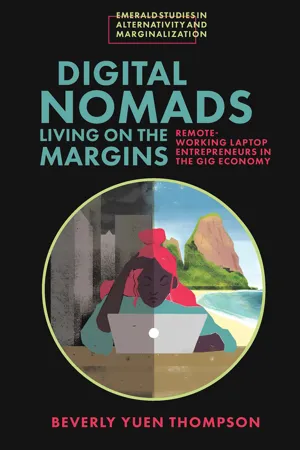
Digital Nomads Living on the Margins
Remote-Working Laptop Entrepreneurs in the Gig Economy
- 168 pages
- English
- ePUB (mobile friendly)
- Available on iOS & Android
eBook - ePub
Digital Nomads Living on the Margins
Remote-Working Laptop Entrepreneurs in the Gig Economy
About this book
In this increasingly neoliberal gig economy, exponentially expanding with technological advances, the ability to work online remotely has led some western millennials to travel the world to work and play, while making a subsistence living as digital platform workers. Digging beneath the superficial newspaper articles that highlight beach-bound, bikinied workers, adorned with laptops, this book asks, what are the social implications of adopting the subcultural lifestyle known as 'Digital Nomadism'?
Information
Chapter 1
Digital Nomads, Liquid Modernity, and the COVID-19 Pandemic
Introduction
Zygmunt Bauman’s (2007) “liquid modernity” – his term to capture the perspective that society was becoming less totalizing and more prone to swift changes or non-linear progressions. Bauman emphasizes an important shift in this society, marking an epoch change, the movement of people from being producers, to consumers. The shift from the gold standard took the material backing out of currency – it shifts to an empty signifier unattached to a material reality. And companies have a powerful role as “persons” in United States law, with the corporate charter to focus solely on maximizing profits, and the larger political will is friendly to bending regulatory laws in their favor (Winkler, 2014). How are workers to position themselves in an economic context where corporations hold all of the power over employee rights, in the American case? The melting of the Keynesian ideal of full and lifelong employment gives way to the gig economy, in which jobs are unpaired from full-time security, benefits, and a future. Each day is its own financial hustle for the micro-entrepreneur. Bauman states that the nomad is the perfect citizen of the liquid society, a stranger in their own land, wandering to find a place for themselves. However, this nomad follows in previously established pathways of tourism often following histories of colonialism, especially in the developing nations. Digital nomads are not refugees, but Westerners with strong passports and resources, just not enough to live as comfortably in their own land as in someone else’s. And the COVID-19 pandemic represents one potential crisis of the liquid times, Naomi Klein’s concept of “disaster capitalism,” is apparent in this pandemic outcome, the outcomes of which always benefit the richest. This chapter overviews Bauman’s (2007) liquid society as a theoretical concept that can help make sense of neoliberalism, the gig economy, and worker’s rights.
Liquid Society
Zygmunt Bauman’s (2007) concept of liquid modernity, as opposed to the concept of post-modernity, is defining a new and distinct epoch. Institutions and concepts of modernity forge onward, hollowed, their promises no longer bearing fruit, but such facts go overlooked as the gaze is directed not toward the factual, but toward the illusion. The workplace and the school retain the organizational similarity to the mass factory, even though industrial production has left the United States decades before. Our expectations still reside in a Keynesian era, even as the austerity of neoliberalism erases such social protections, we remain fixated on the promises of functional government and workers’ rights. Time is liquid precisely because it does not hold its shape. Social forms are liquid “because they decompose and melt faster than the time it takes to cast them, and once they are cast for them to set” (Bauman, 2007, p. 1). We see global despots quickly consolidate their power and control, ensuring their continued domination, at the expense of slashing the survival of millions. Bauman (2012) warns us: “Abandon all hope of totality, future as well as past, you who enter the world of fluid modernity” (p. 21). Not only can people not secure their future paths and that of their children, but even government and corporations cannot plan beyond their next quarter-statement report. As current governments and businesses attempt to plan for multiple different future outcomes of how to maintain profits during times of pandemic and climate catastrophe – we will remain in this liquid uncertainty. Society is abandoned by the state and left to the “inherently unpredictable market forces and/or are left to the private initiative and care of individuals” (Bauman, 2007, p. 2). One major transition that has taken place in late modernity is that “society engages its members primarily in their capacity as consumers rather than producers” (Bauman, 2012, p. 76). Whereas those of previous generations defined themselves based on their professional or employment status. Now, individuals must assess themselves from the perspective of a variety of identity-options, a shopping market of potential identifications, but always from an uncertain, shifting terrain. Bauman offers,
Being modern means being perpetually ahead of oneself, in a state of constant transgression … it also means having an identity which can exist only as an unfulfilled project. In these respects, there is not much to distinguish between the plight of our grandfathers and our own. (2012, p. 28)
The nomad becomes the iconic character of liquid times – a tourist in their own country, a wandering question mark on the global stage of signification.
One of the strongest holdovers from modernity is the logic and relentless drive of industrial capitalism, coupled with the shriveling defenses of the state against such ravages on the workforce and environment. Neoliberal logic sets its sights upon taking public goods and turning them into private profit (Aronowitz & DiFazio, 2010).
In 1971, Richard Nixon’s decision to “unpeg the dollar from precious metals entirely, eliminate the international gold standard, and introduce the system of floating currency regimes has dominated the world economy ever since” (Graeber, 2012, p. 53). Decoupling currency from tangible backing and regulations eventually would give rise to speculative finance and increasingly extreme market volatility (Feher, 2018; Geiselberger, 2017). This development dovetails with privatization of public goods and the increasing indebtedness of individuals (Graeber, 2012; Lazzarato, 2011). Indebtedness as social practice tethers citizens to a corporate controlled life. But, Lazzarato (2011) argues, it is not the free market giving rise to finance, it is that of “injections of astronomical sums of public money” to keep capitalism alive. Through multiple cycles of bailouts that continuously shift wealth from the public to the billionaire class, workers also lose more than money, they lose safety protections (Davis, 2009).
Liquid Employment
The height of affluence for middle-class Americans peaked in the early 1970s and has been in decline ever since. Wages have flat-lined while corporate profits have exploded (Reich, 2013). The technological revolution has contributed to the vast downsizing of the workforce. Once manufacturing provided stable employment for the working class, it was then offshored to other countries for cheaper labor costs and fewer environmental restrictions. The technological revolution allows for some remote work, which could potentially expand corporate access to the global workforce. Touted by proponents as “freedom” for workers to “be their own boss,” the reality reveals a marked lowering of worker income. The gig economy simply does not pay well enough. Makimoto and Manners (1997) did predict that technological skills would be important to achieve “location independence,” in addition to the need for a “healthy bank account.” Indeed, technology contributes to freedom, but the reality shows the opposite. Technology has increased surveillance of all kinds, including those of workers and their data, in addition to fierce propaganda campaigns transported via social media. As Wood (2005) argues, of all the trajectories of technology and society intersections, with the potential for liberation, is instead, “simply a new and rapidly growing ‘phase of capitalist accumulation and commodification’ ” (p. 56).
The Gig Economy
“Late capitalist society is engaged in a long-term historical process of destroying job security, while the virtues of work are ironically and ever more insistently being glorified” (Aronowitz et al., 1998, p. 40). As workers receive fewer wages and benefits, their productivity continuously rises, and the powers of surveillance over their activity are also continuously expanding. The worker is increasingly tethered to their computer regardless of whether they work for a single employer or an app. Rather than relying on a boss’ recommendation letter, platform workers accrue client ratings and recommendations, which have a strong impact on their future access to the platform. As Gandini (2016a, 2016b) and E. B. Duffy (2017) find in their empirical research on freelance remote workers and aspirational workers, their online reputation means everything for their career trajectory. Negative reviews can have an impact on one’s ability to access future work, thus workers must stress over their interactions with each client (De Stefano, 2016, p. 18).
Application-based employers such as Uber and TaskRabbit, are “almost entirely a small number of technology firms backed by large amounts of venture capital” (Slee, 2017, p. 16). Needless to say, such corporate models aim to achieve high profits, not worker freedom. Arun Sundararajan (2016) is a proponent of what he terms “the sharing economy,” and based on his interviews with top corporate leaders, he admits that such an economy will alter employment as we know it:
Crowd based capitalism could radically transform what it means to have a job. Our regulatory landscape will be reshaped. Our social safety net, often funded by corporate employment, will be challenged. The way we finance, produce, distribute, and consume goods, services, and urban infrastructures will evolve. (loc. 244)
He continues:
Important worker protections like health coverage, insurance against workplace injuries, paid vacations, a stable income, and other safeguards often provided or guaranteed by large institutional employers will need to come from other sources. (loc. 4196)
Corporations and governments work together – or fail to regulate – such exploitation of workers. While corporations race to create new and questionable practices of business models and employment, the state is slow to keep pace with regulations. Thus, businesses operate without regulation for years before their models are challenged in the courts. A. Sundararajan (2016) admits that freelancers cannot live off of their meager salaries but brushes off the responsibility – or coupling of work with payment – suggestion that “other sources,” that is, the government, will have to make up for the lack created by the companies. However, neoliberal policies have decimated government budgets with underfunding, coupled with crises of pandemics and environmental disasters. Makimoto and Manners (1997) foresaw this outcome,
Project working makes for high temporary rates of pay followed by financial insecurity, in contrast to remaining for a lifetime at one company in secure employment with predictable pay patterns. (loc. 1701)
The mechanization of app work also has an impact on workers’ experience. De Stefano (2016) points out it “can ‘distort’ the perception businesses and customers may have of these workers and significantly contribute to a perceived dehumanization of their activity” (p. 8). Just as some employment sectors, such as translation, are being replaced by technology, human workers are compared against these automated performances. This translates into work intensification (Kelliher & Anderson, 2010).
Let us return to A. Sundararajan’s (2016) idealistic spin on the outcomes of “the sharing economy”:
A growing number of people worry if this is an early glimpse into a future of work with less reliable benefits and more uncertainty about where your next paycheck is coming from. Of course, it is not immediately clear that this future is inferior. Perhaps the flexibility and fluidity of contracting through digital platforms rather than working a day job can be empowering. (p. 329)
Rosenblat (2018) points out in his critique of “Uberland” that such upstarts “rely on three poetic fables: the myth of the economic value of ‘sharing,’ the myth of technological exceptionalism, and the myth of glamorized millennial labor” (p. 30). Newspaper and magazine articles touting the “freedom” and potential glamor of freelance work are perceiving it through rose-colored glasses of privilege. The illusion created by Sundararajan requires an unspoken Universal Basic Income (UBI) – that is, “benefits would have to come from elsewhere.” It requires a wage large enough to provide Tim Ferriss’s (2009) promised “4-Hour Workweek.” “It’s ultimately political” writes Graeber (2018, p. 266) on why the labor landscape is arranged as it is. Traditional pressures for government regulations have been slow to develop but are important contributions to hinder the ravaging impacts of the platform economy.
Schor and Attwood-Charles (2017) have conducted empirical research on platform workers and have witnessed the extent of how such employment options have contributed to increased inequality and lower incomes for workers. They state:
By making cheap labor available at the click of a finger, these platforms and apps are leading to a world in which lower income people are deployed to perform everyday tasks for the more fortunate, whether it is delivering a latte in a rainstorm or picking up groceries. (Schor & Attwood-Charles, 2017, p. 9)
This makes workers vulnerable on many levels: “physical risk, legal risk, and platform risk” (Schor & Attwood-Charles, 2017, p. 9). Platform workers may find themselves acting as drivers in a drug run, managing drunk or unruly clients in their cars, receive damages to their property, and so on, without the company adequately addressing their role in the encounter. The platform economy sells its business as one of technology and providing connections with sellers and clients, but the companies remove themselves from responsibility of what these encounters may bring. Such a system is creating an environment in which marginalized workers contribute all of their time and energy into making meager wages, while providing all of their own resources, and risk (Schor, 2017). Livingston (2016) points out that “almost half of employed adults in this country are eligible for food stamps” (p. 2). Both sides of the platform economy – from the proponents such as Sundararajan to critics such as Schor, agree that the vast majority of platform workers are not making a living wage. And both sides even state the need for a UBI. This shifts responsibility from corporations to properly compensate their workers, to the social programs of the government – another instance of corporate welfare. Yet, the government itself is shrinking from lack of corporate taxes paid. Aronowitz and DiFazio (2010) points to the importance of having “a political and social commitment to a national guaranteed income that is equal to the historical level of material culture” (p. 353). But this is not the direction that our political climate is headed. Instead, a strengthening of the labor movement and social justice movements are imperative to fight this ever-increasing power of the corporations. And while the state is often not the specific target for some of these employment changes, collective action can be targeted instead at the platform itself and its reach.
Neoliberal Leisure and Neocolonial Tourism
Digital nomadism inverts the work-leisure hierarchy and places leisure objectives ahead of employment location. Leisure and consumerism reflect the new economy based on consumption-over-production. Previously identified through one’s place in the workforce, now individuals can define themselves more directly through their consumption practices. For digital nomads, this is their travel exploits, as represented on their social media posts. The pathways of contemporary travel follow along historical pathways of colonial encounters. While digital nomads use the word “nomad,” they are not nomadic in the definitional sense of a member of a people who move seasonally to herd animals. Nor are they – like the vast majority of contemporary nomadic people – refugees, fleeing war, famine, oppressive governmental action, or persecution. Also distinctive from the global population, digital nomads have powerful passports that allow them to travel to nearly every country on the globe. The remanence of colonialism continues to contribute to current instability and displacement (Green, 2020a; Kaplan, 1996). Tourism and travel follow the pathways of expanding Western capitalism (Kaplan, 1996, p. 3). While under colonialism, Western nations extracted resources from other nations. Under contemporary tourism, Western multinational corporations establish and profit from hotels and tourism infrastructure that does not trickle down to benefit the local population, outside of service employment (Cole, 2016; F. F. Taylor, 1993). Indeed, while tourists may enjoy the finest services in town, including clean water and garbage disposal, the local population may not be as fortunate (Cole, 2016, p. 43; Gmelch, 2012, p. 23). Developing a tourism economy and other export-oriented activities are often promoted for development by the international lenders and other power holders, at the expense of local people who go without (Munshi, 2006). In the Caribbean, as its plantation economy lessened, it then was promoted as a tourist spot for Americans and other Westerners (Pattullo, 2005). But the Caribbean does not control its own tourism economy, especially the cruise ship industry, airline routes, and hotel chains (Alexander, 2005; Munshi, 2006; Urry & Larsen, 2011). Furthermore, tourism drives up the price of land, food, and imports, making it more difficult for locals to afford than traveling Westerners (Gmelch, 2012). Hospitality industries have to also sell tourists on the welcoming nature of the local population, even if that means it needs to be extracted with some force by the government or industries. For example, Alexander (2005) writes about how in the Bahamas, the tourism ministry “initiated a major smile campaign in which Bahamians were urged to remind themselves to be courteous to tourists by wearing smile buttons. But Bahamians refused to smile” (p. 55). This can have a further, more sinister connotation of hospitality and service from locals as sexual availability is implied to attract tourism, which has a distinctly gendered outcome (Munshi, 2006). Tourism objectifies locals, reducing them to a service provider and commodity for Western travelers who come to inhabit a sense of entitlement in such places and over such people.
Liquid Modernity and the COVID-19 Pandemic
In their application of a liquid-modern perspective to the COVID-19 pandemic, Doyle and Conboy (2020) argue that a global pandemic disruption is the perfect example of liquid modernity. Doyle and Conboy (2020) state:
Liquid modernity prioritizes mobility over rootedness, flexibility over rigidity, adaptability over endurance, ephemerality over durability and responsiveness over restraint. Innovation creates the li...
Table of contents
- Cover
- Title
- Introduction. The Digital Nomad
- Chapter 1. Digital Nomads, Liquid Modernity, and the COVID-19 Pandemic
- Chapter 2. Western Millennials: Demographics and Socioeconomic Status
- Chapter 3. Digital Nomads: Outcasts of the Global Bazaar Economy
- Chapter 4. Bright Sided: Positive Psychology and Its Adaptation to Digital Nomadism
- Chapter 5. Laptops, Sunscreen, Surfboards, and Selfies: Travel, Tourism, and Leisure Practices of the Digital Nomads
- Chapter 6. Seeking Same: Digital Nomads Seek Community
- Chapter 7. Marginalized Identities, Social Justice, and Volun-tourism
- Chapter 8. Digital Nomads as Canaries in the Coalmine: Disruption and the Future of Work and Leisure
- Conclusion
- References
- Index
Trusted by 375,005 students
Access to over 1.5 million titles for a fair monthly price.
Study more efficiently using our study tools.
Frequently asked questions
Yes, you can cancel anytime from the Subscription tab in your account settings on the Perlego website. Your subscription will stay active until the end of your current billing period. Learn how to cancel your subscription
No, books cannot be downloaded as external files, such as PDFs, for use outside of Perlego. However, you can download books within the Perlego app for offline reading on mobile or tablet. Learn how to download books offline
Perlego offers two plans: Essential and Complete
- Essential is ideal for learners and professionals who enjoy exploring a wide range of subjects. Access the Essential Library with 800,000+ trusted titles and best-sellers across business, personal growth, and the humanities. Includes unlimited reading time and Standard Read Aloud voice.
- Complete: Perfect for advanced learners and researchers needing full, unrestricted access. Unlock 1.5M+ books across hundreds of subjects, including academic and specialized titles. The Complete Plan also includes advanced features like Premium Read Aloud and Research Assistant.
We are an online textbook subscription service, where you can get access to an entire online library for less than the price of a single book per month. With over 1.5 million books across 990+ topics, we’ve got you covered! Learn about our mission
Look out for the read-aloud symbol on your next book to see if you can listen to it. The read-aloud tool reads text aloud for you, highlighting the text as it is being read. You can pause it, speed it up and slow it down. Learn more about Read Aloud
Yes! You can use the Perlego app on both iOS and Android devices to read anytime, anywhere — even offline. Perfect for commutes or when you’re on the go.
Please note we cannot support devices running on iOS 13 and Android 7 or earlier. Learn more about using the app
Please note we cannot support devices running on iOS 13 and Android 7 or earlier. Learn more about using the app
Yes, you can access Digital Nomads Living on the Margins by Beverly Yuen Thompson in PDF and/or ePUB format, as well as other popular books in Social Sciences & Sociology. We have over 1.5 million books available in our catalogue for you to explore.