![]()
1
HUMAN RESOURCE MANAGEMENT AND THE GIG ECONOMY: CHALLENGES AND OPPORTUNITIES AT THE INTERSECTION BETWEEN ORGANIZATIONAL HR DECISION-MAKERS AND DIGITAL LABOR PLATFORMS
Kristine M. Kuhn, Jeroen Meijerink and Anne Keegan
ABSTRACT
This work examines the intersection between traditional human resource management and the novel employment arrangements of the expanding gig economy. While there is a substantial multidisciplinary literature on the digital platform labor phenomenon, it has been largely centered on the experiences of gig workers. As digital labor platforms continue to grow and specialize, more managers, executives, and human resource practitioners will need to make decisions about whether and how to utilize gig workers. Here the authors explore and interrogate the unique features of human resource management (HRM) activities in the context of digital labor platforms. The authors discuss challenges and opportunities regarding (1) HRM in organizations that outsource labor needs to external labor platforms, (2) HRM functions within digital labor platform firms, and (3) HRM policies and practices for organizations that develop their own spin-off digital labor platform. To foster a more nuanced understanding of work in the gig economy, the authors identify common themes across these contexts, highlight knowledge gaps, offer recommendations for future research, and outline pathways for collecting empirical data on HRM in the gig economy.
Keywords: Gig economy; gig workers; digital platform labor; contingent work arrangements; sharing economy; future of work
The rise of the gig economy has transformed not only the lives of millions of workers worldwide but also the operations and outcomes of businesses, both small and large, that rely on digital platforms to source labor. Location-based (on-site) gig workers include skilled chefs as well as those who deliver food orders, and remote (online/virtual) gig work incorporates both (semi)anonymous crowdworkers who do online piecework and highly skilled knowledge professionals who work on longer term projects. The term “gig economy” has sometimes been used to refer broadly to all casual or contingent work arrangements, while “platform economy” and “sharing economy” can refer to both labor (e.g., Uber, Upwork) and capital-based platforms (e.g., Etsy, Airbnb). Increasingly, however, both popular and academic discourse are converging on a shared understanding of the gig economy as paid labor facilitated by intermediary platform firms that connect organizations or consumers with on-demand workers via apps or web sites (Aloisi, 2015; Friedman, 2014; Koutsimpogiorgos, Van Slageren, Herrmann, & Frenken, 2020; Kuhn & Maleki, 2017; Meijerink & Keegan, 2019; Prassl, 2018; Stewart & Stanford, 2016).
While the field of human resource management (HRM) has developed a substantial scholarly literature on temporary employees and other forms of non-standard work (Cappelli & Keller, 2013; Connelly & Gallagher, 2004; Fisher & Connelly, 2017; Lepak & Snell, 1999; McLean Parks, Kidder, & Gallagher, 1998; Pfeffer & Baron, 1988), digital labor platforms constitute a novel employment arrangement (Kuhn & Maleki, 2017; Vallas & Schor, 2020). Electronically mediated gig work poses unique challenges to human resource management theory and research (Aguinis & Lawal, 2013; Kuhn, 2016; Meijerink & Keegan, 2019).
To date, most academic and public discourse on the gig economy has centered on workers’ experiences and outcomes (Prassl, 2018; Rosenblat, 2019). But as digital labor platforms continue to proliferate and the number of people seeking gig work continues to grow, more organizational decision-makers such as executives, line managers, and human resource practitioners will intersect with the gig economy as part of their employee roles, raising many questions of practical importance to traditional organizations. Here we provide a framework for considering the challenges and opportunities posed by the gig economy and digital labor platforms for such organizational decision-makers. In particular, we highlight how the HR policies and practices organizations enact regarding gig work and gig workers should be informed by HR expertise. The executives, line managers, and project managers making these decisions do not necessarily have significant training or background in human resource management. HR professionals can benefit from expanding their scope of influence beyond the management of the firm’s employees to offer strategic and operational guidance on non-employee gig labor. Similarly, an HR perspective has much to offer research on the digital labor platform phenomenon, which until recently was largely derived from other disciplines such as sociology, information systems, and economics (e.g., Sutherland & Jarrahi, 2018; Vallas & Schor, 2020).
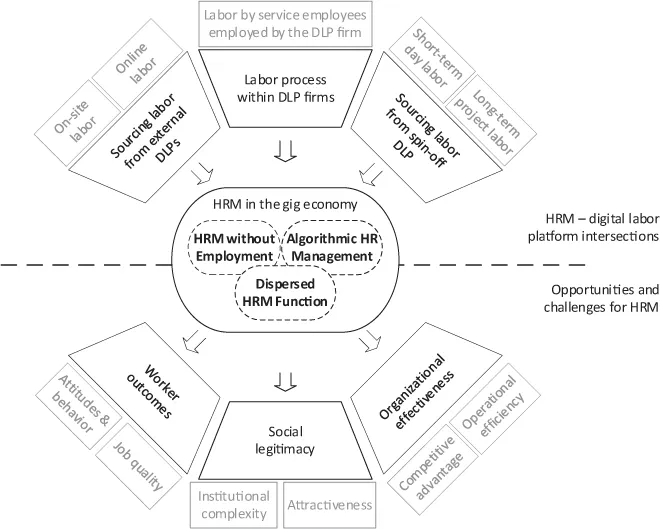
This chapter is organized as follows. We begin by describing the nature of gig work and discuss unique features of HRM in the gig economy – that is, HRM without employment, algorithmic HR management, and a dispersed HRM function – that challenge current thinking in the HRM literature. Then we discuss three ways HRM (in traditional organizations) intersects with digital labor platforms and the challenges as well as opportunities that these intersections present for the managers, HR practitioners, and other employees who engage with gig workers. First, we outline the diverse ways organizations are sourcing contingent labor through external digital labor platforms, and the benefits of addressing associated issues through a HR lens. Second, we consider HRM and labor processes within digital labor platform firms themselves, detailing issues relevant to the service employees that are employed by the platform firm and who make decisions about gig workers and their management. Third, we discuss the growing trend of large firms developing (or acquiring) their own spin-off and/or in-house platforms, addressing the strategic implications for such firms and for HR practice. Throughout we identify common themes in the interplay between organizations, their employees, and their non-employee gig workers: outcomes for gig workers, social legitimacy, and organizational effectiveness. The overarching framework that underlies this work is presented in Fig. 1. We conclude by spotlighting specific knowledge gaps that merit future research into HRM and the gig economy, and outline barriers and pathways to conducting this research.
THE NATURE OF GIG WORK
Gig workers are officially considered to be self-employed, but the digital platforms they use to find clients shape their working conditions and compensation to varying degrees. Technology affords labor platforms ways to manage nominally independent gig workers while still allowing them to deny the existence of an employment relationship (Meijerink, Keegan, & Bondarouk, 2021). Most notably, digital labor platforms utilize automatically generated reputational feedback mechanisms and implement algorithmic controls that can determine compensation and eligibility for work opportunities (Duggan, Sherman, Carbery, & McDonnell, 2020; Wood, Graham, Lehdonvirta, & Hjorth, 2019a).
Gig workers in wealthy countries do not enjoy the same regulatory protections and benefits offered to those classified as employees, and so they can be viewed as prime exemplars of the precariat, that is, workers who bear a great deal of risk with limited opportunity (e.g., Berg & Johnston, 2019; Gray & Suri, 2019; Pfeffer, 2015; Stewart & Stanford, 2017; Tran & Sokas, 2017). Those who do gig work as a side hustle to supplement regular waged employment may be better positioned to benefit from the flexibility and entrepreneurial aspects of gig work, and so labor platforms can arguably be viewed as free-riding off traditional employers (Schor, Attwood-Charles, Cansoy, Ladegaard, & Wengronowitz, 2020). However, growing numbers of people around the world depend on digital labor platforms as their primary source of income (Wallenstein, de Chalendar, Reeves, & Bailey, 2019), including workers with weaker labor market positions such as migrants (Van Doorn, Ferrari, & Graham, 2020).
Fig. 1. The Kaleidoscope of Human Resource Management in the Gig Economy. Note: DLP, digital labor platform; HRM, human resource management.
The sustainability of gig work for individual workers and their economic vulnerability are ongoing topics of debate (Kost, Fieseler, & Wong, 2020; Prassl, 2018; Rosenblat, 2019), particularly in the United States where health care access remains largely tied to employment. Digital labor platforms that facilitate remote (i.e., online, such as Fiverr or Upwork) work may disproportionately benefit individuals in emerging economies who can use platform-generated signals of their quality to obtain better paid work from foreign clients (Kanat, Hong, & Raghu, 2018; Lehdonvirta, Kässi, Hjorth, Barnard, & Graham, 2019). Although remote gig work may boost incomes for workers in developing nations, it also subjects them to risks like predatory intermediaries and social isolation (Graham et al., 2017).
Most empirical studies of gig workers have examined those who use prominent on-demand consumer service platforms, particularly Uber drivers (e.g., Rosenblat & Stark, 2016) and “Turkers” who do remote piecework tasks via Amazon’s Mechanical Turk platform (Keith, Harms, & Tay, 2019). Digital labor platforms vary on a number of dimensions, however, and even the experiences of workers on the same platform are likely to vary depending on individual differences and the broader context.
For example, qualitative studies of Uber drivers in the United States and Europe have found sharply mixed emotional reactions and substantial variation in work-related attitudes (e.g., Malin & Chandler, 2017). Quantitative research has shown that the flexibility and autonomy of gig work creates surplus economic value for drivers (Chen, Rossi, Chevalier, & Oehlsen, 2019) as well as greater evaluative subjective well-being (Berger, Frey, Levin, & Danan, 2019), but only for those drivers motivated by this aspect of gig work. Some evidence suggests that the availability of Uber as an income-earning option allows people in wealthy countries to better weather unemployment shocks and other financial crises, and, therefore, it is still arguably a boon even to those drivers motivated by push rather than pull factors (Nian, Zhu, & Gurbaxani, 2020). Daniels and Grinstein-Weiss (2019), however, found it increases financial hardship for lower income households even if income volatility is reduced. In less developed countries, the advent of ride-hailing platforms may have increased the precarity and reduced the autonomy of people providing transportation services, because drivers no longer have the ability to negotiate with customers and apps supplant former methods of acquiring passengers (Sperber, 2020).
To date, there is limited empirical research on higher income professionals who utilize freelance labor platforms. HR and organizational behavior (OB) research on independent workers in knowledge-intensive and creative fields has typically studied freelancers who use word-of-mouth or other traditional methods to find clients (Ashford, Caza, & Reid, 2018; Bidwell & Briscoe, 2009; Petriglieri, Ashford & Wrzesniewski, 2019). But tens of millions of professional freelancers now rely for all or part of their income on labor platforms such as Upwork and Freelancer.com, where they compete for project-based work. Some recent studies have demonstrated that platform features and policies are critical to shaping the experiences of these presumably more autonomous gig workers, analogous to their effects on remote gig workers who perform less complex and more repetitive work (see Lehdonvirta, 2018). Bellesia and her colleagues (Bellesia, Mattarelli, Bertolotti, & Sobrero, 2019) studied IT develop...