This concise textbook provides a comprehensive and clear overview of the theory and practice of creative problem solving from a management perspective.
The book works step by step through the creative thinking process. Beginning with theoretical frameworks, it considers ways of thinking, defining problems and structuring responses to them, techniques for generating ideas, evaluating and defining them, and finally how technology can be used within the creative problem-solving process. Pedagogical features to aid learning include objectives at the start of each chapter, further reading suggestions and practical examples.
Divided into ten short chapters to suit content delivery, this textbook is designed as either core or recommended reading for advanced undergraduate, postgraduate, MBA and Executive Education students studying Creativity and Innovation, Management and Leadership and Management Skills.
First, we look at definitions of creative thinking and move on to consider theories regarding its nature. We consider the brain as a processor of information, where creativity is explained best by the neuro-physiological functioning of the brain, as the most appropriate of these theories. Whole-brain and two-brain theories exemplify this latter approach. We shall see a connection between the neuro-physiological functioning of the brain and the cognitive theory of creative problem solving discussed later in the chapter. We finish the chapter by examining ideas about analogical reasoning. The theoretical issues raised in this chapter act as a background for appreciating the elements of the next chapter, which introduces the creative problem solving process.
What is creative thinking?
Wertheimer (1945) suggested that creative thinking involved breaking down and restructuring our knowledge in order to gain new insights into its nature. Creativity is something which occurs when we are able to organise our thoughts in such a way that readily leads to a different and even better understanding of the situation we are considering.
Rickards (1988: 225) advocated a view of creativity as an ‘escape from mental stuckness.’ Sternberg and Lubart (1995) argue that creativity requires a coming together of six clear-cut yet interconnected assets: intellectual abilities, knowledge, styles of thinking, personality, motivation, and environment. However, Simonton (2017) points out that there is no dearth of alternative definitions of creativity. These various definitions seem to agree that creativity involves an ability to come up with new, different, and even useful viewpoints. However, any definition of creativity is complicated because the concept is multi-faceted. Let us now turn to consider how creativity is thought to be generated.
Early theories of creative thinking
There are a number of schools of thought as to the origin of creativity (Henry, 1991): grace, accident, association, cognitive, personality.
Grace
Creativity is something of a mystery, drawing forth images of wonderful insights, imaginative efforts, illumination, and intuitions that come from nowhere. It seems the work of magic. The idea of genius may add force to this notion since creative artists, musicians, etc. seemed to be endowed with superhuman potential. Creativity, in this sense, is seen as a divine gift.
Accident
This is the opposite of it being a divine gift. It rises by chance. Holders of this view offer various types of accidental discoveries such as those of immunisation arising from an interruption in work, radioactivity from the wrong hypothesis, and the smallpox vaccination from observation.
Association
This is the most popular and suggests that applying procedures from one area to another gives rise to novel associations, and that such associations form the bedrock of creative ideas. The notion was popularised by Koestler (1964) under the term ‘bisociation,’ and it underlies the justification for many divergent thinking techniques, such as lateral thinking and brainstorming.
Cognitive
Creativity is a normal human activity. It uses cognitive processes like recognition, reasoning, and understanding. Many inventors work at a problem for years. Research has concluded that ten years of intense preparation is needed for significant creative contributions. Deep thinking about an area over a long period leaves the discoverer informed enough to notice anomalies that might be significant. Highly creative people are strongly motivated and seem able to concentrate over a long period.
Personality
Creativity is a state of mind which can be learnt. Some people seem to have a facility for it while others do not, but they can improve with practice. Mental barriers to creativity have to be removed to allow innate spontaneity to flourish. Creative acts are not isolated acts of perception, they require an emotional disposition, too, for any new idea replaces and in effect destroys the previous order. It takes courage and persistence to brave the resistance that any change seems to engender.
The five perspectives make some valid points, but here we pay particular credence to the cognitive theory.
The brain as an information processor
Ideas are a form of information and as such are formulated in the brain. The brain has two cerebral hemispheres – a left and a right. The primary mental processes of these hemispheres include vision, hearing, body senses, reasoning, language, and non-verbal visualisation. Within each hemisphere is to be found one half of the limbic system. This is a control centre that governs such things as hunger, thirst, sleeping, waking, body temperature, heart rate, blood pressure, and emotions. The limbic system plays an important role in transferring incoming information into memory. The two cerebral hemispheres and the two halves of the limbic system make up the four quadrants of the brain. The upper quadrants represent the cerebral hemispheres, while the lower quadrants represent the two halves of the limbic system.
Fibres connect the two cerebral hemispheres, and these fibres carry communications both within and between the two hemispheres. When solving complex problems or other intricate work, different thinking methods are required. The brain switches signals back and forth very rapidly between different areas within the two hemispheres via the fibre links. Switching thinking modes within the cerebral hemispheres (within each of the two upper quadrants) is simple, but switching between the two lower or upper quadrants is more difficult. Diagonal switching is most difficult because there are no fibre connections between diagonally opposite quadrants of the brain.
The Whole Brain/Four-Quadrant Model
Herrmann (1990) showed that it is possible to build a model of the human brain with two paired structures, the two halves of the cerebral system and the two halves of the limbic system. This permits one to differentiate between not only the more popular notions of left/right brain, but also the more sophisticated notions of cognitive/intellectual which describe the cerebral preference, and visceral, structured, and emotional which describe the limbic preference.
Herrmann’s Whole Brain Model also made use of the concept of dominance. Evidence indicates that, wherever there are two of anything in the body, one of them is naturally dominant over the other. For example, we may be right- or left-handed. We can also be thought of as predominantly right- or left- ‘brained.’ The implications of this for the way in which we prefer to do things are important. Indeed, sometimes our preferred way of doing things may well be counterproductive. Predominantly left-brained thinkers may experience more difficult relationships with colleagues than right-brained thinkers because they are not as sensitised to other people. On the other hand, it may be that predominantly right-brained thinkers need to have goals and a schedule set for them to help them be more efficient.
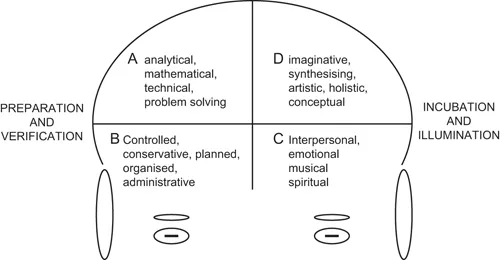
The Whole Brain Model (Figure 1.1) presents four distinct thinking styles:
Figure 1.1 Brain theories – the Whole Brain Model (Hermann/Wallis)
The upper (cerebral) left
A – analytical, mathematical, technical, and problem solving
The lower (limbic) left
B – controlled, conservative, planned, organised, and administrative in nature
The lower (limbic) right
C – interpersonal, emotional, musical, and spiritual
Upper (cerebral) right
D – imaginative, synthesising, artistic, holistic, and conceptual modes
Among other things:
Predominantly A-quadrant thinkers prefer organising information logically in a framework, listening to lectures and reading textbooks, studying example problems and solutions, thinking through ideas, doing scientific/academic research, judging ideas based on facts, criteria, and logical reasoning, dealing with reality and current problems
Predominantly B-quadrant thinkers like finding practical uses for knowledge learnt, planning projects, practising new skills, writing practical guides about how to do something
Predominantly C-quadrant thinkers like to be very organised and precise in their work
Predominantly D-quadrant thinkers like to take an overall view of new topics (not the detail), to take the initiative, ponder on possible outcomes of actions, use visual aids, solve open-ended problems, enjoy wild ideas, experiment, rely on intuition rather than on logic, synthesise ideas, approach a problem from different angles
From the point of view of undertaking creative problem solving activities, type-D thinkers seem to have the most favourable frame of mind for this activity.
During the 1960s, research on the brain caused scientists to conclude that both hemispheres are involved in higher cognitive functioning. It was found that each half of the brain produced different modes of complex thinking. The main argument to develop was that there appear to be two modes of thinking – verbal and non-verbal – which tended to be conducted separately by the left and right hemispheres, respectively. This in turn led initially to a number of ‘brain’-related theories concerning creative thinking, notable amongst which was Roger Sperry’s Left Brain/Right Brain Theory. According to this theory, the left brain is used for logical thinking, judgement, and mathematical reasoning, while the right brain is the source of dreaming, feeling, visualisation, and intuition.
Convergent and divergent thinking
Guilford (1967) claimed and cited evidence to support the view that divergent thinking processes, as opposed to convergent thinking processes, are related to creativity. Divergent thinking involves a broad search for decision options with respect to a problem for which there is no unique answer. In the divergent processes, the generation of alternatives involves finding many combinations of elements that may provide many possible answers. Fluency of thinking and originality characterise a divergent search for alternativ...
Table of contents
Cover
Half-Title
Endorsements
Series
Title
Copyright
Contents
Introduction
1 Theoretical frameworks
2 Blocks to creativity
3 Problem solving
4 The creative thinking process
5 Objective finding, fact finding, and problem finding – definitions
6 Idea generating – non-analogical
7 Idea generating (analogical)
8 Evaluation
9 Implementing ideas
10 Digital creativity
Index
Trusted by 375,005 students
Access to over 1.5 million titles for a fair monthly price.
Study more efficiently using our study tools.
Frequently asked questions
Yes, you can cancel anytime from the Subscription tab in your account settings on the Perlego website. Your subscription will stay active until the end of your current billing period. Learn how to cancel your subscription
No, books cannot be downloaded as external files, such as PDFs, for use outside of Perlego. However, you can download books within the Perlego app for offline reading on mobile or tablet. Learn how to download books offline
Perlego offers two plans: Essential and Complete
Essential is ideal for learners and professionals who enjoy exploring a wide range of subjects. Access the Essential Library with 800,000+ trusted titles and best-sellers across business, personal growth, and the humanities. Includes unlimited reading time and Standard Read Aloud voice.
Complete: Perfect for advanced learners and researchers needing full, unrestricted access. Unlock 1.5M+ books across hundreds of subjects, including academic and specialized titles. The Complete Plan also includes advanced features like Premium Read Aloud and Research Assistant.
Both plans are available with monthly, semester, or annual billing cycles.
We are an online textbook subscription service, where you can get access to an entire online library for less than the price of a single book per month. With over 1.5 million books across 990+ topics, we’ve got you covered! Learn about our mission
Look out for the read-aloud symbol on your next book to see if you can listen to it. The read-aloud tool reads text aloud for you, highlighting the text as it is being read. You can pause it, speed it up and slow it down. Learn more about Read Aloud
Yes! You can use the Perlego app on both iOS and Android devices to read anytime, anywhere — even offline. Perfect for commutes or when you’re on the go. Please note we cannot support devices running on iOS 13 and Android 7 or earlier. Learn more about using the app
Yes, you can access Absolute Essentials of Creative Thinking and Problem Solving by Tony Proctor in PDF and/or ePUB format, as well as other popular books in Business & Business General. We have over 1.5 million books available in our catalogue for you to explore.