
The book features real-life examples and amazing diversity focusing on sociology's unique ability to personally resonate well with students' experiences. Throughout the text, the author carefully balances coverage of core topics and contemporary changes in society. Every chapter explores unique topics, such as same-sex marriage, Boko Haram, mob justice, Sharia law, as well as issues of inequality related to race, ethnicity, gender, social class, and urbanization.The text empowers students to use the lenses of sociological imagination to see sociology in everyday life. Using sociological imagination, theory, and sociological perspectives, the text helps students move beyond individual perspective to gain a sociological perspective.
eBook - ePub
Sociology
About this book
Information
Chapter 17
Population, Urbanization, and the Environment
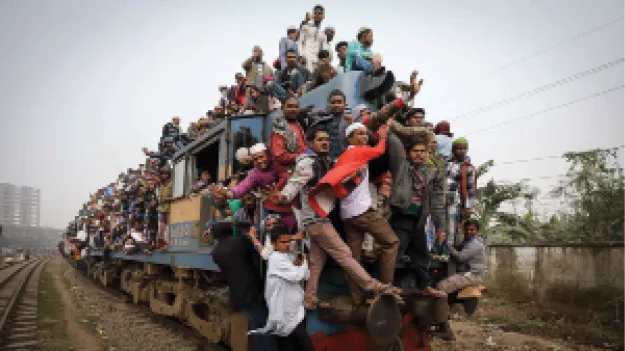
Overcrowded passengers on a train in overcrowded Dhaka, Bangladesh.

Living dangerously. People in Kibera, Nairobi, Kenya, with houses near the railway line.
Learning Objectives
- Explain the concepts of fertility, mortality, and migration and how they affect population size.
- Analyze population trend using Thomas Malthus’s theory and demographic transition theory.
- Identify the contributions of Ferdinand Tönnies, Émile Durkheim, Georg Simmel, Louis Wirth, Robert Park, and Karl Marx to our understanding of urban life.
- Describe the third urban revolution now underway in poor societies.
- Summarize patterns of urbanization in the US and around the world.
- Analyze current environmental problems such as pollution, environmental deficit, and global warming.
Demography
Demography is the study of the size, composition, and distribution of human population. Demography is not just about counting people per se. The demographers analyze the changes and trends in the population and acknowledge the fact that as human beings, we are born and then we die. As a result, demographers consider a wide array of population characteristics, including rates of birth, marriage, mortality, and fertility, among others. Demographers not only collect and analyze data but also raise important questions about the effects of population growth and suggest how it might be controlled. The following sections present basic demographic concepts.
Fertility
Demographers define fertility as the incidence of childbearing in a country’s population. Note that though our concern lies primarily with the total impact of childbearing on a society, we must recognize that the birth rate is the accumulation of millions of individual decisions to have or not to have children. Therefore, when we refer to a “high-fertility society,” we are referring to a population in which most women have several children, whereas a “low-fertility society” is one in which most women have few children. Naturally, some women in high-fertility societies have few children, and vice versa. Fertility is composite of two parts, one biological and one social. The biological component refers to the capacity to reproduce, and while obviously a necessary condition for parenthood, it is not enough alone. Whether children will be born and, if so, how many, given the capacity to reproduce, is largely a result of the social environment in which people live.
Crude Birth Rate
The basic measure of fertility is crude birth rate, the number of live births per one thousand women in population. Crude birth rate indicates the number of live births occurring during the year per one thousand population. Crude birth rate is influenced by the age structure of the country’s population. It will be higher in a population where more of the women are in the childbearing ages, roughly fifteen forty-nine. It may also be influenced by the sex composition. If there is a higher percentage of women in the population, the crude birth rate may be higher. But it may also be influenced by the level of education of women in a society. More educated women who have higher incomes and live in urban areas may not adhere to traditional gender ideology. They simply love their life as it is. These women value their freedom and independence and don’t have time for children. Crude birth rate in the United States was reported at 12.4 in 2015 (World Bank 2016). Subtracting the crude death rate from the crude birth rate provides the rate of natural increase, which is equal to the rate of population change in the absence of migration.
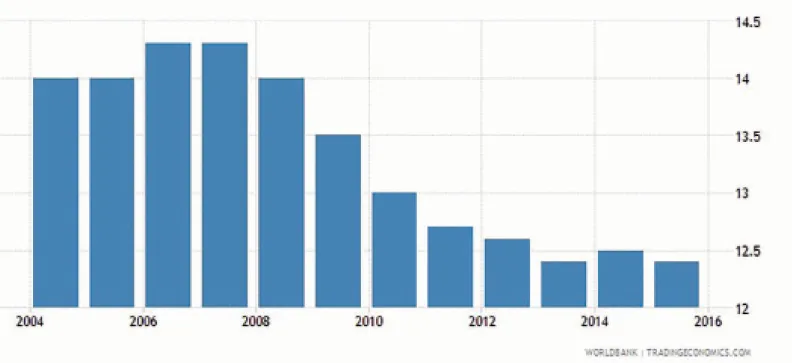
United States birth rate. Source: Trading Economics.
Fecundity
A term that is sometimes confused with fertility is fecundity, the number of children that women are capable of bearing or the biological maximum number of children that can be born. Because women rarely have the maximum number of children they are capable of bearing, the fertility of a society is normally quite a bit lower than its fecundity. The above figure shows the changes in crude birth rate in the United States. African Americans have 2.3 times the infant mortality rate of white Americans since 2004. The global average fertility rate is 2.5 children per woman. It has halved over the last fifty years. In pre-modern era, fertility rates of 4.5 to 7 children per women were common. However, in recent years, as most societies get to embrace modernization, the number of children per woman decreases very substantially. Fertility has declined in nearly all regions of the world. Even in Africa, where fertility levels are the highest of any region, total fertility has fallen from 5.1 birt...
Table of contents
- Sociological Perspectives
- Doing Sociology
- Culture and Society
- Socialization
- Social Interaction
- Groups and Organizations
- Sexuality and Society
- Deviance and Crime
- Social Stratification
- Global Stratification
- Gender Stratification
- Race and Ethnicity
- The Family and Religion
- Education
- Health and Medicine
- Economics and Politics
- Population, Urbanization, and the Environment
Trusted by 375,005 students
Access to over 1.5 million titles for a fair monthly price.
Study more efficiently using our study tools.
Frequently asked questions
Yes, you can cancel anytime from the Subscription tab in your account settings on the Perlego website. Your subscription will stay active until the end of your current billing period. Learn how to cancel your subscription
No, books cannot be downloaded as external files, such as PDFs, for use outside of Perlego. However, you can download books within the Perlego app for offline reading on mobile or tablet. Learn how to download books offline
Perlego offers two plans: Essential and Complete
- Essential is ideal for learners and professionals who enjoy exploring a wide range of subjects. Access the Essential Library with 800,000+ trusted titles and best-sellers across business, personal growth, and the humanities. Includes unlimited reading time and Standard Read Aloud voice.
- Complete: Perfect for advanced learners and researchers needing full, unrestricted access. Unlock 1.5M+ books across hundreds of subjects, including academic and specialized titles. The Complete Plan also includes advanced features like Premium Read Aloud and Research Assistant.
We are an online textbook subscription service, where you can get access to an entire online library for less than the price of a single book per month. With over 1.5 million books across 990+ topics, we’ve got you covered! Learn about our mission
Look out for the read-aloud symbol on your next book to see if you can listen to it. The read-aloud tool reads text aloud for you, highlighting the text as it is being read. You can pause it, speed it up and slow it down. Learn more about Read Aloud
Yes! You can use the Perlego app on both iOS and Android devices to read anytime, anywhere — even offline. Perfect for commutes or when you’re on the go.
Please note we cannot support devices running on iOS 13 and Android 7 or earlier. Learn more about using the app
Please note we cannot support devices running on iOS 13 and Android 7 or earlier. Learn more about using the app
Yes, you can access Sociology by John Ambenge in PDF and/or ePUB format, as well as other popular books in Social Sciences & Sociology. We have over 1.5 million books available in our catalogue for you to explore.