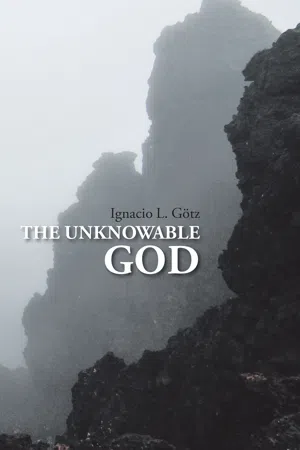
Most contemporary Christians are polytheists. They believe in many gods—unawares, of course. There is a Father-god, depicted old and white-haired; there is a Son-god, middle-aged, identified with Jesus of Nazareth; and there is a Spirit-god, symbolized by a dove. Many artists have depicted this trinity, like El Greco, who painted his "The Trinity" in 1578. These three gods are believed to constitute only one divinity, but very few ordinary Christians could explain how this could be the case. This plurality of gods is the reason why Christianity is reviled by Jews and Muslims who affirm steadfastly the unicity of God and who ban any pictorial representation of the divinity.The very first Christians, the family and friends of Jesus, who were Jews, would not have held such a pagan belief, but their writings were destroyed by later adherents, so we lack the evidence to prove this.Christians claim that the Trinity has been revealed, but the fact is that such revelation is disproved by science and philosophy. So why not transcend this trinity in a contemplation of the One Unknowable God of all? Why not learn to live without knowing what God is, being satisfied with the belief that God is neither male nor female, neither triad nor monad, but simply the Divine Incognito?
- 196 pages
- English
- ePUB (mobile friendly)
- Available on iOS & Android
eBook - ePub
The Unknowable God
About this book
Information
Topic
Theology & ReligionSubtopic
Theology5
Quodlibets on Living a Life without Concluding
Without concluding, one continues questioning.
—Albert Camus
Questioning is the piety of thought.
—Martin Heidegger
I have resisted the temptation to conclude.
—E.M. Cioran
1. Tulshuk Lingpa said, “Don’t listen to anybody. Decide by yourself and practice madness. Develop courage for the benefit of all sentient beings. Then you will automatically be free from the knot of attachment. Then you will continually have the confidence of fearlessness and you can then try to open the Great Door of the Hidden Place.”202
According to Shor, the Hidden Place of refuge from the ravages of calamity was called Beyul Demoshong, and it was supposed to be somewhere on the slopes of Kanchenjunga, the third highest mountain in the world, its snows visible to me every morning as I got up barely fifty miles away as the crow flies. Padmasambhava had hidden the entrance, but his consort, Khandro Yeshe Tsogyal, had revealed to Tulshuk Lingpa its location as well as the gate to enter it.
In 1962, Tulshuk Lingpa forgot his own advice. He took a bunch of followers up the mountain in order to find the gate and enter the Hidden Place. The effort proved disastrous: he was killed in an avalanche, and the place remained hidden.
Essentially the same thing happened when Jim Jones took his followers to Guayana and when David Koresh decided to prove his messiahship. It was the same with Sabbatai Svi and with Menachem Schneersohn and with everyone who has claimed to know the path to heaven.
The Greeks thought that the gate to the underworld could be found, and Ulysses entered and came back out unscathed. So did Aeneas, and Dante wrote a long poem about the journey down and back up, except that he bypassed the earth in his ascent to heaven. Of course, thousands of years before, Inanna, Goddess of Heaven and Earth, had found the entrance to the underworld and had actually descended there, meeting in the process an untimely death at the hands of her lugubrious sister, Ereshkigal. But Inanna was restored to her royal realm by her father, and nothing more was said about this.
Also, there was Faust, but his journey to the Mothers was specifically called neither ascent nor descent, and it was very clearly stated that there was no way or path to them nor a gate nor any specific location.
Two things, perhaps, stand out in all of this: Don’t listen to anyone who claims to know the way anywhere in the spiritual life, especially if they have a particular place in mind or a special path or an entrance and if they want to charge money for admission. If Tulshuk Lingpa had remembered his own advice, perhaps he would still be around. It’s not for nothing that the old saying goes, “If you meet the Buddha on the road, kill him!”
Wisely, the Dalai Lama, when asked by Father Boff which was the best religion, he responded, “The one that leads you to God best.”
*****
2. Thomas Merton, in Conjectures of a Guilty Bystander (1966), wrote:
At the center of our being is a point of nothingness which is untouched by sin and by illusion, a point of pure truth, a point or a spark which belongs entirely to God, which is never at our disposal, from which God disposes of our lives, which is inaccessible to the fantasies of our mind or the brutalities of our own will.203
Merton identifies this point with what Massignon, in his life of al-Hallâj, calls un point vierge (“a virginal point”), perhaps in reference to al-Hallâj’s ‘ayn (“eye,” “essence,” or “source,”), or sirr (lit. “mystery”), which in the Treatise of Qushayri (1021) is called “the heart-secret,” “what cannot be looked upon,” “known only to the real,” and therefore is “virgin, undeflowered by anyone’s guess.”204 St. Augustine called this point interior intimo meo (“more inner than my most intimate”), and Meister Eckhart called it “that little spark in the soul, which neither space nor time touches.”205 And he elaborated:
There is an agent of the soul—no, not an agent but something more, a Being—yet not a Being, but something more than Being liberates—something so pure, sublime, and precious than no creature can get into it to stay except God himself. To tell the truth, not even God himself could get in there if he were creaturelike. There is no device or condition by which God can enter there, save as he comes in the naked divinity of his nature.206
St. Teresa of Ávila thought that “this must be the center of the soul,”207 “a kind of spark I know not where.”208 This “spark” is fundamentally limitless; this is why we always seek to go beyond all limits, especially in the search for truth.209
According to the Upanishads, this is the point in which the Supreme Self (Atman) is present in each and every being.210 This point, or infinitesimal space, is represented by the silence that closes the sacred syllable AUM, a silence that is “letterless, incommunicable,”211 through which, yet, one slips into the Universal Supreme Self as if squeezed through a pinhole. The Zohar quotes God as saying, “Open for me a door the size of a pinhole.”
In all these traditions, this is a point of reference to God, however God be conceived. Such an interpretation makes sense within a religious point of view. But it seems to me that this point, as described in the various literatures, is primarily a human point; that is, a place to be found in all human beings, even those who are not particularly religious. This place is found in all of us simply because we are human. How we interpret its function, if any, is for us to decide, and here, there are many interpretations as were mentioned above.
For me, this point vierge is the place where we know ourselves, where we take stock of our lives, where we acknowledge who we are without subterfuges, but also without judgment, for we are who we are, and it makes no sense to place value on what we are existentially: we just are. At the same time, we cannot hide in it from ourselves because it is part and parcel of us. Buber says, “I point to the unknown conscience in the ground of being, which needs to be discovered ever anew, the conscience of the ‘spark,’ for the genuine spark is effective also in the single composure of each genuine decision.”212
Now, as Bernard-Henry Levy says, this “point” is essential to our becoming human:
To be human is to preserve, inside oneself, against all forms of social pressure, a place of intimacy and secrecy into which the greater whole cannot set foot. When this sanctuary collapses, machines,...
Table of contents
- Prolegomena to Any Future Theologizing
- Legenda Inusitata
- A Certain Sense of His Presence
- Deus Absconditus/a/um
- Quodlibets on Living a Life without Concluding
Trusted by 375,005 students
Access to over 1.5 million titles for a fair monthly price.
Study more efficiently using our study tools.
Frequently asked questions
Yes, you can cancel anytime from the Subscription tab in your account settings on the Perlego website. Your subscription will stay active until the end of your current billing period. Learn how to cancel your subscription
No, books cannot be downloaded as external files, such as PDFs, for use outside of Perlego. However, you can download books within the Perlego app for offline reading on mobile or tablet. Learn how to download books offline
Perlego offers two plans: Essential and Complete
- Essential is ideal for learners and professionals who enjoy exploring a wide range of subjects. Access the Essential Library with 800,000+ trusted titles and best-sellers across business, personal growth, and the humanities. Includes unlimited reading time and Standard Read Aloud voice.
- Complete: Perfect for advanced learners and researchers needing full, unrestricted access. Unlock 1.5M+ books across hundreds of subjects, including academic and specialized titles. The Complete Plan also includes advanced features like Premium Read Aloud and Research Assistant.
We are an online textbook subscription service, where you can get access to an entire online library for less than the price of a single book per month. With over 1.5 million books across 990+ topics, we’ve got you covered! Learn about our mission
Look out for the read-aloud symbol on your next book to see if you can listen to it. The read-aloud tool reads text aloud for you, highlighting the text as it is being read. You can pause it, speed it up and slow it down. Learn more about Read Aloud
Yes! You can use the Perlego app on both iOS and Android devices to read anytime, anywhere — even offline. Perfect for commutes or when you’re on the go.
Please note we cannot support devices running on iOS 13 and Android 7 or earlier. Learn more about using the app
Please note we cannot support devices running on iOS 13 and Android 7 or earlier. Learn more about using the app
Yes, you can access The Unknowable God by Ignacio L. Götz in PDF and/or ePUB format, as well as other popular books in Theology & Religion & Theology. We have over 1.5 million books available in our catalogue for you to explore.