Now when it comes to women in the kingdom and their new standing in Christ Jesus. What was once true under the curse is now no longer true in Christ. A change has been made when we move from under the Law to now being under Grace. The curse is lifted! The status of women under the Law has changed. In Christ, believing women have moved out from under the Law into the kingdom. Paul states in Col.1: 12-14 that a translation has occurred. The word translation suggests a change in position, status, and location. The New Covenant reveals that under grace the status or standing (position or rank) of believing women has now changed. Now, no longer under the curse of sin: and now finding a new status and a new identity in Christ Jesus! The old has given way to the new! The new has given new meaning to the old! Being translated out from under the curse into a new positon held in Christ Jesus. What God did only for a few, in times past, he will now do for all in the present time. What God did only for the Jews, under the Old Covenant, he will now do as well for the Gentiles in the New Covenant. What was once enjoyed only by the free, under the dispensation of the giving of the Law, is now enjoyed by all (slave and free) in the dispensation of Grace. What was once held only by men in the past (under the curse) is now held by all (both men and women) in the present and in the church through the power and ministry of the Holy Spirit.
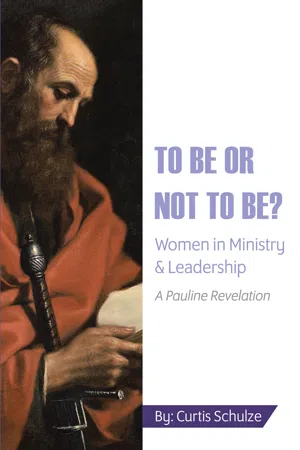
- 288 pages
- English
- ePUB (mobile friendly)
- Available on iOS & Android
eBook - ePub
About this book
Information
Print ISBN
9781098058814
Topic
Theology & ReligionThe Pauline Revelation
Now, without further ado, let us address the topic we have all been awaiting. What did Paul really think about women being used in ministry in the church? To be, or not to be? That is the question! Should women be allowed to have a ministry? Should they be allowed to function in any leadership capacity within the church? That is the million-dollar question and possibly the most hotly debated topic in all of Christendom. The division this has caused, and many opinions this has produced is astronomical. Many have taken a very hard stance either for or against it, and there is absolutely no budging for many on the subject. I estimate the writing of this book alone will create much controversy in both traditional and contemporary circles. Why? Because God is neither for the traditional (religious) stance of today nor is he for the liberal position that tends to lean toward modern thinking and worldly practices.
When approaching this subject scripturally, there will be a need to balance our understanding between three main areas addressed in all of Paul’s teachings: the world, the church, and the home. These three are not the same, and many often confuse them when attempting to interpret his epistles. Many apply the principles of the home to the church, while others apply the principles for how the believer is to interact with the church, to the world. While it is true that sometimes they can, and will, overlap, it should be understood that these principles are still distinct from one another. If they’re confused with each other, it will skew the original meaning of Paul’s intent and result in a misrepresentation of the scripture.
Paul’s epistles are considered a specific genre of writing. Although they do contain prophecies and at times, quote the law, they’re not like either of those types of books and are much different in comparison. Because of this, the approach to gaining an understanding of them must be unique to that type of writing and its context, or it could otherwise distort the overall meaning.
When studying his letters, many tend to deal with them as if they are straightforward doctrine or teaching, perhaps as if he was standing in front of an audience lecturing out of the scriptures, but this was not the case. Instead, his epistles were actually a back and forth dialogue between him and the recipients of his letters. They were conversations between he and churches he was overseeing. Often they would take on the nature of a question and answer session. Without first having a proper understanding of the problems the believers were having in their respective churches, it would be difficult to also grasp Paul’s solution to them.
It is unfortunate that because of pride and tradition most are not open to correcting this error. Because we lack the background story, the content behind the dialogue and the actual question being posed, it becomes very difficult to know for sure Paul’s intended meaning.
“For we know in part, and we prophesy in part…for now we see through a glass, darkly; but then face to face” (1 Cor. 13:9, 12). Notice, Paul put knowledge in part along with prophesying in part. This means that Paul is not referring to the letter of the written record, but rather to revelation knowledge. Prophecy here means inspired speech under divine influence. It’s impossible for any person to have all knowledge on any given subject. Revelation knowledge (from the Lord) comes to us in part. The word part means only a portion. It is so necessary to find a balance in everything being taught. All spiritual knowledge is given and communicated in part which is why great humility is needed for all those who teach the scriptures. Pride goes before a fall, or in other words, pride comes before error in the scriptures. When God gives us spiritual knowledge, we only see it looking through a glass darkly (1 Cor. 13:12). It is communicated to us in part. If we’re only given a few facts at a time, our spiritual eyesight is limited by all the missing pieces. It takes time to grasp the full revelation of a thing, so searching the scriptures should be treated with great care and patience in order to ensure an accurate interpretation.
The word darkly means obscurity. Obscurity is a word that means ambiguity or mysteriousness. It is something that is not clear, distinct, or easily recognizable, and it is incredibly difficult to interpret those obscure passages of scripture without revelation knowledge. To learn how to hear with our newly created spirit is a very challenging task, and because many are unfamiliar with it, it makes receiving revelation knowledge seem impossible. When this happens, people make the mistake of running too early with an interpretation of a text before its revelation is fully developed. So often, when they do interpret the scriptures, they do so using sense knowledge, or in other words, they only use their mind. Revelation knowledge comes to us by the Spirit (of God), into our spirit, and through our spirit into the heart. Then and only then will it illuminate the mind. Understanding the letter (the scriptures) apart from the Holy Spirit is using sense knowledge of the mind. That understanding brings bondage, but the Spirit, through revelation, brings liberty (sets us free and gives us clear answers/direction).
Having said that, it’s critical we interpret the scriptures by the Holy Spirit. To interpret them otherwise, by using sense knowledge, is to exalt our intellect as lord. This is why there is so much resistance today toward change. It stems from our religious traditions, born out of an exalted intellect that has worked so hard for so long that the church can no longer tell the difference between the works of the flesh and the walk of the Spirit. If something is obscured and hidden from the natural mind, how then can the natural mind be used to search and dig out its meaning? This is why the Holy Spirit is master, and the mind or intellect of man is his servant. The scriptures and the Spirit are not adversarial but when men choose to interpret the scriptures apart from the Spirit, this is resisting Christ. This is why Jesus said: “Making the word of God of no effect through your tradition.” (Mk. 7:13). None effect in the Greek means to invalidate or disannul, to weaken, reduce its strength, to make inoperative and ineffective. Jesus was saying, by your traditions, you are rendering the word of God powerless. Wow! The word of God does work, but our traditions stand in the way!
I found it necessary to write the preceding chapters in order to prepare for this one because I know this revelation will be challenging for many to receive at first. The things discussed in this chapter and the information gathered in the previous eight chapters, are designed to help give you the best possible understanding for it. I am well aware that not everything in this book will be understood the first time around because some parts are condensed. There may be a need to read through this material several times and you’ll need to spend time studying it so that over time, the content will become clearer. It took many years for me to receive this, so I imagine it will take some time on the part of the reader to fully absorb it also, but with great care and patience, these revelations will unfold and unveil themselves.
Women or Wives
“You wives, be in subjection to your own husbands” (1 Pet. 3:1). The word subjection in the Greek means to be under obedience (authority), to submit. You’ll notice the text says “…your own husbands.” This pattern is repeated several times in the New Testament. In 1 Peter 3:1, 5; Titus 2:5; Colossians 3:18; 1 Corinthians 7:2, and Ephesians 5:22, 24, we see these scriptures repeatedly direct the wife to submit to her own husband as it is fit in the Lord, or as following the Lord (Col. 3:18; Eph. 5:22). Does this mean she is to follow her husband blindly, as if he is the Lord? What is fit in the Lord? The word fit in the Greek means proper. As unto is a phrase which means to go after, which, in turn means, to follow after. Jesus said, “If any man (or woman) will come after me, let him/her deny themselves, and take up his/her cross, and follow me.” (Matt. 16:24). That command applies to all Christians, both male and female. To follow in the Greek me...
Table of contents
- Reconciling the Scriptures
- Letter or the Spirit
- The Early Years
- Obedience before Scriptural Evidence
- The Early Church
- Bishop of our Souls
- Early Pauline Influences
- Witness of the Old Covenant
- The Pauline Revelation
- Three Problem Areas
Trusted by 375,005 students
Access to over 1.5 million titles for a fair monthly price.
Study more efficiently using our study tools.
Frequently asked questions
Yes, you can cancel anytime from the Subscription tab in your account settings on the Perlego website. Your subscription will stay active until the end of your current billing period. Learn how to cancel your subscription
No, books cannot be downloaded as external files, such as PDFs, for use outside of Perlego. However, you can download books within the Perlego app for offline reading on mobile or tablet. Learn how to download books offline
Perlego offers two plans: Essential and Complete
- Essential is ideal for learners and professionals who enjoy exploring a wide range of subjects. Access the Essential Library with 800,000+ trusted titles and best-sellers across business, personal growth, and the humanities. Includes unlimited reading time and Standard Read Aloud voice.
- Complete: Perfect for advanced learners and researchers needing full, unrestricted access. Unlock 1.5M+ books across hundreds of subjects, including academic and specialized titles. The Complete Plan also includes advanced features like Premium Read Aloud and Research Assistant.
We are an online textbook subscription service, where you can get access to an entire online library for less than the price of a single book per month. With over 1.5 million books across 990+ topics, we’ve got you covered! Learn about our mission
Look out for the read-aloud symbol on your next book to see if you can listen to it. The read-aloud tool reads text aloud for you, highlighting the text as it is being read. You can pause it, speed it up and slow it down. Learn more about Read Aloud
Yes! You can use the Perlego app on both iOS and Android devices to read anytime, anywhere — even offline. Perfect for commutes or when you’re on the go.
Please note we cannot support devices running on iOS 13 and Android 7 or earlier. Learn more about using the app
Please note we cannot support devices running on iOS 13 and Android 7 or earlier. Learn more about using the app
Yes, you can access To Be or Not to Be? by Curtis Schulze in PDF and/or ePUB format. We have over 1.5 million books available in our catalogue for you to explore.