Effective leadership and management in health and social care are built on good practice, strong relationships and a critical understanding of the wider context in which care takes place. Leading, Managing, Caring illustrates how leadership and management work in everyday settings, providing invaluable support to those practising or studying in the area. The book introduces the four core building blocks of the caring manager or leader: personal awareness, team awareness, goal awareness and contextual awareness. Together these form a firm foundation for understanding and practice.
Drawing on up-to-date case studies, the authors explore how critical theoretical understanding can support practical attempts to work through complex situations with a diverse range of people. Also included is a toolkit containing carefully selected and practical tools for leading and managing change.
This comprehensive textbook is suitable for existing and aspiring managers and leaders in a range of health and social care professions, or anyone interested in understanding more about the complex landscape in which care services are managed and delivered in the UK.
Management matters. Without it, nothing happens. From deciding on and buying the weekly grocery shop to designing, building and running the giant atom-smasher at Cern, nothing effective happens without budgeting, scheduling and implementation.
(The King’s Fund, 2011, p. 1)
Your boss is talking about it, the Government says how important it is, the newspapers deplore the lack of it … leadership is needed ‘at all levels’ – in all situations.
(Pedler et al., 2004, p. viii)
In these turbulent times, the health and social care sector is under increasing pressure to deliver more and more for less and less. Increasingly complex care needs mean that now, more than ever, the effective integration of health and social care services is essential. To ensure that the interface between health and social care does not become a battleground, it is important to appreciate the different rules and guidelines which underpin diverse practice and professional groups, and to make sure that all staff and service users are involved creatively in designing and leading change (Harvey et al., 2009).
Synergy: when two of more things function togethef to pfoduce a result that is not independently obtainable. As the Greek philosopher Aristotle said: ‘The whole is greater than the sum of its pacts.3 (Figure 1.1)
In this context, it is essential to ensure that the most effective managers and leaders are in place to guarantee efficiency and effectiveness, working in tune with their staff in a synergistic way. But what sort of managers? And what types of leaders? They will have to understand how people work, how relationships are formed or not, and how organisations shape people’s ability to function. They will need to be able to manage staff, control budgets and mobilise a diverse range of people in responding to complex challenges.
Many books on leadership or management focus almost exclusively on the tools and personal qualities of successful managers and leaders, with little critical analysis of the organisational context they may be working in, let alone any broader acknowledgement of the political, economic or social climate. The assumption seems to be that if managers can only get themselves right then they will be free to lead unhindered, as if operating in a vacuum. However, the world is rarely that straightforward, even for the most effective of leaders or most diligent of managers. Other books therefore explore leadership and management as complex and distinct processes which require insight into theoretical understandings of what makes a good or effective leader or manager in their particular context. While many notable books do just this (for example, Bennis, 2009; Kotter, 1990; Northouse, 2009; Daft, 2010), they are predominantly written from a ‘business’ perspective and fail to address a health and social care workforce.
Other publications split health from social care, focus on the American experience, or fail to provide any practical tools to translate the wealth of theoretical insights into meaningful action. However, this book aims to acknowledge the wider contextual issues which impact on management and leadership in health and social care, and to facilitate an understanding of them which is realistic, yet empowering, for existing and aspiring managers or leaders.
Given the sheer complexity of the health and social care system, it is little wonder that leadership and management are so important. Even so, political and public opinion on the role of managers in health and social care is not universally sympathetic. Eighty-five per cent of the public support the idea of reducing the number of managers in the NHS (Ipsos MORI, 2009), and many believe that ‘box ticking’ and bureaucracy are given higher priority than caring for service users. However, such simplistic statements belie a complex picture and ignore the crucial point that when effective leadership and management are lacking in caring contexts, the results can be catastrophic:
The Caleb Ness enquiry into the death of an 11-week-old baby in Edinburgh … catalogued difficulties with the lack of co-ordination between services; poor administrative systems; poor chairing of meetings; lack of proactive senior social worker involvement … Each of the areas outlined demonstrated the catastrophic impact when leadership and management was not carried out in an effective manner …
(Watson, 2008, p. 323)
Hard-hitting cases such as the death of a baby highlight precisely why effective management and leadership are so essential in health and social care. It is not just a question of running an efficient business or making innovative cost savings – managers in this sector are dealing with life-and-death situations. Effective management, underpinned by strong leadership, can work towards preventing such catastrophes, and in this book we aim to provide the foundations for achieving this.
This chapter begins by asking three core questions.
• What is the difference between ‘managing’ and ‘leading’ and how do they complement each other?
• What are the foundations underpinning a caring approach to management and leadership?
• How can you begin to prepare for a management or leadership role in health and social care?
1.2 Leading, managing, caring in practice
Case study 1.1: Anwen
Anwen worked as a project manager for a group of wards in a district general hospital, with responsibility for overseeing the introduction of new efficiency measures. She was very proud of how dedicated the nurses were to implementing the changes, despite being overworked due to staff shortages.
Anwen met monthly with a business director from the Trust to report progress. She always felt frustrated in these meetings as she was worried the nurses were losing morale and she wanted recognition from the director for their hard work. But his remit was simply to collect the progress figures.
Increasingly, for many managers, there is pressure not just to achieve existing goals, but to go beyond those and think of better ways to get things done: to lead change. Hence, there is a blurring of the boundaries between management and leadership, and yet there are important distinctions that need to be acknowledged. Anwen’s experience illustrates this. She made a breakthrough when she realised there were competing expectations of her in her role as ‘project manager’ and ‘team leader’. The director was motivated not by how hard people were working but by the need to complete his monthly report. However, Anwen’s team wanted recognition for hard work even when ‘results’ were not great. Having reflected on this, she realised it was up to her to provide that recognition and motivation as the director was motivated by other issues.
Was Anwen a leader or a manager? Was the director a leader or a manager?
Anwen was discovering that there were subtleties involved in applying her management and leadership skills. She clearly had a role to play in motivating and leading her team, but she also had to manage conflicting expectations. Managers such as Anwen often feel inadequately supported, and find dealing with pressures from above and below difficult to handle as a result (Jack and Donnellan, 2010).
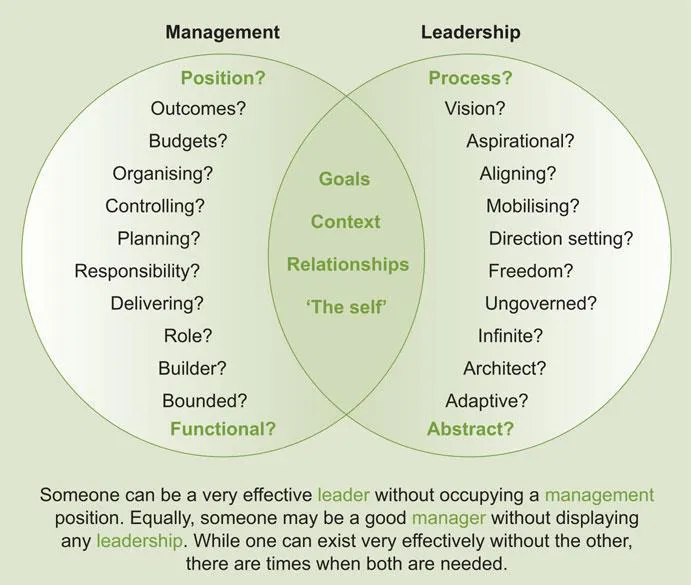
Clearly, differentiating leadership and management is not easy (Larkin, 2008). Anwen, like many people in positions of responsibility, had to act as both leader and manager, but what does this mean, and is it realistic? Anwen’s experience illustrates the complexity of trying to be an effective leader and an efficient manager at the same time. This is because some elements that might be associated with the two are very different (Figure 1.2).
Figure 1.2 Thinking through the concepts of management and leadership
Both leadership and management are concerned with outcomes or goals – which may be the same or very different – but they involve taking different approaches to get there. A manager may have a set of job descriptions, organisational aims and even disciplinary procedures which can help to frame the way they achieve their goals. However, a leader may not necessarily wield such formal power, and may have to rely instead on their ability to motivate other people around a shared vision (Kotter, 1990). Larkin (2008) suggests management tends to focus on the outcomes first and ‘pushes’ people towards them, whereas leadership starts with the people as a means of achieving those outcomes and tries to ‘pull’ them in that direction. What differentiates leadership from management for Larkin, then, is the approach but, despite such differences, the two can work together very successfully (Kotter, 1990).
‘A manager’s job is to keep an existing machine running; a leader’s job is to continually change the machine …’ (Robbins and Finley, 2004, p. 119). Do you agree with this statement?
Managers have to work within strictly imposed boundaries determined by budgets, forecasting and efficiency measures, while leaders often have the freedom to think beyond those potentially constraining factors with more creativity, inspiration and vision. So managers work towards consistency and order, whereas leaders inspire change and movement (Kotter, 1990). However, both play equally important and fundamental roles in any organisation, and such distinctions can come crashing down with the practicalities of everyday work. As Anwen’s experience shows, a manager might have to be creative about making things happen in different ways for different people, and being an effective leader is something that can help here. She realised that complaining about her team’s workload was ineffective; it was more important to motivate her staff and lead by example. Anwen, therefore, acted as a broker for her staff, ensuring senior management received the hard data on progress while also ensuring her staff received motivational support and recognition. She was both a manager who wanted to lea...
Table of contents
Cover
Half Title
Dedication
Title Page
Copyright Page
Table of Contents
Contributors
Chapter 1 Preparing to lead 1
Part 1 Leading, managing, caring in practice
Part 2 Leading, managing, caring in context
Acknowledgements
Index
Trusted by 375,005 students
Access to over 1.5 million titles for a fair monthly price.
Study more efficiently using our study tools.
Frequently asked questions
Yes, you can cancel anytime from the Subscription tab in your account settings on the Perlego website. Your subscription will stay active until the end of your current billing period. Learn how to cancel your subscription
No, books cannot be downloaded as external files, such as PDFs, for use outside of Perlego. However, you can download books within the Perlego app for offline reading on mobile or tablet. Learn how to download books offline
Perlego offers two plans: Essential and Complete
Essential is ideal for learners and professionals who enjoy exploring a wide range of subjects. Access the Essential Library with 800,000+ trusted titles and best-sellers across business, personal growth, and the humanities. Includes unlimited reading time and Standard Read Aloud voice.
Complete: Perfect for advanced learners and researchers needing full, unrestricted access. Unlock 1.5M+ books across hundreds of subjects, including academic and specialized titles. The Complete Plan also includes advanced features like Premium Read Aloud and Research Assistant.
Both plans are available with monthly, semester, or annual billing cycles.
We are an online textbook subscription service, where you can get access to an entire online library for less than the price of a single book per month. With over 1.5 million books across 990+ topics, we’ve got you covered! Learn about our mission
Look out for the read-aloud symbol on your next book to see if you can listen to it. The read-aloud tool reads text aloud for you, highlighting the text as it is being read. You can pause it, speed it up and slow it down. Learn more about Read Aloud
Yes! You can use the Perlego app on both iOS and Android devices to read anytime, anywhere — even offline. Perfect for commutes or when you’re on the go. Please note we cannot support devices running on iOS 13 and Android 7 or earlier. Learn more about using the app
Yes, you can access Leading, Managing, Caring: Understanding Leadership and Management in Health and Social Care by Sara MacKian,Joan Simons in PDF and/or ePUB format, as well as other popular books in Business & Nonprofit Organizations & Charities. We have over 1.5 million books available in our catalogue for you to explore.