eBook - ePub
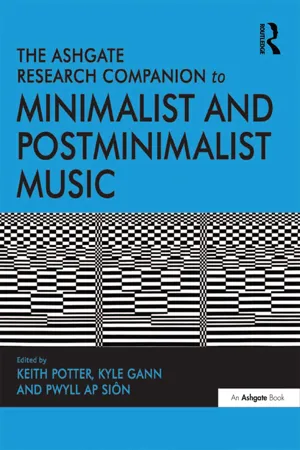
The Ashgate Research Companion to Minimalist and Postminimalist Music
- 464 pages
- English
- ePUB (mobile friendly)
- Available on iOS & Android
eBook - ePub
The Ashgate Research Companion to Minimalist and Postminimalist Music
About this book
In recent years the music of minimalist composers such as La Monte Young, Terry Riley, Steve Reich and Philip Glass has, increasingly, become the subject of important musicological reflection, research and debate. Scholars have also been turning their attention to the work of lesser-known contemporaries such as Phill Niblock and Eliane Radigue, or to second and third generation minimalists such as John Adams, Louis Andriessen, Michael Nyman and William Duckworth, whose range of styles may undermine any sense of shared aesthetic approach but whose output is still to a large extent informed by the innovative work of their minimalist predecessors. Attempts have also been made by a number of academics to contextualise the work of composers who have moved in parallel with these developments while remaining resolutely outside its immediate environment, including such diverse figures as Karel Goeyvaerts, Robert Ashley, Arvo Pärt and Brian Eno. Theory has reflected practice in many respects, with the multimedia works of Reich and Glass encouraging interdisciplinary approaches, associations and interconnections. Minimalism's role in culture and society has also become the subject of recent interest and debate, complementing existing scholarship, which addressed the subject from the perspective of historiography, analysis, aesthetics and philosophy. The Ashgate Research Companion to Minimalist and Postminimalist Music provides an authoritative overview of established research in this area, while also offering new and innovative approaches to the subject.
Information
PART I
Historical and Regional Perspectives
1
Mapping Early Minimalism
When writing the New Grove entry on minimalism for this dictionary’s 2001 edition,1 I thought it best to restrict myself to the narrower definitions and interpretations of the term ‘minimalism’ stemming from the narrative set in motion by the ideas and work of La Monte Young, Terry Riley, Steve Reich and Philip Glass in the 1960s – even though to do so was to allow these figures a hegemony in this area that some would find unacceptable. And as the author of Four Musical Minimalists, published the year before, I confined any broader excursions into this territory along purely music-historical lines to two matters. Some investigation was attempted into the first uses of the description ‘minimal’ in a musical context, by Michael Nyman and Tom Johnson, as applied, respectively, to compositions by Henning Christiansen (1932–2008), the Danish composer and member of Fluxus, and Alvin Lucier (b. 1930), the American pioneer in exploring acoustic and psycho-acoustic phenomena as the basis for making music: two composers who could well provide alternative starting points for ‘mapping minimalist music’. And the emergence was noted of musical minimalism out of what Nyman (again), following John Cage, called ‘experimental music’; which meant, basically, pursuing another USA-based story in which Cage himself is the major player. For the rest, my introduction to that book concerned minimalist art, and a mixture of cultural history and cultural theory that seemed appropriate to the task.2
If I once more focus on the four ‘usual suspects’ in the present chapter, this is for four reasons.3 First, issues around defining minimalism have been addressed by all three editors at the start of this book. Second, really ‘broadbrush’ approaches to charting what might reasonably be deemed ‘minimalist territory’ raise questions that cannot properly be answered in so short a space: a further deferral is, then, proposed for any future work on this. To give a single example out of many that are possible, take Robert Fink’s tale of a 25-day ‘performance’ in 1957 by the much-venerated Japanese violin pedagogue Shinichi Suzuki. ‘[Placing] the bow on a string, then [producing] beautiful tone with the well-balanced bow’, he quotes Suzuki as saying, ‘I carefully played a stroke at a time after checking the balance of the bow each time. I did this exercise 100,000 times (it took me about 25 days). People’, Suzuki reported, ‘recognized the leaping progress in the beauty and clarity of my tone in those 25 days.’ If, Fink goes on, such a demonstration of the Suzuki method as repetitive Soto practice, translated into repetitive musical process, had been publicly performed in 1957 ‘in a lower Manhattan loft space, [Suzuki] would now be hailed as a pioneer of “hypnotic” musical minimalism, having beaten La Monte Young to the composition of arabic numeral (any integer) by a full three years’.4
Third, some, at least, of the many ‘alternative histories’ of early musical minimalism in First- and Second-World cultures are tackled by other authors in this volume: whether moving outside the USA-based purview (Maarten Beirens on European minimalism, for instance) or staying within it (Dean Suzuki’s coverage of musical minimalism in a performing-arts context, for instance, or Jonathan Bernard’s investigation into the convergences arising when minimalism and popular music are jointly examined). Fourth, and lastly, the job of exhuming, making available and assessing the outputs of those individual composers and improvisers who might lay claim to as yet inadequately recognized significance in the story of musical minimalism is, at last, now being done by specialists who have made it their business to gain the particular kinds of access necessary to tell such stories reliably and as comprehensively as possible.
Such scholarship, of course, is often American-based and often requires extending the search outside the area of purely musical endeavour. It includes recent and ongoing efforts on behalf of such figures as, from the USA, Terry Jennings (by Brett Boutwell and Christopher Hobbs), Dennis Johnson (by Kyle Gann), Meredith Monk (a better-known composer-performer, but one on whom still very little scholarship has been done) and Phill Niblock (by a number of writers, including myself); or, from elsewhere, the Belgian Karel Goeyvaerts (by Mark Delaere and Maarten Beirens), the Russians Nikolai Korndorf, Vladimir Martynov, Sergei Zagny and (in particular, in the case of her own present research) Alexander Knaifel (by Tara Wilson), and the Lithuanian Bronius Kutavicius (by Antonas Kucinskas), to say nothing of the burgeoning scholarship on performance art, the early history of tape and other technologies and so on. All these will surely, in due course, not only yield a plethora of new information, but also form the basis for future assessments of musical minimalism much broader than those in the present chapter – even, indeed, than in this book as a whole.5 I look forward to that time, since much good work is now being done by a generation of scholars for whom such creative activity is a serious topic for scholarly endeavour and not, as it has been for so many of my own generation, the subject of derision.
Two Alternative Minimalisms?
To return to 2001, however. When writing that Grove entry, I was nevertheless at pains to stress that there seemed to be at least two rather contradictory views of musical minimalism in circulation; and I thought that I had at least implied – though it seems not always successfully so, to judge from some of the feedback that I have had – that some of the problems there appeared to be in defining and understanding what minimalism in music had been, and could be, probably arose from confusing those two contradictory views. It might, accordingly, be helpful to begin by attempting to identify these two approaches as clearly as possible. And then to take a look, given that this chapter is confined to the earlier manifestations of musical minimalism, at the first of them, including some of the ways in which it already gave clues as to how the second approach later came about. I aim to show that, far from generating two neatly distinguishable maps, which might be thought to be the desired outcome, the position is, in practice, rather messier.
So what are these two opposing views? First, there is the avowedly radical one, conjuring up the image of a music of drastic cheese-paring of material means, of opposition in the socio-cultural sphere (whether it concerns a riposte to the social or political establishment, a challenge to the artist’s professional status or an attempt to denigrate immediately prior art forms), and of perceptual challenge to its (necessarily modest-sized) audiences. Such a radical minimalism would be firmly characterized as a cultural Other to any kind of ‘mainstream’ practice.
Second, there is the apparently conservative view, folding itself back fairly comfortably into any notion of a surviving late-twentieth-century ‘mainstream’ that has survived the ravages of modernism. Such a minimalism is now frequently read as the sensible, and in retrospect inevitable, return to the basic building blocks of music that significant areas of Western composition, particularly in the third quarter of the twentieth century, had rejected. As I wrote in 2001, such a minimalism is widely seen as:
the major antidote to Modernism, as a reaction against both the serialism of the American Milton Babbitt and the European composers Pierre Boulez and Karlheinz Stockhausen, and against the indeterminacy of John Cage. This minimalism openly seeks greater accessibility. It is tonal or modal where Modernism is atonal, rhythmically regular and continuous where Modernism is aperiodic and fragmented, structurally and texturally simple where Modernism is complex. First flourishing to popular acclaim in the USA, it was typified in the 1980s and 90s by the music of … Glass … probably the most commercially successful composer of the later 20th century to work predominantly within the concert halls and opera houses of the ‘cultivated tradition’.6
Minimalism as Modernism?
The first, radical, view surely emerges in part out of minimalist music’s contacts with minimalist visual art, whatever the difficulties experienced in comparing two quite different media, and however much the composers of this radical music might register protests about the usefulness of the links with the artists themselves, their ideas and practice that are asserted on their behalf by others. The so-called Black paintings of Frank Stella, first exhibited in 1959, are usually credited with being the first artworks of Minimalism. Minimalist painting thus predates Minimalist sculpture; reminding us that this fact tends to be forgotten, Edward Strickland argues that the importance of Minimalist painting has been underestimated in the literature.7 It seems, nevertheless, to be the challenge thrown down by the ‘new three-dimensional work’ of the sculptor (and critic) Donald Judd, among several others, to the concept, practice and perception of painting on rectangular flat surfaces that most firmly projected Minimalism to the forefront of artistic developments in the 1960s. Most of these early Minimalist artists, including Sol Le Witt, Robert Morris and Richard Serra, and many of the early minimalist composers, had New York as their central professional base; which, of course, suggests that links between them would be natural and likely to be nurtured, if not inevitable. Minimalist sculptures proclaim not only a firm rejection of representational painting but also, like Minimalist painting, a rejection of the highly individualized and gestural outcomes of another American art movement, Abstract Expressionism: dominant in the 1950s and practised by, for example, Willem de Kooning and Jackson Pollock.
Links between the artists and the musicians, and between the art and the music here, can of course be biographical ones. For all the protestations that Reich, for instance, has made concerning the overrating of the extent and significance of his connections to figures such as Le Witt and Serra, the evidence seems undeniable. One example each must suffice here for Reich and Glass.
Steve Reich (b. 1936) was close to Le Witt in the years 1967–70, and the artist bought the original score of Four Organs so that the hard-up composer could buy glockenspiels for Drumming. Le Witt may also have purchased some sections of Drumming’s manuscript as well, though the only evidence that I have uncovered so far among Reich’s papers (now acquired by the Paul Sacher Stiftung in Basel) is a page torn out of one of the composer’s sketchbooks. Labelled ‘first version of reductions from Drumming’ (‘reductions’ signalling the process of gradually reducing the complete Basic Unit to a single note), this was originally dated 15 December 1970. On 7 February 1971, Reich added ‘for Sol from Steve Sunday 2/7/71’, photocopied the page and stuck the photocopy in his sketchbook in place of the original. Though this could have been bought by Le Witt, the original itself could also have been given as a present to him; either way, the artist would have quite possibly placed a financial as well as a sentimental value on it, just as if he would have if a fellow visual artist had given him a sketch of some kind.
Philip Glass (b. 1937) first met Serra – and Serra’s then partner, the painter and sculptor, Nancy Graves – in Paris in the mid-1960s, when Glass was studying composition with Nadia Boulanger, and Serra and Graves were both on travelling fellowships to Europe. Back in New York soon after this, Glass says that Graves helped him in a variety of ways, including the design of posters for his concerts. Serra offered even greater support, including the employment of Glass for a period as a full-time studio assistant. In 1969, the composer – together with the artist Chuck Close (creator of the iconic portrait of Glass made in the same year), the performance artist Spalding Gray, ...
Table of contents
- Cover Page
- Title Page
- Copyright Page
- Dedication Page
- Contents
- List of Figures
- List of Tables
- List of Music Examples
- Notes on Contributors
- Foreword
- Acknowledgements
- Introduction: experimental, minimalist, postminimalist? Origins, definitions, communities
- PART I HISTORICAL AND REGIONAL PERSPECTIVES
- PART II MINIMALISM AND THE THEATRE
- PART III MINIMALISM AND OTHER MEDIA
- PART IV ANALYTICAL AND PHILOSOPHICAL PERSPECTIVES
- PART V MINIMALISM AND BEYOND
- PART VI ISSUES OF PERFORMANCE
- Select Bibliography
- Index
Trusted by 375,005 students
Access to over 1.5 million titles for a fair monthly price.
Study more efficiently using our study tools.
Frequently asked questions
Yes, you can cancel anytime from the Subscription tab in your account settings on the Perlego website. Your subscription will stay active until the end of your current billing period. Learn how to cancel your subscription
No, books cannot be downloaded as external files, such as PDFs, for use outside of Perlego. However, you can download books within the Perlego app for offline reading on mobile or tablet. Learn how to download books offline
We are an online textbook subscription service, where you can get access to an entire online library for less than the price of a single book per month. With over 1.5 million books across 990+ topics, we’ve got you covered! Learn about our mission
Look out for the read-aloud symbol on your next book to see if you can listen to it. The read-aloud tool reads text aloud for you, highlighting the text as it is being read. You can pause it, speed it up and slow it down. Learn more about Read Aloud
Yes! You can use the Perlego app on both iOS and Android devices to read anytime, anywhere — even offline. Perfect for commutes or when you’re on the go.
Please note we cannot support devices running on iOS 13 and Android 7 or earlier. Learn more about using the app
Please note we cannot support devices running on iOS 13 and Android 7 or earlier. Learn more about using the app
Yes, you can access The Ashgate Research Companion to Minimalist and Postminimalist Music by Keith Potter,Kyle Gann in PDF and/or ePUB format, as well as other popular books in Media & Performing Arts & Music. We have over 1.5 million books available in our catalogue for you to explore.