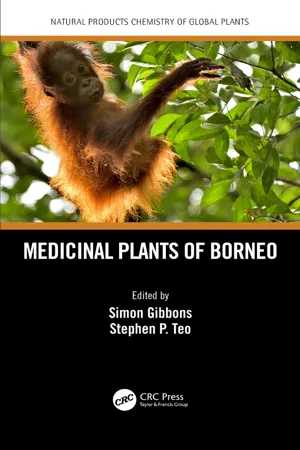
Medicinal Plants of Borneo
eBook - ePub

Medicinal Plants of Borneo

  1. 165 pages
  2. English
  3. ePUB (mobile friendly)
  4. Available on iOS & Android
eBook - ePub

About this book

The rich biodiversity of Borneo provides many useful plants for medicinal purposes. Written by experts in the field, Medicinal Plants of Borneo provides a guide and introduction to the medicinal plants from Borneo used traditionally as well as plants whose medicinal uses have been recently discovered. These include anti-HIV plants – such as Calophyllum lanigerum (calanolide A) – and anti-cancer plants – such as Aglaia foveolata (silvestrol). The book also provides information on the relevant medicinal chemistry, such as isolated bioactive compounds and the mechanism of action, where available.

FEATURES


  • Discusses the rich experience in the use of medicinal plants and the wide diversity of Borneo's botanical resources


  • Presents plants with medicinal properties from a scientific perspective


  • Provides readers with current information on the chemistry and pharmacology of natural products with pharmaceutical potential


  • Covers a range of chemical, botanical and pharmacological diversities


  • Forms an important part of the Natural Products Chemistry of Global Plants series due to an increasing global interest in natural products and botanical drugs

Simon Gibbons is Head of the School of Pharmacy, University of East Anglia, UK, and a Professor of Natural Product Chemistry. He was formerly a Professor of Medicinal Phytochemistry at the School of Pharmacy, University College London (UCL).

Stephen P. Teo is a forest botanist with the Forest Department, Sarawak, Malaysia.

Frequently asked questions

Yes, you can cancel anytime from the Subscription tab in your account settings on the Perlego website. Your subscription will stay active until the end of your current billing period. Learn how to cancel your subscription.
No, books cannot be downloaded as external files, such as PDFs, for use outside of Perlego. However, you can download books within the Perlego app for offline reading on mobile or tablet. Learn more here.
Perlego offers two plans: Essential and Complete
  • Essential is ideal for learners and professionals who enjoy exploring a wide range of subjects. Access the Essential Library with 800,000+ trusted titles and best-sellers across business, personal growth, and the humanities. Includes unlimited reading time and Standard Read Aloud voice.
  • Complete: Perfect for advanced learners and researchers needing full, unrestricted access. Unlock 1.4M+ books across hundreds of subjects, including academic and specialized titles. The Complete Plan also includes advanced features like Premium Read Aloud and Research Assistant.
Both plans are available with monthly, semester, or annual billing cycles.
We are an online textbook subscription service, where you can get access to an entire online library for less than the price of a single book per month. With over 1 million books across 1000+ topics, we’ve got you covered! Learn more here.
Look out for the read-aloud symbol on your next book to see if you can listen to it. The read-aloud tool reads text aloud for you, highlighting the text as it is being read. You can pause it, speed it up and slow it down. Learn more here.
Yes! You can use the Perlego app on both iOS or Android devices to read anytime, anywhere — even offline. Perfect for commutes or when you’re on the go.
Please note we cannot support devices running on iOS 13 and Android 7 or earlier. Learn more about using the app.
Yes, you can access Medicinal Plants of Borneo by Simon Gibbons, Stephen P. Teo, Simon Gibbons,Stephen P. Teo in PDF and/or ePUB format, as well as other popular books in Medicina & Inmunología. We have over one million books available in our catalogue for you to explore.

Information

Publisher
CRC Press
Year
2021
Print ISBN
9781138601079
eBook ISBN
9780429893414
Edition
1
Subtopic
Inmunología
1
Anti-Malarial Plants
Farid Kuswantoro and Stephen P. Teo
CONTENTS
Introduction
Lansium parasiticum (Osbeck) K.C. Sahni & Bennet
Traditional Use
Biological Activity
Chemistry
Alstonia scholaris (L.) R.Br.
Traditional Use
Biological Activity
Chemistry
Eurycoma longifolia Jack
Traditional Use
Biological Activity
Tinospora crispa (L.) Hook. f. & Thomson
Traditional Use
Biological Activity
Chemistry
Carica papaya L.
Traditional Uses
Chemistry

Introduction

Malaria has been a threat to mankind since ancient times. Even today, it is still a threat in developing tropical countries. The Centre for Disease Control (CDC) estimated that in 2016 alone there were 445,000 deaths caused by malaria worldwide. Malaria cases were also reported from Borneo. For instance, in 2013, a high number of malaria infections were reported in the Central and East Kalimantan provinces of Indonesian Borneo (Ompusunggu, 2015). Some plant species were utilized by people in Borneo to treat malaria (Leaman et al., 1995). Below are described some of the anti-malarial plant species that have been used.

Lansium parasiticum (Osbeck) K.C. Sahni & Bennet

Lansium parasiticum (Osbeck) K.C. Sahni & Bennet (synonym: Lansium domesticum) is a fruit tree species (Figure 1.1) that belongs to the Meliaceae or Mahagony family (Anon., 2020).
image
Figure 1.1 Tree (right) and leaves (left) of Lansium parasiticum (Photo credit: S. Teo).

Traditional Use

Leaman et al. (1995) and Noorcahyati (2012) both reported the utilization of L. parasiticum as a remedy for the treatment malaria. In fact, the bark of this plant was used as a remedy for malaria throughout Borneo by the indigenous people before the advent of modern drugs such as chloroquine and others.

Biological Activity

Various parts of L. parasiticum exhibited anti-plasmodial activity toward Plasmodium falciparum. The aqueous bark extract of L. parasiticum was reported by Leaman et al. (1995) and Omar et al. (2003) to display anti-plasmodial activity toward both chloroquine-resistant and sensitive strains of P. falciparum. Murnigsih et al. (2005), on the other hand, reported anti-plasmodial activity of L. parasiticum bark aqueous extract toward P. falciparum.
The leaves and fruit skin extract of L. parasiticum were also reported by Yapp and Yap (2003) to exhibit anti-plasmodial effects toward both chloroquine-resistant and the drug-sensitive P. falciparum strain, with the fruit skin extract also able to interrupt the parasite’s life- cycle.

Chemistry

Omar et al. (2003) reported that some compounds isolated from L. parasiticum extract were also shown to possess anti-plasmodial activity toward Plasmodium falciparum and Plasmodium berghei. Other research by Saewan et al. (2006) showed that some chemical compounds extracted from L. parasiticum seed also exhibited anti-plasmodial activity toward a multi-drug-resistant P. falciparum strain.
Various types of triterpenoids such as cycloartanes, onoceranoids and tetranortriterpenoids (limonoids) including domesticulides B–D (9–11) (Figure 1.2) have been isolated from different parts of L. parasiticum. However, only tetranortriterpenoids have, so far, shown activity against the malarial parasite. Compounds such as Domesticulides B–D showed anti-malarial activity against P. falc...

Table of contents

  1. Cover
  2. Half Title
  3. Series Page
  4. Title Page
  5. Copyright Page
  6. Contents
  7. Series Preface
  8. Preface
  9. Acknowledgments
  10. Editors
  11. Contributors
  12. Aims and Purpose
  13. Introduction
  14. Chapter 1 Anti-Malarial Plants
  15. Chapter 2 Anti-Fungal Plants
  16. Chapter 3 Anti-Mycobacterial Plants
  17. Chapter 4 Anti-Viral Plants
  18. Chapter 5 Anti-Cancer Plants
  19. Chapter 6 Anti-Diabetic Plants
  20. Chapter 7 Plants for Fever Remedy
  21. Chapter 8 Anti-Hypertensive Plants
  22. Chapter 9 Anti-Diarrhoeal Plants
  23. Chapter 10 Plants for Eye-Related Diseases
  24. Chapter 11 Plants Used in Dental Treatment
  25. Chapter 12 Poisonous Plants Used as Blowpipe Dart
  26. Chapter 13 Plants Used to Treat Arthritis
  27. Chapter 14 Plants Used for Wound Healing
  28. Conclusion
  29. Bibliography
  30. Index