- 334 pages
- English
- ePUB (mobile friendly)
- Available on iOS & Android
eBook - ePub
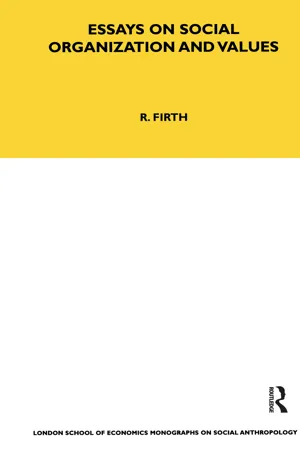
Essays on Social Organisation and Values
About this book
In this volume Professor Firth has brought together and commented upon a number of his papers on anthropological subjects published over the last thirty years. All these essays relate in different ways to his continuing interest in the study of social process, especially in the significance within a social context of individual choice and decision. Although some specialist studies are included, e.g. the group of papers dealing with the Polynesian island of Tikopia, the main themes of the book are broad ones and there are important general essays on such topics as social change; social structure and organization; modern society in relation to scientific and technological progress; and the study of values, mysticism, and religion by anthropologists. There is also a hitherto unpublished chapter on anthropology as a developing science.
Information
PART I SOCIAL ORGANIZATION
Introductory Notes
My general aim in these essays has been to present samples of analysis of on-going social process, and. to show the range and validity of an organizational approach to problems of social continuity and social change. Incidentally, some of the essays may show how far this approach has anticipated aspects of the study of the social implications of processes of decision-making, which is one of the modem trends in social anthropology.
Chapter I is the only new essay in this book, and is an attempt to see some recent developments in social anthropology in the light of developments in some other fields of social science. Chapter II was delivered as a Presidential Address before the Royal Anthropological Institute in 1954, and was followed the next year by the address which appears as Chapter III of this book. (They were published in the Journal of the Royal Anthropological Institute, vol. 84, pp. 1-20,1954; and vol. 85, pp. 1-18,1955.) The essays are closely related, and embody ideas with which I had been occupied for some years. The essence of my critique of social structure, for instance, was given in a paper read to the first meeting of the Association of Social Anthropologists, in 1946. It was not enthusiastically received at that time, when ‘structuralism’ was in its heyday, and I did not publish it, though part of the argument was presented in my Elements of Social Organization (Chanter I. 1051).
Chapter IV, on ‘Marriage and the Classificatory System of Relationship’, was originally published in more extensive form in the Journal of the Royal Anthropological Institute, vol. 60, pp. 235-268,1930. Some genealogies also have been omitted here, and a few consequential alterations in wording made. Although this essay is now more than thirty yean old, I have included the substance of it in this volume because it was my first exposition of a problem in what I have later come to call the organizational method of analysis. A brief reference to the history of the article will show how the problem arose and how theoretical formulations interact with the study of empirical situations. In Tikopia by the beginning of 1929 I had already obtained a working knowledge of the kinship system and its major structure. I also had managed to overcome the opposition of the chiefs to my study of the pagan religion and had finished an arduous participation in one seasonal cycle of die Work of the Gods. I was, therefore, then free to begin my sociological census, to make some assessment of my field material so far, and to think about collecting fresh data on a new variety of subjects. I turned again to some of the kinship sections in W. H. R. Rivers’s The History of Melanesian Society. An entry in my diary in early February reads, ‘Evening. Read Rivers’s H.M.S. on anomalous marriages. He annoys me very much; all is hypothesis.’ The next evening I spent sketching out a scheme for dealing with the Tikopia kinship system.
About this time I also began to collect material on changes of kinship terminology on marriage. I had previously regarded the kinship terms used by people for one another in a community as unalterable, fixed in a frame of usages so that each specific term-use was logically inferable from the general set of terms and relationships involved. I now found the logic unimpaired, but the relationships to be taken as assumptions more complex and more related to individual interests than I had previously perceived. I had realized some time earlier that some changes on marriage were implied, because as I had noted, since all the people of Tikopia are related, ‘men must always marry their have or tamajine, etc.’ I did nothing more with this for about two months, but then took it up again as part of a general plan for presentation of my material. Then came an event which stimulated my interest - the only large-scale wedding which took place during my stay. The context of this actual marriage led to a great deal of discussion of genealogies and of the implication of marriage for kinship structure, especially terminology. Partly as a result of my reaction against Rivers’s view, I began to examine these problems more closely. A comment on an incident in my notebook is ‘Shows how kinship system not a rigid, inflexible mechanism, but one which is elastic, capable of being adapted to meet new situations’; and a note in my diary says, “‘Anomalous relations” may be important as well as interesting.’
I currently began to work on the article, finishing the draft in Tikopia about two months later, though 1 still continued to collect further material which was incorporated in the final version. It was this experience, rooted in empirical observation, which as much as any other alerted me to the need for constant scrutiny of organizational elements in social situations.
Chapter V, ‘Authority and Public Opinion in Tikopia, is reproduced from the volume on Social Structure: Studies Presented to A. R. Radcliffe-Brown, edited by Meyer Fortes (Oxford, 1949, pp. 168-88). The essay was offered as a general tribute to RadcliffeBrown rather than as a specific token of allegiance to his system of ideas. Though never a pupil of his, as his junior colleague in Sydney in 1930-11 learned much social anthropology from him. But I continually felt obliged to reject Radcliffe-Brown’s more formalistic notions, in particular that of social systems in equilibrium - a rejection (see p. 143) hinted at in my introduction to the English edition of Lin Yueh-Hwa’s book, The Golden Wing, two years before (Firth, 1947). This essay then was as much a study in political process as in political structure.
Since the orginal article was published my analysis of Tikopia political organization has been extended, not only by an examination of succession to chieftainship (Chapter VI, infra), but also by some more detail of the alleged practice of black magic by chiefs (Firth, 1954), and consideration of the status and role of executive officers (Firth, 1959, pp. 285-96). Problems of social control have also been examined (Firth, 1959, pp. 299-337) and an article on Tikopia suicide (Firth, 1961a) analyses the relation between personal intention and social pressures.
Chapter VI, ‘Succession to Chieftainship in Tikopia’, was published in Oceania, vol. 30, 1960, pp. 161-80. It involved some historical reconstruction, and in this respect has been supplemented by more detailed material, including stories of threats to the succession, in my analysis of Tikopia traditions (Firth, 1961b). It could be argued that such traditional material describes not the actual principles of succession but what the Tikopia thought they were, or thought they ought to have been, or wished it believed that they were. But two considerations are relevant here. The elaborate Tikopia genealogies and stories of the succession of their chiefs make on the whole not only a consistent and plausible account (which perhaps is what one might expect), but also one which accords with historical practice as far as I was able to check it (cf. Firth, 1959, p. 32; 1961b, p. 158). Moreover, during my absence of more than twenty years, four chiefs died. They had been succeeded by others along the lines indicated by the data I had gathered before. Again, even if this is not the presentation of an historical reality, but a projection of it on to a sociological plane, the theory of succession as outlined is of a flexible, sophisticated system. It makes due allowance for human frailty and variation in individual disposition and circumstance but displays an acute sense of political realities. In obtaining the stories and commentary from the Tikopia, I felt that I was receiving a contribution to my political understanding.
CHAPTER I Comment on 'Dynamic Theory' in Social Anthropology1 (1962)
1 This essay is a revised version of a talk delivered at a Wenner-Gren Supper Conference in New York on 11 April 1962, and repeated in modified form at a staff-student colloquium in the Department of Anthropology, University of Chicago, on 16 April 1962, I am indebted to both audiences for helpful criticism and suggestions,
In 1954 I wrote: ‘We are hardly yet on the threshold of any general theory of a dynamic kind which will enable us to handle comprehensively the range of material within our normal anthropological sphere’ (p. 56, infra). In assembling these essays I have been led to consider contemporary anthropological theory again from this point of view.
Modem social anthropology is still sometimes said to be in need of, or in process of constructing, a ‘dynamic’ or ‘more dynamic’ social theory (e.g. C. Geertz, 1957, p. 34; Worsley, 1957, p. 266). Various anthropologists have described their own or other work, as ‘dynamic’ analysis (e.g. Belshaw, 1954, pp. 141 et seq.; Firth, 1939, p. xi; 1954, p. v. in Leach, 1954; 1959, p. 344; Powell, 1960, p. 143; Bailey, 1960, pp. 238 et seq.). But it is not always clear that they have meant the same by this expression.
What are the requirements and defining features of a ‘dynamic’ theory? What should it do which no other type of theory does?
I assume that the object of any anthropological theory is the statement of hypotheses which will be found to have an explanatory value in reference to problems of human social behaviour. Literally, from its Greek etymology (dunamis - power), dynamic theory should be of the kind which is concerned with the power mechanisms of social behaviour. But almost any kind of social theory is apt to be concerned with power mechanisms. To be meaningful, then, dynamic theory should be concerned with only certain types of power, or with the exercise of power in certain types of social conditions.
The types of social conditions to which analysis thought to have been appropriately termed ‘dynamic’ has been applied by anthropologists can be judged by examples. At least three types of conceptual approach seem to have been involved:
(a) The operation of forces in action within an unaltered social system. This is illustrated by Fortes’s analysis (1945) of the ‘dynamics’ of Tale clanship and lineage. While pointing to an undercurrent of tension in every clan and lineage arising directly from their segmentary structure, and while recognizing occasional conflict in their relationships, Fortes saw lineage solidarity prevailing in the long run, based on the religious premisses of the ancestor cult and the moral premisses of kinship. In this study of the ‘dynamics of clanship’, Tale society is assumed to persist in the form there presented, with its major institutions unchanged. The power mechanisms operate, but not with disintegrative or disruptive effect on social forms.
(b) The operation of forces with immediate or partial disintegrative effect on the existing society, but in a developmental evolutionary manner, tending to the creation of social forms blending old and new elements. This viewpoint is represented, e.g., by some of Malinowski’s emphases on the need for cooperation and the significance of the forces of consensus in the dynamics of culture change in modem Africa (1938, 1945). As Kaberry has said of Malinowski (1945, p. xiii), ‘His approach is essentially dynamic in that he views the contact situation in terms of stresses and strains, of conflict and co-operation, and of compromise and passive resistance...’ This is not to be equated with an equilibrium analysis, as is sometimes thought. To me, it is pretty clear that what Malinowski was doing was not making an assumption but pleading a case. In essence, he was envisaging alternative outcomes of the African situation. Writing in the late ’thirties, he was pointing out to European opinion what he saw as the only solution for the continuance of European interests in Africa-a willingness to face unpalatable facts, and draw the necessary implications for action. The forces of radical change set in motion by new African aspirations, given the inequitable distribution of resources and incomes between them and Europeans, were certain to sweep away the Europeans unless the latter analysed the situation intelligently, saw where their common interest lay with the Africans, and made the inevitable compromises. Malinowski’s The Dynamics of Culture Change was in this sense a political tract as well as a scientific analysis. Its dynamic was one of change, but of a facultative, conditional kind. This analysis is akin in assumption to e.g. W. W. Rostow’s view that ‘the outcome of conflict in a regularly growing society is likely to be governed by ultimate considerations of communal continuity’ (1961, p. 151).
(c) The operation of forces tending to change the system by developmental movement of a revolutionary kind. The assumption here is that change is the resultant of the forces of opposition within a social system, and, moreover, that the opposition is of such radical nature that no permanent compromise is possible. The opposition may be suppressed, or it may lose impetus from other causes, but no lasting modus vivendi between the opposed forces is possible. Worsley’s analysis of ‘cargo cults’ in Melanesia (1957) used this type of assumption.
We have here then what may be called both non-emergent and emergent dynamics - the one referring to a social system maintaining itself in essentially the same form, and the other referring to a social system in process of alteration, with issue in a different form. I think both conceptions of ‘dynamic’ are legitimate, but there is no doubt that in social anthropology it is the latter which has received most attention, and for which many anthropologists would wish to reserve the term.
From this point of view what should be the object of a dynamic theory?
It should be able to identify and measure or at least assess the general magnitude of changes in social form. It should indicate the forces responsible for such social change, i.e. demonstrate the relationship between the existing conditions and antecedent phenomena. It should also indicate the direction or trend of events, by relating antecedent and existing conditions to some further probabilities in the pattern of development. Ideally a fully worked-out ‘dynamic' theory then should give some guide to prediction.1 In this respect it may recognize a series of phases or stages in social change, with relative constancy of institutional form at each phase; or it may recognize a continuous process of change, without marked stage identification. All this a ‘dynamic’ theory should do specifically for the societies under study. It should presumably also be capable of greater generalization - the results of analysis in a given society should be more widely applicable. There is also another objective held by some to be the prime aim of dynamic theory or a dynamic approach to social factors - it should be that theory or approach which is an instrument of social change. ‘We study society not merely to understand it but to alter it’ is the slogan.1
1 Prediction may be only in the form of ‘If such and such, then so and so’ (cf. Firth, 1956. P. 209; Mair, 1957, pp. 14-15).
1 See e.g. Hader and Lindeman, 1933; cf. Wright Mills, 1959.
But the term ‘dynamic’ is overworked. Not only is it applied to a range of different approaches; it is also often prestigeful, and given a moral connotation - especially when it is identified theoretically with a scheme of developmental stages, and pragmatically with a socially useful instrument. Such ‘dynamic’ analysis is assigned a positive, approving character as against a ‘static’ analysis, regarded disapprovingly as a conservative, negativistic kind of approach. Theorists sometimes tend to be assigned definitively to one kind of approach as opposed to the other. They are regarded not as craftsmen who happen to be using one type of tool, but as doctrinaires who are committed to seeing the world around them in terms of their symbolic use of that tool. Now if the techniques of exploration of scientific thinking were sophisticated enough, perhaps relationships in personal temperament could be traced with enough refinement to identify such theoretical interests with other kinds of personal interests. Moreover, a concern with ‘dynamic’ elements of theory can be equated in a logical way with interest in on-going process, and therefore in past and future as different from, not identical with, present. But the identification of a conceptual approach necessarily with a personal view of how things actually are or of how they should be is in my view a fallacy, and not relevant to our present concern.
STATIC AND DYNAMIC
Yet the term ‘dynamic’ is convenient. A ‘dynamic' social theory involves basically the idea of movement from one soc...
Table of contents
- Cover
- Half Title
- Title Page
- Copyright Page
- Preface
- Table of Contents
- PART I. SOCIAL ORGANIZATION
- PART II. MEANINGS AND VALUES
- REFERENCES
- INDEX
Trusted by 375,005 students
Access to over 1.5 million titles for a fair monthly price.
Study more efficiently using our study tools.
Frequently asked questions
Yes, you can cancel anytime from the Subscription tab in your account settings on the Perlego website. Your subscription will stay active until the end of your current billing period. Learn how to cancel your subscription
No, books cannot be downloaded as external files, such as PDFs, for use outside of Perlego. However, you can download books within the Perlego app for offline reading on mobile or tablet. Learn how to download books offline
Perlego offers two plans: Essential and Complete
- Essential is ideal for learners and professionals who enjoy exploring a wide range of subjects. Access the Essential Library with 800,000+ trusted titles and best-sellers across business, personal growth, and the humanities. Includes unlimited reading time and Standard Read Aloud voice.
- Complete: Perfect for advanced learners and researchers needing full, unrestricted access. Unlock 1.5M+ books across hundreds of subjects, including academic and specialized titles. The Complete Plan also includes advanced features like Premium Read Aloud and Research Assistant.
We are an online textbook subscription service, where you can get access to an entire online library for less than the price of a single book per month. With over 1.5 million books across 990+ topics, we’ve got you covered! Learn about our mission
Look out for the read-aloud symbol on your next book to see if you can listen to it. The read-aloud tool reads text aloud for you, highlighting the text as it is being read. You can pause it, speed it up and slow it down. Learn more about Read Aloud
Yes! You can use the Perlego app on both iOS and Android devices to read anytime, anywhere — even offline. Perfect for commutes or when you’re on the go.
Please note we cannot support devices running on iOS 13 and Android 7 or earlier. Learn more about using the app
Please note we cannot support devices running on iOS 13 and Android 7 or earlier. Learn more about using the app
Yes, you can access Essays on Social Organisation and Values by Raymond Firth in PDF and/or ePUB format, as well as other popular books in Scienze sociali & Teoria e critica storica. We have over 1.5 million books available in our catalogue for you to explore.