Despite the promise of improving care and other benefits, EMR implementations are highly disruptive to the organization.. This book will show you how to create an environment for success in your organization to not only ensure that your EMR implementation effort is successful but that your organization builds change capacity and flexibility in the process. This new nimbleness will serve you well in our world of continual change.
In the introduction, an EMR implementation is compared to a tornado in that it whips through an organization, turning life upside down and throwing users into a world filled with new ways of doing things and seeking ways to recapture some sense of balance and control. EMR technology disrupts the status quo, and along with the many opportunities it promises, it also brings a whirlwind of seemingly never-ending changes, which can have an entirely different effect on different people. While an implementation that is effectively managed even brings these challenges, a poor implementation can be disastrous and will cost the organization much more time, energy, and money to get things back on track.
Dorothy, the character from the movie The Wizard of Oz, held her composure pretty well through the tornado that ripped her from a calm, stable life on the farm and threw her into a foreign world. She was able to manage through the obstacles and challenges and stay the course as she followed the yellow brick road in search of the wizard. Some say this is similar to the experience users have, except for the part when Dorothy wakes up from her dream and finds herself back home as she remembers it!
EMR implementations don’t have to be nightmarish for users, but there certainly will be obstacles and challenges along the way. The key is to help users through the road blocks and enable them to experience a positive journey. This process is always easier when people know what they are getting into, feel supported, and are prepared for what lies ahead, both good and bad. This is the role of change management.
CHANGE MANAGEMENT DEFINED
It’s important to understand why you should make an investment in the people side of the project—bringing in the best technology possible doesn’t mean anything unless users are comfortable and proficient in its use. The truth is just because you build it doesn’t mean they will come.
Let’s start by answering the two questions we are most often asked, “What is change management anyway? What is it change managers do?”
To avoid confusion we’ll say up front we are not talking about change management as it relates to technical issues, such as version or change control. We also want to be clear that change management is not project management. What we are talking about is the human side of electronic medical records implementations, the human-focused work of engaging and preparing people to succeed in the new world of EMRs.
A word about project management: while good project management facilitates change management, the two disciplines are not the same. Project management is much more linear and task-focused, whereas change management deals with the complexities of human behavior. But a good project plan creates a structure and a foundation in which the change management process can occur. Therefore, the two disciplines, though different, complement and support each other.
A word of caution: do not confuse the project plan with the end result. The plan is necessary, and it guides you throughout the process. The plan is proactive; it’s the order in the chaos. But technology adoption is kind of like herding cats; it’s unpredictable, and you need to maintain flexibility to respond as things evolve. This is a more reactive process than what may be expressed in a plan. In our experience, an EMR implementation requires both structure and flexibility.
There is a saying in change management circles: When one door closes another one opens, but sometimes it’s hell in the hallway. Change management deals mostly with the hallway situation, facilitating the human transition from the present to the future. These days, change is ongoing and requires focused leadership if it is to be as fast and painless as possible.
Key Tip
Our assumption is that the software you are implementing works. If the software doesn’t work, you have another kind of problem—one that even the best change management won’t resolve.
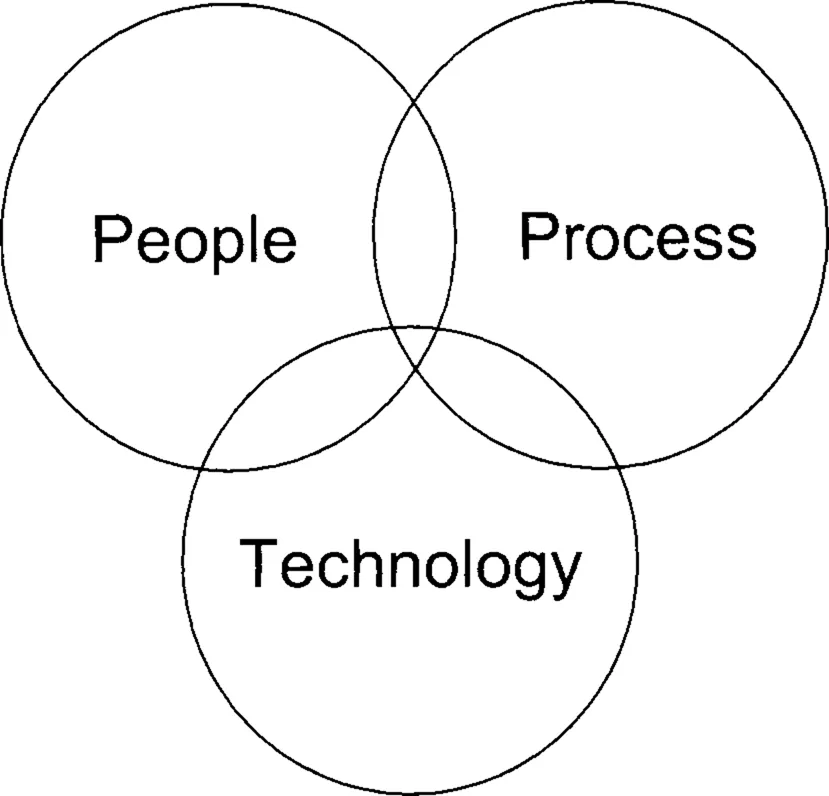
The three legs of the project stool represent the critical components of an implementation (Figure 1-1)—People, Process, and Technology. The people are the most important! When technology projects fail, it is primarily due to a lack of use and not a failure of the software. The focus of change management is people and the objective is to change behavior. This is good for business because it accelerates the change process so benefits are achieved faster. Change management is not about being nice or placing an emphasis on feelings. It’s about performance improvement and results. If you search the literature, you will find a variety of definitions of human-focused change management. They all cover similar concepts, sometimes using different terminology. The simplest explanation of change management is to say, “It’s all about the people!” But for the purposes of this book, we expand on that concept and use the following definition of change management:
A structured process designed to deal directly and intentionally with the human factors involved in not just planning and implementing an EMR but through behavior change, achieving the anticipated benefits that justified the project in the first place.
Desired behavior change is achieved by helping people understand and internalize change and by preparing them to be successful contributors in the future state. In the case of EMR implementations, effective change management delivers users who are willing and able to use an EMR in a way that satisfies the requirements of the job, the needs of the patient, and the health of the organization.
Figure 1-1 : The Three-legged Stool
Well-designed, integrated, people-focused work builds logically over time in a way that makes sense to the user. It brings users along, guiding and supporting them so they arrive at where you want them to be. This is about willingness and ability, hearts and minds. You must have both!
The overarching purpose of change management is to accelerate the speed at which people move successfully through the change process so that anticipated benefits are achieved faster. And there are additional benefits to change management. Through optimizing the efficiency and efficacy of users, an effective EMR change management program will also:
Improve organizational outcomes and performance (effective use of the system generates value to patients and the organization).
Enhance employee satisfaction, morale, and engagement (when people learn new skills, meet performance expectations, and contribute to a greater good they feel pride in their accomplishments).
Improve service quality (users feel valued and supported by an organization that makes an investment in them; this positively impacts how they treat patients).
Help achieve hoped-for benefits (benefits that include EMR value realization, reduction of errors, return on investment).
Create higher levels of openness, trust, involvement, and teamwork (develop an engaged workforce).
Build change capability and capacity in the organization, resulting in improved ability to respond quickly and effectively to new situations (create organizational nimbleness through embedded change management knowledge, structure, and process).
In other words, it really is all about the people. Intentionally managing the cultural, behavioral, and organizational changes that need to take place to make the desired EMR future not only a reality but a sustainable reality pays off on many levels in that it also facilitates organizational transformation. Building on individual capability and organizational capacity, change management results in a change-capable culture—a huge advantage in today’s competitive and fast-changing world.
Change Management, Technology Adoption— What’s the Difference?
There are a number of terms that people use to refer to the work involved in managing the people side of a change effort. We think of change management as the mother ship, that is, the umbrella term that embraces all specialties within the field. Similar to the various specialties or domains of service within a healthcare system, change management professionals may choose specific areas of focus. Technology adoption, specifically information technology (IT), is one such area, and it involves the application of change management principles to the implementation of IT. The focus of this book is technology adoption, and we will mostly use this term instead of change management throughout the rest of the book.
Effective technology adoption professionals align themselves with the operational/business side of the organization and tailor solutions that drive behavioral change and tangible outcomes. They participate in EMR implementation projects from the beginning, driving the people side of change throughout and continuing to add value post-live as the EMR becomes part of the central nervous system of the organization.
THE IMPORTANCE OF THE PEOPLE SIDE OF AN EMR IMPLEMENTATION
There are many references in the literature to failed change efforts and IT implementations. Estimates are that only one third of these projects achieve success, which means two thirds fail to meet expectations. The good news is that failure is optional, as much has been learned about why some change efforts fail and others succeed.
Here’s the issue: while the change that is going to occur is an external event—the EMR implementation, a reorganization, proposed outsourcing, a promotion, etc.—the transition from old to new that those who are impacted experience is a psychological and emotional process. It is this transition that is difficult—even when a change is self-imposed or considered positive.
I...
Table of contents
Cover
Title Page
Copyright Page
About the Authors
Table of Contents
Foreword
Preface
Acknowledgments
Chapter 1: The Business Case for Change Management
Section 1: Leadership—Establishing a Foundation for Change
Chapter 4: Organizational Readiness Team
Section 2: Willingness—Building Commitment
Section 3: Ability—Developing Requisite Skill
Section 4: Summary
References
Index
Trusted by 375,005 students
Access to over 1.5 million titles for a fair monthly price.
Study more efficiently using our study tools.
Frequently asked questions
Yes, you can cancel anytime from the Subscription tab in your account settings on the Perlego website. Your subscription will stay active until the end of your current billing period. Learn how to cancel your subscription
No, books cannot be downloaded as external files, such as PDFs, for use outside of Perlego. However, you can download books within the Perlego app for offline reading on mobile or tablet. Learn how to download books offline
Perlego offers two plans: Essential and Complete
Essential is ideal for learners and professionals who enjoy exploring a wide range of subjects. Access the Essential Library with 800,000+ trusted titles and best-sellers across business, personal growth, and the humanities. Includes unlimited reading time and Standard Read Aloud voice.
Complete: Perfect for advanced learners and researchers needing full, unrestricted access. Unlock 1.5M+ books across hundreds of subjects, including academic and specialized titles. The Complete Plan also includes advanced features like Premium Read Aloud and Research Assistant.
Both plans are available with monthly, semester, or annual billing cycles.
We are an online textbook subscription service, where you can get access to an entire online library for less than the price of a single book per month. With over 1.5 million books across 990+ topics, we’ve got you covered! Learn about our mission
Look out for the read-aloud symbol on your next book to see if you can listen to it. The read-aloud tool reads text aloud for you, highlighting the text as it is being read. You can pause it, speed it up and slow it down. Learn more about Read Aloud
Yes! You can use the Perlego app on both iOS and Android devices to read anytime, anywhere — even offline. Perfect for commutes or when you’re on the go. Please note we cannot support devices running on iOS 13 and Android 7 or earlier. Learn more about using the app
Yes, you can access Change Management Strategies for an Effective EMR Implementation by Claire McCarthy,Doug Eastman in PDF and/or ePUB format, as well as other popular books in Medicine & Business General. We have over 1.5 million books available in our catalogue for you to explore.