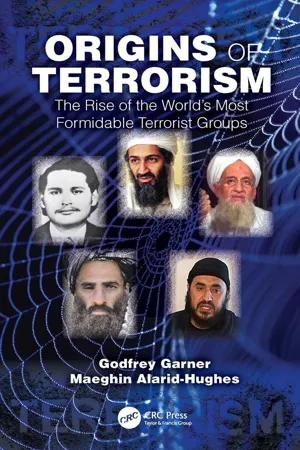
Origins of Terrorism:The Rise of the World's Most Formidable Terrorist Groups examines the roots of Islamic terrorism, it's history, and some of the foundational figures in prominent terrorist organizations. Throughout, the book also addresses the use of terrorism, the "hows" and "whys" of terrorists' goals, and their modus operandi.
Historically, insurgency operations have formed the basis of a number of terrorist groups—resistance to western powers, particularly the United States, and what is viewed as their unwanted interference in regional affairs. Sections are devoted to individual terror organizations, including some of the most well-known and resilient global movements—Al Qaeda, ISIS, the Taliban, and Boko Haram, among others. Coverage details where and how they originated, who the principal organizers were, how these individuals worked—or didn't work—together. In this, the authors look at the circumstances that allowed for these leaders, and their groups', development and success.
In this, the authors expose interesting, little-known stories and facts about the specific upbringing, family life, and personal narrative around these organizations' founders, as well as ties to other terrorist founders and organizations. For example, the relationship between individuals such as Osama bin Laden and Musab al Zarkawi (aka Ahmad al-Khalayleh)—the founder of 'Al Qaeda in Iraq' (AQI), which became ISIS—is examined in detail, providing readers with some of the "stories behind the stories" to understand the prominent figures and underpinnings of major terrorist organizations' philosophies, formation, and elements that have led to their staying power.
Origins of Terrorism will be a valuable resource for security and intelligence professionals, terrorism researchers, and students, providing a unique perspective to understand terrorism and terror movements in considering counterterror efforts.
Throughout this text, we will refer to the concept of “insurgency.” The concept and evolution of insurgency movements are so important to this text and narrative because “terrorism” is used most often to accomplish the objectives of the insurgent, and most terrorists would refer to themselves as “insurgents,” a term that, relatively speaking, carries with it a nobler connotation.
“Insurgency”: this simple word has led to some of the longest-lasting wars and the heaviest tolls in loss of life in the history of mankind. Some experts would assert that insurgency movements have killed more people than the most prolific plagues known to man.
In its simplest form, an insurgency is a movement that develops when a group of people are dissatisfied with the leadership of their country and want to depose it, that is, when a change is sought. Actions of terrorist groups are all directed toward effecting a change of some type, and an insurgency is a process that seeks the greatest change.
Insurgencies generally begin benignly at the ballot box if such exists in the particular country. If unsuccessful, it evolves into force, as frustration grows. As the movement expands, the local government assisted by any allies conducts “counterinsurgency” operations to defeat the movement. The most important aspect of any insurgency/counterinsurgency is the people. The more the people (citizens of the country) side with the insurgent movement, the more is the likelihood of success. Adversely, the more the people resist, or side with the government, the more likely the movement will fail. Without the support of the people, an insurgency cannot survive.
We often refer to an insurgency/counterinsurgency as two beaus trying to woo the same girl. The beaus being the “two movements (insurgents and counterinsurgents), and the girl metaphorically being the people.” As is often the case, the beaus use “carrots” to woo the girl, “come with us, we provide a better life for you.” If however this doesn’t work, the beaus may switch to the “stick” (research will show that most often the “insurgents” signify the beaus who are most willing to shift to the “stick”): “you’ll come with us, or else.”
As said, governments do this (use the stick) as well, but they aren’t as likely or as quick to resort to such, because they wield more power than the insurgents. Finally, “putting a bow on it,” insurgent groups that last long without achieving the stated goals, especially in Islamic countries, at some point become terrorist groups, resorting to terrorism to achieve their objectives. With Islamic extremist terror groups such as Al Qaeda and Islamic State (Daesh), the objective (the change sought) is to attain a pure Islamic state, “pure” the way they perceive it. Terrorism is used to achieve this objective because no other means, as far as they’re concerned, exist for them.
An insurgency is a movement that has its beginning in simple frustration. A good, recent example is the “Arab Spring” movement, which, though highly successful in the beginning, met a wall in Syria, which led to the Syrian civil war which to date has taken the lives of a half million men, women and children and shows no sign of abating. There was little appetite among the young people who launched the movement initially to become terrorists, and of course, as they met with much success early on, there was no need for it. However, the fact is that the government of Syria has been extremely ruthless and barbaric in handling the movement. For his part, Bashar al-Assad, the Syrian President, would argue that the rebels, or insurgents, are nothing more than terrorists.
The Arab Spring movement began in spring 2011 (spark was lit in December 2010) in Tunisia when an elderly street vendor, who used to sell vegetables on the street for years, set himself on fire because the government seized his vendor cart and forced him off the street. The ensuing demonstrations caused the Tunisian leader to abdicate and flee the country, and all this happened in a very short period of time. The movement quickly spread to Egypt and Libya, meeting with similar success. When it developed in Syria, however, a full-scale civil war erupted that continues till today.1
Another example of a successful insurgency is that which took place in Vietnam. This insurgency took the lives of millions before it ended in unification of north and south, in 1975; again, a successful insurgency that was birthed in a moment of frustration.
In short, an insurgency is a rebellion against existing rule. It is carried out by individuals referred to as insurgents. Some would say an insurgent can also be referred to as a “freedom fighter,” but the choice of either term is strictly a relative one. It is entirely in the mind of the beholder, which brings up the principal problem in conducting a successful insurgency, gaining support and agreement from those most affected. Every insurgency faces the problem of convincing those affected (the citizens) to join the process. Successful insurgencies are successful because the majority of the people support them, by choice or because they are forced or coerced into support.
The consideration of “freedom fighters vs. terrorists” is very convoluted. Even Ronald Reagan spoke of this in a 1985 speech. The topic is the subject of countless journal articles and research papers and has been debated back and forth among those in the defense arena. Some scholars argue that freedom fighters or terrorism is “justifiable” provided it adheres to the “Just War” criteria.
Michael Walzer, a historian who wrote Just and Unjust Wars (1977), describes this as terrorism being permissible under “extreme emergencies.”2 The most interesting point in this work, “one person’s freedom fighter is someone else’s terrorist,” is that the perceptions of individuals involved are often based on their geographic proximity to the actions of the freedom fighters/terrorists. If this is happening in your own backyard, or you are the target of the action, you may look at a group as terrorists. If you are on the other side of the world and removed from the direct actions of the group, you may see them as freedom fighters. As an example, Israelis may see the Palestinian Liberation Organization as terrorists, but those far-removed from the conflict may feel Palestinians have a right to a homeland and call the group freedom fighters.
An insurgency begins as stated, through frustration against the current leadership of a country. This frustration grows until it evolves into resistance. This resistance may materialize as peaceful or violent (most insurgencies begin as peaceful movements). Mahatma Gandhi and Martin Luther King, for instance, led peaceful and successful insurgencies. As stated, the aforementioned Arab Spring insurgency began as peaceful resistance, but led to civil war.
Al Qaeda, though it began in Pakistan as a support movement for the mujahideen fighting against the Russians in Afghanistan, quickly became a terror organization, following withdrawal of Russian troops from that country. Most analysts believe that Osama bin Laden intended the development of Al Qaeda all along, but the focus had nothing to do with the war in Afghanistan. His intent all along was resistance to the Saudi Royal Family’s embracing of the west, and the opportunity presented itself when Saddam Hussain invaded Kuwait. As it developed, bin Laden very simply made the calculated decision to use acts of terror to accomplish his goals (Figure 1.1).
Figure 1.1 Arab Spring protests in Taiz, Yemen, February 2011. (Source: www.shutterstock.com; Used with permission).
His hatred was directed primarily toward the United States and its allies, but it began as a hatred for and a resistance against his own country. We will see, as we go forward, this same pattern evolving with most of the other organized terror groups: resistance, insurgency and terrorism.
Religion and its Role in Islamic Extremism
From the beginning of this text, we have been and will continue to provide examples in order to allow the student of this most important subject to better understand the context. This section will delve into the impact certain interpretations of Islam have, and will continue to have, on extremism. It is an understatement to point out that the worst of any religion lies in its interpretation, and Islam is certainly not insulated from this. As a matter of fact, various interpretations of the Prophet Mohammad’s intent on basically all matters and questions (e.g., what did he intend in taking this action or declaring this) are possibly more varied and confusing than those of any other religion, Christianity included. Every religion has, to varying degrees, extremist-driven narratives that more often than not cause hardship. Think of “what you know and understand” when you are reading about and studying “what you don’t know, or understand.”
Islam in America, the UK, or even Saudi Arabia is so vastly different from Islam in Afghanistan as it seems to be a different religion altogether. This section however will focus on what the authors know about Islam in Afghanistan since that region provides a framework for most of the extremist groups in the world today.
Initially, the reader must understand that Islam and its guiding principles, as well as the perceived (word “perceived” is vitally important) intent of the Prophet Mohammad and the Quran and Hadith, are all encompassing in Afghanistan. Islam controls every facet of life, especially in the back country. Nothing, absolutely nothing, is done without first considering the Quran or the Hadith or simply what is universally understood about Islam and its principles.
Business is not conducted without it, governmental functions are not performed without it, and simple daily interactions with a neighbor or a family member for that matter are not conducted without it. To ask that Islam takes a back seat to any other consideration is asking a fish to forgo the use of water.
This is both a good thing and a bad thing. The importance of religious advisors present at all times to “advise” terrorist leaders as to their actions has been a guiding factor in everything from negotiations to suicide attacks and plays that same role today. Terror leaders such as the late Osama bin Laden, Mullah Mohammad Omar and Musab Zarqawi all kept their “favorite, preferred” mullah or spiritual advisor close at hand throughout all their operations. Zarqawi, for instance, consulted a spiritual advisor before he ordered the suicide attack on a Jordanian wedding celebration that killed hundreds of men, women, and children. He no doubt slept well afterward knowing he was within the will of Allah.
The bad thing about such dogmatic adherence to a religious philosophy is that it removes the need for moral consideration or self-restraint or guidance of the individual conscience. If your spiritual advisor tells you that it is Allah’s will that you kidnap and rape Yazidi girls as young as 14 but no younger, then there’s no reason to think the matter through. This was a common practice by ISIS. They kidnapped numerous Yazidi women and young girls and forced them into sexual slavery; according to them, it is all within the bounds of Islam.
Another compelling factor along these lines specific to the country of Afghanistan, particularly in the regions away from the cities, is extreme poverty. People who haven’t experienced it the way Afghans in the villages experience it lose sight of the physical toll it takes on one, just to survive and to feed families. This is vitally important because moral considerations, matters of the conscience and right vs. wrong are all matters that require energy and effort to consider. It’s much easier just to follow the guidance than to take the time and effort to conceptualize or mentally debate. The local Mullah will tell you what’s right. Just do it and don’t waste time and energy thinking about it.
Off the subject slightly, but this is a prime reason “democracy” has never worked well and probably never will work well in the “back country.” Most people don’t realize it, but “democracy” on the part of individuals involves mental and often physical efforts, and there’s very little of that available, especially when the rewards are never considered to be worth the effort.
Another benefit of this adherence to strict interpretations of Islam, however, is that many young people can be swayed at times by a cogent argument using the Quran. One of the authors of this text has been involved in interrogations in which young people have changed their focus because of logical arguments and explanations as to the error of their Islamic interpretations or the error of their ways. The Jordanian Mukabarat (counterterror unit) was often successful in the early days, in influencing Musab Zarqawi, before he became the rock star persona in the terror world that would supersede all else until his death.
Finally, on this subject, Afghans, especially rural Afghans who of course make up the vast majority of the country’s people, are completely convinced that their brand of Islam is the only pure Islam and that all other Muslims are inf...
Table of contents
Cover
Half Title
Title Page
Copyright Page
Contents
Preface
Authors
1 Insurgency, Religion and Terrorist Relationships
2 Terror Mind Manipulation
3 Terrorist Landscape: Laying a Foundation
4 How bin Laden Rose to Fame: A Historical Perspective
5 A Closer Look at bin Laden
6 What about Russia?
7 Meeting Key Players: Mullah Omar and the Taliban
8 Osama bin Laden; Mullah Mohammad Omar; Their Focus during This Period
9 Abu Musab Zarqawi
10 Birth of the Islamic State
11 Women within Terrorism: New Tactics and What We Can Expect Next
Index
Trusted by 375,005 students
Access to over 1.5 million titles for a fair monthly price.
Study more efficiently using our study tools.
Frequently asked questions
Yes, you can cancel anytime from the Subscription tab in your account settings on the Perlego website. Your subscription will stay active until the end of your current billing period. Learn how to cancel your subscription
No, books cannot be downloaded as external files, such as PDFs, for use outside of Perlego. However, you can download books within the Perlego app for offline reading on mobile or tablet. Learn how to download books offline
Perlego offers two plans: Essential and Complete
Essential is ideal for learners and professionals who enjoy exploring a wide range of subjects. Access the Essential Library with 800,000+ trusted titles and best-sellers across business, personal growth, and the humanities. Includes unlimited reading time and Standard Read Aloud voice.
Complete: Perfect for advanced learners and researchers needing full, unrestricted access. Unlock 1.5M+ books across hundreds of subjects, including academic and specialized titles. The Complete Plan also includes advanced features like Premium Read Aloud and Research Assistant.
Both plans are available with monthly, semester, or annual billing cycles.
We are an online textbook subscription service, where you can get access to an entire online library for less than the price of a single book per month. With over 1.5 million books across 990+ topics, we’ve got you covered! Learn about our mission
Look out for the read-aloud symbol on your next book to see if you can listen to it. The read-aloud tool reads text aloud for you, highlighting the text as it is being read. You can pause it, speed it up and slow it down. Learn more about Read Aloud
Yes! You can use the Perlego app on both iOS and Android devices to read anytime, anywhere — even offline. Perfect for commutes or when you’re on the go. Please note we cannot support devices running on iOS 13 and Android 7 or earlier. Learn more about using the app
Yes, you can access Origins of Terrorism by Godfrey Garner,Maeghin Alarid-Hughes in PDF and/or ePUB format, as well as other popular books in Politics & International Relations & Cyber Security. We have over 1.5 million books available in our catalogue for you to explore.