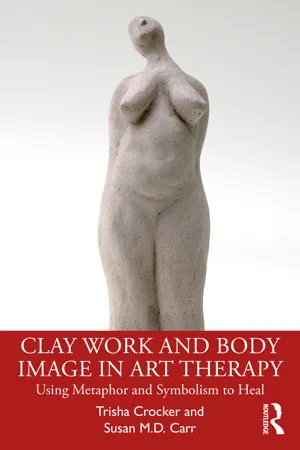
Clay Work and Body Image in Art Therapy provides an important addition to resources available in the field of clay work and art therapy, highlighting the unique sensory aspects of the medium and its ability to provide a therapeutic resource for women who experience body image issues.
Chapters offer a comprehensive distillation of current knowledge in the field of body image, clay work, neuroscience, and art therapy, building a theoretical framework around personal narratives. Case studies examine the benefits of exploring body image through clay work within art therapy practice, providing a positive and contained way to find personal acceptance and featuring photographs of clay body image sculptures created by research participants that highlight their individual stories and experiences. As well as offering both clinical and practical implications, the text provides a full protocol for the research and evaluation methods carried out, enabling further replication of the intervention and research methods by other therapists.
This book highlights clay work as a significant resource for art therapists, arts in health practitioners, and counsellors, providing an emotive yet contained approach to the development of personal body image acceptance and self-compassion.
I was born in Hollywood, California and brought up in Beverly Hills during the 1950s, an area of the world known for its obsession with the ‘perfect’ body. Becoming a professional dancer in the 1960s, I attended many auditions where the choreographer was less interested in the perfect kick than in the perfect bottom! One can point the finger at social media, air-brushed models, even painfully thin Disney characters; whatever the reasons the results are the same – women feel pressurised to conform to an unrealistic female body image, and to feel flawed and ugly if they do not, resulting in a lack of self-esteem, and poor body image.
My personal interest in the effect of poor body image on women developed when, later in life, I became a dance and fitness instructor. I remember how astounded I was to find that so many of the beautiful women I taught had negative thoughts about their bodies. I was particularly concerned as these women seemed outwardly confident and comfortable in their bodies, and yet they all expressed stress and anxiety around their body image. I wondered why so many women seemed dissatisfied with their bodies, and where this self-judgement emanated from.
Later, from my experience as an art therapist working with women with a negative body image, I began to see how this could lead to the women experiencing feelings of utter despair and self-loathing, resulting in anxiety, depression, and a lack of self-confidence. I began thinking about the potential value of creating images using the tactile and three-dimensional properties of clay as a safe tactile material for women to explore their body image, and turn their negative experiences into positive ones.
I was also inspired to develop a suitable intervention for women with body image issues after reading a book called A Waist Is a Terrible Thing to Mind (Philips et al. 2000), a collection of poems and stories written by women across America, describing the ways in which they battled with a negative body image. I discovered the book quite unintentionally whilst exploring body image through working on my own series of clay sculptures of women. My attention was immediately seized by the urgency and despair in the writings, a despair I recognised in my own art therapy clients, underlining for me just how important this subject is. I was also struck by the link between mothers and daughters and body image. Here ‘Maggie’ writes about her anxiety for her unborn daughter:
Most of all, this is for my daughter, a daughter who is not even born. A daughter I would comfort, tasting the tears off her cheek when one day she, too, learns that she is not pretty enough, she is not perfect enough [. . .] simply not enough.
(Maggie, quoted in Philips et al. 2000, p.166)
Maggie goes on to say:
This is for the tears I will cry with her because I have no words to feed the empty place in her that will never understand that she absolutely IS just enough.
(ibid.)
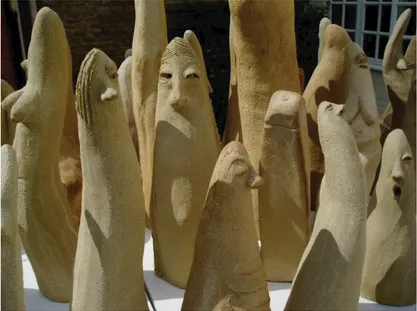
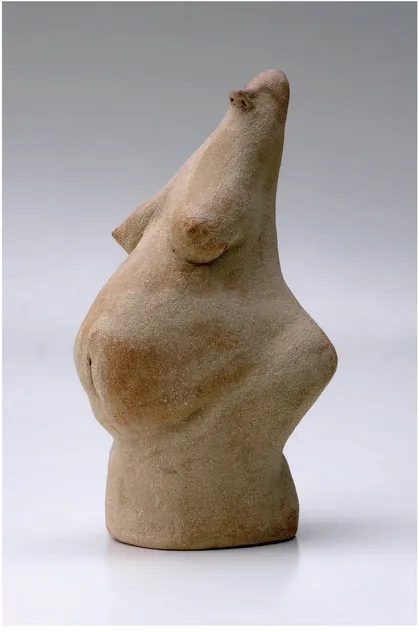
Ideas for the intervention were sparked when, during a clay teaching session, I intuitively sculpted a small shape and gave it breasts and a belly. In between the weekly sessions I felt drawn back to the studio to make another, larger sculpture of a round-bellied women with full breasts and buttocks. When women from a ceramics class I was running at the time walked into my pottery the following week and saw the sculpture, one pointed at one of my sculptures and exclaimed “That is definitely me!” The following week another lady from the class walked in and saw my latest sculpture and exclaimed “This one is me!” I therefore became aware that women identified strongly with my sculptures, and I felt compelled to sculpt the female form in all its multitudes of shapes and sizes and at different ages. This resulted in a series of over 200 sculptures I called An Army of Women (see Figures 1 on p.5 & 2 on p.6), which were exhibited in 2008 at Norden Farm, in Maidenhead, The Mirror Gallery, South Hill Park, Bracknell, and the Henley Festival. An Army of Women spoke to me about feelings of ‘solidarity’ with all women and the idea of there being ‘strength in numbers’. It seemed to me that each of my sculpted ‘women’ possessed a soul and a reason for existence, and the key message I wanted the Army of Women to portray, was for women to recognise that each of them, in their own unique way, is beautiful, and is ‘enough’, no matter what shape or size they are.
In a review written about the exhibition, Dr Outi Remes (2010) wrote that the work portrayed ‘bodies of difference’ and a ‘celebration of the female form’ with ‘multiple body shapes and colours’ without any hierarchy of race or class. At the exhibition, I witnessed strong emotions from many female visitors, who often remained near the sculpture they most identified with, seemingly searching for the ‘soul’ within the piece. Through this ‘soul searching’ they were able to find their own personal connections and interpretations within the ‘army’.
Therefore, the Army of Women is testimony to my personal exploration of the female form in clay, something that has been explored as far back as 28,000 years ago (Henley 2002), since humans first took a fist of clay or stone and fashioned it into the shape of a woman. Small figures, often referred to as ‘Venuses’ with overly large breasts and bellies, were fashioned out of clay, then placed on hot coals until they exploded, signifying their magical significance and power as objects of fertility (ibid., p.83). Clearly, despite the span of centuries, the female form remains a subject of curiosity and awe, and these ancient creations resonate and share a kinship with my own early clay work and those of the women who share their own personal stories and creations around body image within this book.
Figure 1 “An Army of Women No. 1” by Trisha Crocker, 2008.
In my own art therapy practice I use a person-centred approach to clay work, with the focus often being on that of play. I currently work at a school with excluded children aged between 5 and 11 years, and play works because it comes naturally to children, and my role is about ‘being with’ the child, allowing them to interpret their creations, and develop personal understanding so that opportunities for change can become a natural outcome. This same paradigm of clay work as ‘play’ was used in the PhD research case studies (Crocker 2017), discussed in this book. Play speaks of letting go, of being given permission to ‘make a mess’, allowing a sense of freedom and learning to develop, within the ‘held’ therapeutic space. My PhD thesis explored clay as a tool to help women heal their body image issues, and the evidence provided by this is outlined within this book, offering a new intervention for art therapists to use in their practice, providing the full protocol and analysis techniques used within the study to aid replication. The evidence provided within this book
Figure 2 “Large and Lovely” by Trisha Crocker, 2008.
shows that women who create their body image in clay are (perhaps for the first time) able to take ownership of that image and to heal the psychological trauma of never feeling ‘good enough’.
A Creative Collaboration: Embodiment and Self-Portrayal, by Susan Carr
It was a natural development for Trisha and I to collaborate on this book. When we were art therapy students together, we both aspired to continue our MA research by individually undertaking a PhD, and although the subject matter of our PhDs differ, they are linked by a fundamental interest in self-portrayal and disturbances in body image, whether it be through the impact of illness, or the impossibility of living up to idealistic female social stereotypes.
My own interest in body image was sparked by my work as an art therapist in the field of palliative care. My PhD – developing Portrait Therapy (2015, 2018) – was therefore inspired by working with clients, and involved developing an art therapy intervention for patients living with life threatening or chronic illnesses. Portrait Therapy reverses the traditional terms of engagement within art therapy and uses the art therapist’s artistic practice or ‘third hand’ (Kramer 1971, 1977, 2000; Carr 2014, 2015, 2017, 2018) to create portraits for patients; however, in a series of ‘negotiations’, the patients co-design their own portraits – directing how they wish to be portrayed.
This builds on an understanding that severe illness is not just an attack on the body, it is an attack on a person’s sense of self-identity and body image, shattering the means by which a person experiences the world, and by which they also are experienced. This profound sense of loss and disruption to self-identity and body image contributes to a person’s sense of distress and powerlessness and is made manifest in statements such as “I don’t know who I am anymore” and “I look in the mirror and say ‘who’s that?’”
As body image is an integral part of self-identity, it is important to explore this in relation to the creation of an ‘embodiment’ of the self in clay. Concepts such as ‘self’ and ‘identity’ have been historically, and to this day, a complex and contested phenomenon (Bauman 2004 p.77; Lawler 2008), with meanings that are both ambivalent and elusive (Vecchi 2004, p.2). However, they remain key topics of interest across the social sciences (e.g. Oyserman et al. 2012; Leary & Tangney 2012).
For the purposes of this book, we describe a ‘cohesive sense of self-identity’ as comprising: ‘a realistic body image, subjective self-sameness, consistent attitudes, temporality, gender, authenticity, and ethnicity’ (Akhtar & Samuel 1996). However, Palmer’s (2007 [1998]) description of identity is also important as it brings together all the diverse cultural and nurturing elements that may make up a person’s sense of self-identity. He describes identity as
[. . .] an evolving nexus where all the forces that constitute my life converge in the mystery of self: my genetic makeup, the nature of the man and woman who gave me life, the culture in which I was raised, people who have sustained me and people who have done me harm, the good and ill I have done to others and to myself, the experience of love and suffering [. . .] identity is a moving intersection of the inner and outer forces that make me who I am, converging in the irreducible mystery of being human.
(Palmer 2007 [1998], p.14)
Self-identities can therefore be viewed as relational and also culturally constructed (Evans 2005a, p.40) or at least culturally influenced, and as such char-acterised by change and fluidity, sometimes referred to as a ‘reflexive project’ (Giddens 1991, p. 32).
Embodiment
For renowned phenomenological philosopher Merleau-Ponty (1908–1961), the body is central to how we experience and interpret the world, and is the whole reason we have a world to experience (Merleau-Ponty 2002). Certainly, our embodiment is central to our experience as human beings and it is through our bodies that we are able to understand other people (ibid. p.186). This is something that Finlay (2009) describes as our ‘embodied intersubjectivity’, or our ‘corporeal commonality’ (p.8). As therapists and researchers, it is therefore important to be able to put ‘oneself into the experience of the patient as much as possible, feeling it as if in one’s own body – without losing a separate sense of self’ (Yontef 2002, p.24).
With an understanding that the body or embodiment is central to all aspects of perception, consciousness, and human experience (Merleau-Ponty 2002), the concept of the body as home can be recognised, with body image sculptures therefore becoming a depiction of a person’s sense of homelike or unhomelike-being-in-the-world (Svenaeus 2011). The idea of ‘home’ brings to mind a protective material environment, combining a sense of permanence, security and continuity, with a space that is full of emotional significance and meaning (Dupuis & Thorns 1998, p.30).
With our bodies so significant to our understanding of the world, it follows that as human beings we are intensely conscious of our own bodies and those of other people. A large part of the way we communicate with others is through body language or facial expressions, instantly recognising behavioural or emotional clues that tell us something about the thoughts, feelings and intended actions of the other person (Freeland 2010, p. 154). When creating our own body image out of clay, the sculptural form becomes imbued with personal significance that can be perceived by others, it exists in space in a way that bodies do and has an intentionality that is recognisably human. This subject/object that is both ‘me’ and ‘not me’, ‘home-like’ and ‘unhome-like’, is a significant therapeutic vessel for exploring the intra-personal relationship one has with one’s own body, and how that body relates to others and the world. The process of creating one’s body image in clay enables people to depict themselves as they see themselves, through the lens of the distorted mirror that encapsulates all the damaging things others have said about their bodies over time, and then gradually rectify these distortions through the malleability of clay, coming to a more balanced and personally healing view of the self.
Clay as a Therapeutic Medium
For most of the women who attended the body image sessions featured in this book, clay work was new to them, or at the very least a distant memory from art classes at school, or from making ‘mud pies’ in the garden as a child. As such it was still a familiar material, something that was unlikely to provoke anxiety as a medium. Derived from the very building blocks of mother nature and the universe, the therapeutic and cathartic nature of clay is clearly evident, and the sensory playful qualities it exudes are plain to see.
In its natural form clay is: tactile, wet, malleable and messy, it can be shaped, scraped, cut, rolled, squashed, squeezed and even poured and ‘clay has the capacity to be done and undone multiple times, providing the opportunity to smash down or remake a clay-sculpture’ (Rubin 1984, p.58). Once fired, clay becomes solid, immovable, durable, and yet retains a fragility that reflects the human condition. The firing process, like that of life, is dangerous and unpredictable, with clay sculpture prone to breaking, cracking, or exploding within the kiln.
Clay is a sensory, tactile, three-dimensional material for creating one’s own body image; it allows for play and reflection in ways that other two-dimensional materials do not. It can be cut, pulled apart and then repaired and put back together, becoming a metaphor for injury, trauma, and making whole again. These processes of change are the practical benefits of clay work. Within this context we understand the term ‘clay work’ (which other authors may write as ‘clay-work’ or ‘claywork’) to mean ‘the process of handling, manipulating, and sculpting clay, and the products of these activities’ (Sholt & Gavron 2006, p.66), highlighting that an ‘art expression is not merely the final product but is also the process by which the product has been developed, and that process and product foster significant psychological processes, revealing meaningful information about the creators’ inner world’ (ibid.). In her therapeutic clay work with children, Rhodes (2008) suggests that pinching, poking, squeezing, constructing, and cutting away are what create the clay work.
A useful theory for therapeutic clay work was identified by Souter-Anderson (2010) as a theory of contact: physical, emotional, and metaphorical; she describes this as follows:
[. . .] playing with the medium is a physical contact, a sensate experience, with the substance that appears to stir feelings and make contact with emotions whilst simultaneously engaging with the world, the imagination, thus incorporating a metaphorical contact.
(Souter-Anderson 2010, p.51)
For the purposes of this book, and the research it refers to, we use Sholt and Gavron’s (2006) description of the characteristics of ‘clay work’ as including ‘procedural expression through touch, movement, and the three-dimensional aspect, the reflection of construction and deconstruction processes, and the regression process’ (p.66). Sholt & Gavron also suggest that clay is ‘a familiar material in art therapy and in psychotherapy’ which many promote for its capacity to provide a therapeutic tool ‘in individual and group therapies’ (Sholt & Gavron 2006, p.66).
Working with clay stimulates all the senses and involves ‘very primary forms of expression and communication’ (Snir & Regev 2013, p.95). Henley (2002, p.75) believes that re-creating the body image in clay ‘naturally invites projective identi...
Table of contents
Cover
Half Title
Title Page
Copyright Page
Dedication
Contents
List of Figures
Acknowledgements
SECTION 1 Preparing the Ground - Digging for Clay
SECTION 2 Vignettes and Case Studies - Shaping the Self
SECTION 3 Protocol, Evaluation Methods, and Conclusions - Opening the Kiln
Bibliography
Index
Trusted by 375,005 students
Access to over 1.5 million titles for a fair monthly price.
Study more efficiently using our study tools.
Frequently asked questions
Yes, you can cancel anytime from the Subscription tab in your account settings on the Perlego website. Your subscription will stay active until the end of your current billing period. Learn how to cancel your subscription
No, books cannot be downloaded as external files, such as PDFs, for use outside of Perlego. However, you can download books within the Perlego app for offline reading on mobile or tablet. Learn how to download books offline
Perlego offers two plans: Essential and Complete
Essential is ideal for learners and professionals who enjoy exploring a wide range of subjects. Access the Essential Library with 800,000+ trusted titles and best-sellers across business, personal growth, and the humanities. Includes unlimited reading time and Standard Read Aloud voice.
Complete: Perfect for advanced learners and researchers needing full, unrestricted access. Unlock 1.5M+ books across hundreds of subjects, including academic and specialized titles. The Complete Plan also includes advanced features like Premium Read Aloud and Research Assistant.
Both plans are available with monthly, semester, or annual billing cycles.
We are an online textbook subscription service, where you can get access to an entire online library for less than the price of a single book per month. With over 1.5 million books across 990+ topics, we’ve got you covered! Learn about our mission
Look out for the read-aloud symbol on your next book to see if you can listen to it. The read-aloud tool reads text aloud for you, highlighting the text as it is being read. You can pause it, speed it up and slow it down. Learn more about Read Aloud
Yes! You can use the Perlego app on both iOS and Android devices to read anytime, anywhere — even offline. Perfect for commutes or when you’re on the go. Please note we cannot support devices running on iOS 13 and Android 7 or earlier. Learn more about using the app
Yes, you can access Clay Work and Body Image in Art Therapy by Trisha Crocker,Susan M.D. Carr in PDF and/or ePUB format, as well as other popular books in Medicina & Tecniche artistiche. We have over 1.5 million books available in our catalogue for you to explore.