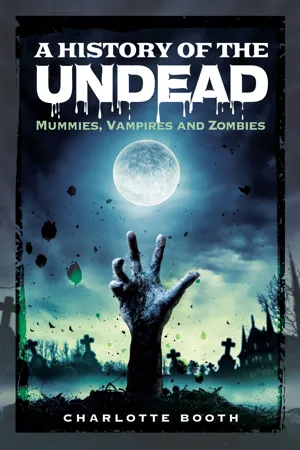
A history of Western culture's fascination with undead creatures in film and television.
Are you a fan of the undead? Watch lots of mummy, zombie and vampire movies and TV shows? Have you ever wondered if they could be "real?"
This book,
A History of the Undead, unravels the truth behind these popular reanimated corpses.
Starting with the common representations in Western media through the decades, we go back in time to find the origins of the myths. Using a combination of folklore, religion and archaeological studies we find out the reality behind the walking dead. You may be surprised at what you find . . .
- 224 pages
- English
- ePUB (mobile friendly)
- Available on iOS & Android
eBook - ePub
About this book
Information
Chapter 1
Mummies in the West
Introduction
Mummies are a relatively new introduction to Western media; only really making an appearance in the early twentieth century. They are inevitably associated with the mummified human remains from ancient Egypt and were therefore more prolific once Egyptology as a discipline became more mainstream at the end of the nineteenth century.
So what is a ‘traditional’ mummy in Western media? Essentially, mummies presented in literature, movies and television series are reanimated corpses wrapped in bandages. As Dendle commented in 2001, ‘a mummy is just a zombie with bandages,’1 which to a certain extent is true.
Unlike zombies, how mummies are reanimated is not always considered that important to the plot. A typical trope in both movies and literature is that reanimation is often due to a curse cast upon the person by ancient Egyptian necromancers, making them victims rather than perpetrators.
It is an interesting twist to the mummy ‘history’ that the British were once thought to be such necromancers, as Egyptologist, Arthur Mace, wrote in his journal (February 6, 1900):
‘The Arabs have a very curious notion as to the reason why we take so many skeletons. They think that in England we are very short of men, and so being very great magicians we can take these bones and bring them to life again.’2
In literature and movies, however, Western necromancers are rarely the ones who bring mummies back to life, despite the Egyptians’ superstitions to the contrary. The necromancers are always represented as being Egyptian; often descendants of the ancients.
Although mummies are the product of such necromancers, when reanimated they are considered ‘evil’ and intent on causing harm even though they are under control of their masters. This adds fuel to the further popular theme of the ‘curse of the mummy,’ which is visited upon its unfortunate victims. This will be discussed further in the following chapter.
Mummy Medicine
Mummies, unlike zombies and vampires, have been embraced in an entirely different way in the West; possibly because they are ‘real’ and can be viewed in museums. They have also been used in a practical way due to their very tangible and real nature.
One of the most bizarre practical applications of mummies is as a medicament. For hundreds of years in the West people knowingly ingested ground-up corpse – known as mummia – for their health. Mummia has been recorded as a medicine since the tenth century and one of the earliest records is of a Persian physician called Avicenna (980–1037 CE), who claimed mummia was used for treating abscesses, eruptions, fractures, concussions, paralysis, epilepsy, vertigo, blood from the lungs, throat, coughs, nausea and disorders of the liver and spleen. It was mixed with herbs before being taken internally.3
Whether this early mummia had any connection to mummies is unlikely as the name mummia was closely associated with a type of bitumen that flowed from a mountain in Persia. When mixed with water it gave off an odour considered beneficial when inhaled. However, the practice of mummification in the later years of Egyptian history included coating the body in a layer of bitumen as an aid to preservation. It is therefore likely that as the name mummia was so similar it was soon to be considered as the same. The earlier records of mummia as medicine probably referred to bitumen whereas by the sixteenth century mummia was made with ground mummies.
Records of mummia being ingested by the rich and influential of Western society for their health become more prevalent in the sixteenth century. In 1549 André Thevat, chaplain to Catherine de Medici, queen of France between 1547 and 1559, is recorded as travelling on expedition to search for mummies for medicine in Saqqara.4
It is also recorded that the physician John Hall (1575–1635), Shakespeare’s son-in-law, used mummia to treat a case of epilepsy. He added it to a mixture of black pitch, benzoic resin and juice of rue and had his patient inhale the smoke when it was burned,5 perhaps closer to the original use of mummia bitumen.
Royalty were known to take mummia, with François I of France (1515–1547) mixing it with rhubarb to treat all manner of ailments from headaches to broken bones.6 Even Britain’s Queen Victoria was recorded as using it when the King of Persia sent her some from the mummy mountain in Persia.7 This was, however, more likely to be bitumen than powdered mummy.
Once the popularity of the medicine became apparent among the wealthy, there was a prolific trade in human and animal mummies from Egypt to Europe to meet demand. Thomas Pettigrew in his History of Egyptian Mummies (1834) said: ‘No sooner was it credited that mummy constituted an article of value in the practice of medicine than many speculators embarked in the trade; the tombs were sacked, and as many mummies as could be obtained were broken into pieces for the purpose of sale.’8
People were buying mummies in bulk for medicines and it is recorded that in 1564 Guy de la Fontaine, the physician of the king of Navarre (a Basque-based kingdom bear the Pyrenees), purchased a bulk order of mummies for this purpose. However, he was horrified to note they were not the genuine article and were, in fact, no older than four years.
The supply and demand disparity started the trade in unclaimed bodies of criminals and the poor. De la Fontaine investigated the trade and discovered that such ‘unclaimed wretches were treated with bitumen and then aged in the sun, producing a rather good likeness of ancient mummified flesh.’9 Pettigrew further added that one particular merchant stated: ‘he cared not when they came, whether they were old or young, male or female, or of what disease they had died, so long as he could obtain them … when embalmed no one could tell.’10
Indeed, even fake mummies were put together with so-called children’s mummies, being made of ibises or even the flesh of camels moulded into the right shape.11 Such fakes had been in circulation from about 1200 CE onwards,12 and there are numerous tales of people purchasing fake mummies believing them to be the genuine article.
However, they were not always the bodies of the poor and criminal classes. W.M.F. Petrie, the eminent Egyptologist, was told of a tourist who had bought a mummy from Aswan, which was eventually identified as the body of an English engineer who had died there.
This entrepreneurial idea was later adopted in Anne Rice’s novel The Mummy, where Henry Stratford, the well-born, gambling drunk was murdered and ended up ‘floating in the bitumen,’13 turning him into a lovely mummy for tourists to buy.
The practice, while a common one, was generally condemned, and as early as 1645 an apothecary admonished his staff for selling ‘arm or a leg of a decaying or hanged leper or of some whorehopper suffering from syphilis’ as genuine mummy.14
The threat of purchasing a fake, however, did not deter people from purchasing such a souvenir from their trip to Egypt. Many ended up as mummia until as recently as 1908 when it was still being sold as a cure- all medicine. It was advised that it should be applied to the affected area or ingested in water. It was not only in the West either that mummia was considered useful. In Egypt at this time it was mixed with butter as a cure for bruises.15
Surprisingly, using mummia in medicine was not considered quackery, and there were some distinguished members of Western society who advocated its use. Francis Bacon (1561–1626), for example, believed it ‘hath great force in staunching of blood’,16 and the Irish philosopher, chemist and physicist Robert Boyle (1627–1691) recommended it for falls and bruises,17 following the native Egyptian use of it.
It is likely that using mummia fell out of popularity, not due to the horror of consuming dead human flesh, but the growth in scientific thinking, as well as the rumour that it may have been instrumental in spreading the plague.18 Although the demand plummeted, as recently as 1973 a New York store sold powdered mummy as a witches’ supply,19 although whether it was the ‘genuine article’ has not been confirmed.
Art Materials
Medicine was not the only dubious use of crushed corpses. Artists were also prolific users of ground-up mummies in the paint colour known as ‘Mummy Brown’, caput mortuum or Egyptian Brown. This colour was popular from the early 1700s but by the 1960s it was falling out of fashion as the supply of mummies came to an end.
The paint was produced by London manufacturer, C. Roberson who stocked and sold ‘Mummy Brown’ throughout the 1920s and 1930s. By the 1960s, sales were declining and in 1964 the managing director said: ‘We might have a few odd limbs lying around somewhere, but not enough to make any more paint.’20
It is recorded that one Egyptian mummy provided enough material to produce paint to satisfy their artists for two decades.21 To produce the paint, crushed mummy was mixed with white pitch and myrrh producing a rich colour which by the mid-nineteenth century was very popular. ‘The pigment itself wasn’t easily imitated. It wasn’t just made of regular long-dried out corpses. The mummification process involved asphaltum or bitumen, often in place of the removed organs. Whole mummies were then ground for commercial and just plain wrong use. Mummy Brown was a fugitive colour, meaning it faded easily.’22
However, despite the name not everyone was aware of the grisly ingredients. Once these became common knowledge it contributed to the decline in popularity.
There is one well-known tale of the funeral of a tube of Mummy Brown, which is recounted by the widow of Pre-Raphaelite artist Edward Burne-Jones, Georgina. She recalls how Lawrence Alma-Tadema and his family were visiting them: ‘We were sitting together after lunch … the men talking about different colours that they used, when Mr Tadema startled us by saying he had lately been invited to go and see a mummy that was in his colourman’s workshop before it was ground down into paint.’ The artists did not believe the paint was made with real mummy, stating it must simply be a clever name. ‘When assured that it was actually compounded of real mummy, he left us at once, hastened to the studio, and returning with the only tube he had, insisted on our giving it decent burial there and then. So a hole was bored in the green grass at our feet, and we all watched it put safely in, and the spot was marked by one of the girls planting a daisy root above it.’23
At the height of the use of Mummy Brown paint Isaac Augustus Stanwood, an American paper manufacturer, was also using mummy wrappings to make brown paper. This was then sold to butchers and grocers to wrap food for sale. When there was an outbreak of cholera the paper was no longer made or used, though whether the outbreak was due to the paper was never proved.24
Although mummies were used as a commodity for both medicine and paint for centuries there were people who objected to the practice. As early as 1658, the philosopher Sir Thomas Browne stated: ‘The Egyptian mummies, which Cambyses or time hath spared, avarice now consumeth. Mummie is become Merchandise, Mizraim cures wounds, and Pharaoh is sold for Balsoms25 … surely such diet is dismal vampirism; and exceeds in horror the black banquet of Domitan, not to be paralleled expect in those Arabian feasts, wherein Ghoules feed horribly.’26
Mummies for Entertainment
The nineteenth century was the height of archaeological practice in Egypt and there was, therefore, a large supply of m...
Table of contents
- Cover
- Title
- Copyright
- Contents
- Illustrations
- Introduction
- Chapter 1 Mummies in the West
- Chapter 2 Unwrapping the Mummy Myth
- Chapter 3 Zombies in the Modern West
- Chapter 4 Identifying Zombie X
- Chapter 5 Vampires in Western Media
- Chapter 6 The Modern Vampire
- Chapter 7 Uncovering the Vampire Myth
- References
- Notes
- Plate section
Trusted by 375,005 students
Access to over 1.5 million titles for a fair monthly price.
Study more efficiently using our study tools.
Frequently asked questions
Yes, you can cancel anytime from the Subscription tab in your account settings on the Perlego website. Your subscription will stay active until the end of your current billing period. Learn how to cancel your subscription
No, books cannot be downloaded as external files, such as PDFs, for use outside of Perlego. However, you can download books within the Perlego app for offline reading on mobile or tablet. Learn how to download books offline
Perlego offers two plans: Essential and Complete
- Essential is ideal for learners and professionals who enjoy exploring a wide range of subjects. Access the Essential Library with 800,000+ trusted titles and best-sellers across business, personal growth, and the humanities. Includes unlimited reading time and Standard Read Aloud voice.
- Complete: Perfect for advanced learners and researchers needing full, unrestricted access. Unlock 1.5M+ books across hundreds of subjects, including academic and specialized titles. The Complete Plan also includes advanced features like Premium Read Aloud and Research Assistant.
We are an online textbook subscription service, where you can get access to an entire online library for less than the price of a single book per month. With over 1.5 million books across 990+ topics, we’ve got you covered! Learn about our mission
Look out for the read-aloud symbol on your next book to see if you can listen to it. The read-aloud tool reads text aloud for you, highlighting the text as it is being read. You can pause it, speed it up and slow it down. Learn more about Read Aloud
Yes! You can use the Perlego app on both iOS and Android devices to read anytime, anywhere — even offline. Perfect for commutes or when you’re on the go.
Please note we cannot support devices running on iOS 13 and Android 7 or earlier. Learn more about using the app
Please note we cannot support devices running on iOS 13 and Android 7 or earlier. Learn more about using the app
Yes, you can access A History of the Undead by Charlotte Booth in PDF and/or ePUB format, as well as other popular books in Social Sciences & Folklore & Mythology. We have over 1.5 million books available in our catalogue for you to explore.