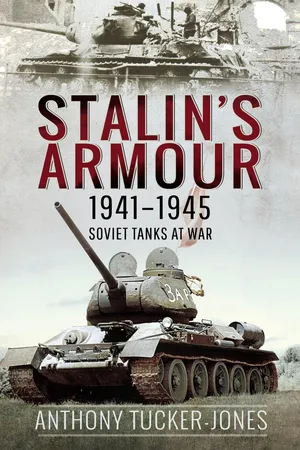
With over 60 photos, this look at the role of Red Army tanks in Hitler's defeat "will be of interest to modelers and military historians alike" (
AMPS Indianapolis).
Stalin's purge of army officers in the late 1930s and disputes about tank tactics meant that Soviet armored forces were in disarray when Hitler invaded in 1941. As a result, during Operation Barbarossa, the Wehrmacht's 3,200 panzers ran circles round the Red Army's tank force of almost 20,000—and thousands of Soviet tanks were disabled or destroyed.
Yet within two years of this disaster the Red Army's tank arm had regained its confidence and numbers and was in a position to help turn the tide and liberate the Soviet Union. This is the remarkable story Anthony Tucker-Jones relates in this concise, highly illustrated history of the part played by Soviet armor in the war on the Eastern Front.
Chapters cover each phase of the conflict, from Barbarossa, through the battles at Moscow, Stalingrad and Kursk to the massive, tank-led offensives that drove the Wehrmacht back to Berlin. Technical and design developments are covered, but so are changes in tactics and the role of the tanks in the integrated all-arms force that crushed German opposition.
- 256 pages
- English
- ePUB (mobile friendly)
- Available on iOS & Android
eBook - ePub
About this book
Information
Print ISBN
9781526777935
Subtopic
Russian HistoryChapter 1
A Tank Aficionado
During the late 1920s the Red Army was slow to adopt the tank. The Russian T-27 tankette, based on a British design, was little more than a machine-gun carrier. However, it was to result in a long line of light tanks, which morphed into fast tanks and finally medium tanks – culminating in the T-34. One man in particular, General Georgi Konstantinovich Zhukov, proved to be a significant tank aficionado. He was to champion the Red Army’s first tank brigades, divisions and armies. How did Zhukov, future hero of the Battles of Moscow, Kursk and Berlin, born to peasant stock in 1896, became Russia’s most famous tank general? He was to achieve this largely through a combination of military aptitude and being in the right place at the right time. He also realized from the start that the future of warfare would be shaped by the tank.
Zhukov was conscripted in 1915 and subsequently joined the Red Army at the start of the Revolution. He first saw action during the Civil War against the Whites near Shipovo in 1919, when his unit was attacked by 800 Cossacks. A key lesson he learned was that cavalry must be supported by adequate firepower. His military career began to progress when he served as a squadron commander with the 1st Cavalry Army under future Marshal Semyon Mikhailovich Budenny; more importantly Zhukov’s brigade commander was Semyon Konstantinovich Timoshenko.
After the war he soon rose to regimental and then brigade commander. Just over two decades later Timoshenko, by then a marshal and People’s Commissar for Defence, ensured Zhukov became his principal assistant, Chief of the General Staff, in January 1941 at the age of 44. Notably Zhukov, prior to his appointment as Timoshenko’s number two, served as Deputy Commander of the Byelorussian Military District. Neither Budenny nor Timoshenko would show the flare exhibited by Zhukov before or during the war. Budenny was a very old-school cavalryman, with a deep rooted scepticism of tanks, and was not considered very bright by some. Nonetheless, from 1937–9 he held the key posts of commander of the Moscow Military District, then the First Deputy People’s Commissar of Defence and during the German invasion commanded the Southwestern Front.
Zhukov was appointed commander of the 3rd Cavalry Corps in 1937, but shortly after he was offered the 6th Cossack Corps. Zhukov was never a conservative cavalryman like Budenny, far from it. While commanding the 3rd and then the 6th Corps, Zhukov cooperated closely with the 21st Detached Tank Brigade, under M.I. Potapov, and the 3rd Detached Tank Brigade, under V.V. Novikov. Both commanders were, in Zhukov’s own words, ‘former mates of mine’. This experience was crucial.
Zhukov was offered the Byelorussian post at the end of 1938, commanding the cavalry and tank units, which were to comprise around five cavalry divisions, four detached tank brigades and other supporting units. Saying goodbye to the Cossack Corps, Zhukov travelled to Smolensk and during May 1939 conducted a series of exercises near Minsk, little realizing that this would soon be the scene of bitter battles with Hitler’s marauding panzers. Of his time in Byelorussia, Zhukov recalled, ‘It was clear that the future largely belonged to armour and mechanized units. Hence we gave undivided attention to questions of cavalry-armour cooperation, and the organization of anti-tank defences in combat and in executing manoeuvres.’
His next posting took him to the far-flung reaches of the Soviet Union. During the summer of 1939, Zhukov defeated the Japanese Army on the steppes of Mongolia so decisively that Japan never meddled in Soviet affairs again. It ensured that Stalin was free to fight on just one front rather than two when the time came. When Hitler’s armies reached Moscow, Zhukov, with his wealth of experience, was there waiting for them along with his battle-hardened Siberian divisions. The Soviet-Japanese War could not have come at a better time for Zhukov and the Red Army. He would gain invaluable experience, developing his new armoured warfare tactics. He would also become familiar with the forces of the Transbaikal Military District, guarding the Chinese Manchuria-Manchukuo border. This district had come into being in the mid-1930s as a precautionary measure in response to Japan’s invasion of China. It also helped create a very useful reserve for the Red Army.
The Soviet high command was understandably alarmed by Japan’s conquest of huge areas of China and assessed that this constituted a very real threat to the Soviet border. Zhukov was ordered to see Marshal Voroshilov, the People’s Commissar of Defence, in Moscow on 2 June 1939. Voroshilov told him, ‘Japanese troops have made a surprise attack and crossed into friendly Mongolia which the Soviet Government is committed to defend from external aggression by the Treaty of 12 March 1936’. Zhukov jumped at the chance to show what he was capable of.
In effect the security of the whole of the Soviet Far East rested in Zhukov’s hands. It was time to put into practice all his training in Byelorussia. Accompanied by a small team he flew east, landing first in Chita, headquarters of the Transbaikal Military District. Zhukov met with General V.F. Yakovlev, the military district commander, and his officers. Yakovlev appreciated Stalin was taking the Japanese incursion into the Mongolian People’s Republic very seriously, especially if the People’s Commissariat of Defence had sent a special envoy with the authority to take charge without recourse to any of the regional commands. In the first instance what Zhukov needed, to make a thorough assessment of the situation, was credible intelligence. He was informed that General N.V. Feklenko’s 57th Special Corps was forward-deployed to the south-east in Mongolia, tasked with protecting the republic.
Just three days after his Moscow briefing, Zhukov arrived at 57th Special Corps’ HQ at Tamtsak-Bulak in Mongolia and met with Feklenko, Corps Commissar M.S. Nikishev and Brigade Commander A.M. Kushchev, Chief of Staff. To Zhukov’s irritation the situation was a complete mess. The HQ had little appreciation of the situation, communication between the Soviet and Mongolian commands was non-existent and coordination lacking. Zhukov was very unhappy that none of the commanders, except for Nikishev, had even visited the front and therefore had little idea of what was happening on the ground. Grasping the situation, he travelled up to the front and found that local intelligence was equally poor. Zhukov quickly came to the assessment that in its present state, 57th Corps was not up to the job of directing operations nor stopping the Japanese.
He immediately sent his report to Voroshilov, stating he planned that Soviet-Mongolian troops should maintain the bridgehead on the right bank of the Khalkhin-Gol river, while preparing for a counteroffensive. Voroshilov agreed and the ineffectual Feklenko found himself immediately replaced by Zhukov. The latter’s first move was to request reinforcements for the air force, plus three rifle divisions, and more significantly a tank brigade and artillery.
Zhukov, alert to the danger of his forces on the east bank being cut off, ordered a large-scale triple-pronged counter-attack with 450 tanks and armoured cars. Under his command was the 11th Tank Brigade, equipped with 150 tanks, the 7th Armoured Brigade with another 154 armoured vehicles and the Mongolian 8th Armoured Battalion, armed with 45mm guns. The 11th Tank Brigade, under its commander Yakovlev, was instructed to strike from the north, supported by the 24th Motorized Regiment, which pressed in from the north-west supported by artillery under Colonel Fedyuinsky. In addition, the 7th Armoured Brigade, under Colonel Lesovoi, was to attack from the south, supported by an armoured battalion from the Mongolian 8th Cavalry Division. Heavy guns from the 185th Artillery Regiment were moved up to support the attack on Bain-Tsagan and the 9th Armoured Brigade in the Khalkhin-Gol bridgehead.
At 0700 hours on 3 July 1939, Soviet aircraft and artillery commenced softening up Japanese positions. Two hours later tanks of the 11th Tank Brigade moved up with the full attack being launched at 1045 hours. Japanese defences and anti-tank guns were inadequate and Zhukov began to make ground. The Japanese response was to launch a counter-attack on the 4th, but it came to grief in the face of Soviet bombers and artillery. That night, the Japanese commander, General Komatsubara, gave the order to withdraw and his men were back over the river by the 5th. Their engineers blew the remaining bridges to prevent the Soviet tanks following, leaving many Japanese with little option but to swim for it. Those troops remaining on the eastern slopes of Bain-Tsagan were annihilated. Although Komatsubara and his HQ got back across the river, hundreds of his men drowned. He left much of his 10,000-strong force behind, strewn all over the mountain.
In the face of a Japanese counter-attack, the Soviets held their ground and by 25 July the Japanese, having suffered over 5,000 casualties, gave up. They counter-attacked again on 12 August and drove the Mongolian 22nd Cavalry Regiment from the Bolshiye Peski height to the south. At this point it would have been prudent for the Japanese to call it a day and summon the diplomats, but instead more anti-tank gun units were brought up ready for another counter-attack. They planned to attack along a 43-mile front on 24 August, but the dynamic Zhukov was to beat them to it by four days.
Zhukov’s Soviet-Mongolian command prepared for a knockout counteroffensive. Reinforcements were brought up, including two rifle divisions, a tank brigade and two artillery regiments as well as supporting bomber and fighter units. Stalin, conscious that Hitler would be closely watching events in Central Asia, despatched further reinforcements to him. These included three infantry and two cavalry divisions, seven independent brigades, including five armoured, and additional artillery and air force units to create the 1st Army Group. Zhukov had everything that he needed.
By now Soviet reconnaissance aircraft had pieced together a good picture of the Japanese defences. Zhukov assessed that the Japanese were most vulnerable on their flanks. He knew that their greatest weakness was their lack of mobility, effective tank units and motorized infantry. This meant they would not be able to respond quickly to any Soviet breakthrough. Zhukov’s armoured fist consisted of the 4th, 6th and 11th Tank Brigades and the 7th and 8th Mechanized Brigades. He planned to encircle the Japanese using his North, South and Central Groups, with his armour on the wings. The Soviets deployed 50,000 troops to defend the east bank and then Zhukov prepared to cross to the west, with three rifle divisions and his armoured forces. Waiting at their jump-off points were 35 infantry battalions, supported by a mobile force of 20 cavalry squadrons, 498 tanks, 346 armoured cars and 502 guns. At 0545 hours on 20 August Soviet aircraft blasted the Japanese forward positions, followed by a three-hour artillery and mortar bombardment.
Zhukov’s tanks roared forward at 0845 hours. By the next day, to the south his forces had swung behind the Japanese, reaching the Khalkhin-Gol’s east-west tributary, the Khailastyn-Gol. On the 23rd the Northern Group, backed by Zhukov’s reserves, seized the Palet Heights and swung south. Although trapped, the Japanese resisted to the last. The two wings of Zhukov’s attack linked up at Nomonhan on 25 August, trapping the Japanese 23rd Division. The following day Japanese forces outside the pocket tried to get through to them, but were met by Zhukov’s 6th Tank Brigade. The Red Air Force also ensured that the Japanese could not bring up reinforcements, dropping 190 tons of bombs in 474 sorties during the first week alone. Having trapped the Japanese, Zhukov spent a week eradicating the survivors. By 31 August it was all over. His strategy had triumphed.
Zhukov’s successful pincer operation at Khalkhin-Gol severely mauled the Japanese. He had passed his first major test of high-level command with flying colours. The Japanese claimed they lost 8,440 dead and suffered 8,766 wounded, while the Soviets claimed 9,284 casualties; however, losses for the Japanese have been put as high as 45,000 killed and Soviet casualties well over 17,000. Certainly, of the 60,000 Japanese troops trapped in Zhukov’s cauldron, 50,000 were listed as killed, wounded or missing. The Japanese 23rd Division was all but wiped out.
Shortly afterwards, on 1 September 1939, Hitler invaded Poland and when the shooting stopped the Soviets occupied the eastern half of the country. Behind the scenes Stalin, alarmed by the ease with which the Wehrmacht had crushed Poland in just four weeks, feared that Finland and the Baltic States might provide a springboard for a Nazi invasion of the Soviet Union. He imposed a mutual defence agreement on Estonia, Latvia and Lithuania in October 1939. This involved allowing the Red Army to be based on their soil, and in July 1940 they were officially incorporated into the Soviet Union.
Then Stalin invaded Finland on 30 November 1939. Despite Timoshenko’s overwhelming victory, the terrible performance of the Red Army greatly influenced Hitler’s decision to invade the Soviet Union. Stalin mobilized half his regular divisions in Europe and western Siberia to fight his tiny neighbour. He relied on brute strength, but Soviet troops, whilst brave, had crucially lacked initiative. Nikita Khrushchev realized the wider ramifications, ‘All of us – and Stalin first and foremost – sensed in our victory a defeat by the Finns. It was a dangerous defeat because it encouraged our enemies’ conviction that the Soviet Union was a colossus with feet of clay.’
The ineptitude of the Red Army in Finland convinced Hitler that Operation Barbarossa would swiftly bring the Soviet Union to its knees. As a result, he chose to ignore Zhukov’s resounding victory at Khalkhin-Gol. Unfortunately for the Soviet Union and the Red Army, the valuable experience gained by Zhukov in Mongolia, and during his earlier massed military exercises, was all but ignored. ‘We relegated to oblivion the fundamentals of combat-in-depth tactics and of combined arms manoeuvres’, recalled Marshal Biriuzov, ‘which had been widespread before the Finnish campaign.’
After Khalkhin-Gol, Zhukov singled out his tank brigades, especially the 11th under Yakovlev, for praise, as well as the 36th Motorized Division under Petrov, and the 57th Rifle Division under Galanin. The 82nd Division, now under Fedyuninsky, was to distinguish itself fighting the Germans, while Fedyuninsky would command the 42nd
Army at beleaguered Leningrad. Potapov, who had acted as Zhukov’s deputy, ended up commanding the 5th Army.
On the assumption that Operation Barbarossa went according to schedule, the German General Staff had to get their assessments of Soviet manpower, and indeed industrial capacity, right because it was vital they predict the Red Army’s response. Accurate intelligence regarding Soviet front-line units and reserves was crucial to the success of the entire enterprise. It was these judgements that convinced Hitler to invade and secondly fight the Battle of Moscow in the winter of 1941/42, because he believed it would exhaust the depleted Red Army’s reserves.
Crucially, thanks to his experiences in the Far East, Zhukov ensured that the Transbaikal Military District sowed the seeds for the Reserve Front, that would help defend the western Soviet Union. By the end of June 1941, Zhukov was anticipating being able to deploy just under 150 divisions running north to south in the Baltic, Western, Kiev and Odessa Military Districts. The manpower of these units was 50 per cent less than an average German division. The Wehrmacht would have to overcome these, plus at least another twenty regular army divisions being assembled.
Just before Barbarossa commenced, Timoshenko and Zhukov, who by then held the top posts of Commissar for Defence and Chief of Staff respectively, did all they could to warn Stalin of the growing threat of invasion. Zhukov was instructed to prepare State Defence Plan 1941. While this was based on the premise that Red Army operations would be in response to Nazi aggression, the idea was to take the fight to the enemy in an offensive rather than defensive manner. Zhukov’s defence plan and Soviet mobilization plans envisaged nearly all the Red Army being deployed in the west.
This meant that of the Red Army’s impressive order of battle, which comprised a total of 303 divisions, the bulk of them, some 237 divisions, would be deployed in the west facing the Nazi threat. However, of this impressive overall total, eighty-eight divisions were still in the process of being formed across the breadth and width of the Soviet Union.
Stalin’s reluctance to mobilize and the logistics involved meant by the summer of 1941 only 171 divisions were in the field in the western Soviet Union, deployed in three belts. They were to be strengthened by Stalin’s twenty-five new mechanized corps, fielding about 1,800 heavy and medium tanks plus thousands of inadequate light tanks. As a result, only a third of the Soviet divisions were actually in the crucial first defensive echelon. Under such circumstances it was clearly impossible for Zhukov to conduct a forward offensive defence.
Only in late April 1941 did Stalin acquiesce to Timoshenko and Zhukov’s request to mobilize the reservists, as well as re-deploy troops from the Urals, Siberia and Far East to the west. This deployment could not be completed until 10 July – this was to prove three weeks too late. Fortunately for Stalin, when Hitler reached the very gates of Moscow, Zhukov knew what to do. He would save the Soviet capital and go on to defeat the Germans at Kursk and Minsk, then crown his remarkable career with the capture of Berlin.
Chapter 2
Lost Advantage
The panzer commander Major General Friedrich von Mellenthin acknowledged that the Red Army:
began the war with the great advantage of possessing the T-34, a model far superior to any tank on the German side. … The Russian tank designers understood their job thoroughly; they cut out refinements and concentrated on the essentials – gun power, armour, and cross-country performance. During the war their system of suspension was well in advance of Germany and the West.
On the brink of war with Germany, Zhukov recalled that all was not well with the Soviet tank factories, thanks to the introduction of two new tank types:
The Defence Committee studied the situation in the tank industry on the Central Committee’s direction and reported that some of the plants did not fulfil production targets, had difficulties in adjusting production processes, and that the troops were getting the KV and T-34 tanks too slowly. The Government adopted appropriate measures. The Central Committee and the Council of People’s Commissars passed exceptionally important decisions to organize mass production in the Volga area and in the Urals.
Zhukov appreciated that the T-34 was simply not ready in time:
We had failed to correctly estimate the capacity of our tank industry. We required 16,600 tanks of the latest types only, and altogether as many as 32,000 tanks to equip the new mechanized corps to full strength. Such numbers could not be produced in a year with the existing facilities …
We managed to equip less than half the corps before the war broke out. And it was those very corps that essentially repelled the first enemy blows. The corps which at the outset of the war were still in the formative stage,...
Table of contents
- Cover
- Title
- Copyright
- Table of contents
- List of Illustrations
- Introduction
- Chapter 1 A Tank Aficionado
- Chapter 2 Lost Advantage
- Chapter 3 Stalin’s Mechanized Corps
- Chapter 4 Desperate Counter-Attacks
- Chapter 5 Tank City Falls
- Chapter 6 The T-34 Escapes
- Chapter 7 The Stalingrad Flank
- Chapter 8 Save the Oil
- Chapter 9 New Tank Armies
- Chapter 10 Other People’s Tanks
- Chapter 11 Triumph at Kursk
- Chapter 12 Battles for Kharkov
- Chapter 13 Victory in the Crimea
- Chapter 14 Stalin’s Armoured Steamroller
- Chapter 15 Punishing Traitors
- Chapter 16 Stopped Before Warsaw
- Chapter 17 The Road to Hungary
- Chapter 18 Tanks in Budapest
- Chapter 19 Beneath the Brandenburg Gate
- Chapter 20 Heroes of Socialist Labour
- Appendices
- Bibliography
- Plate section
Trusted by 375,005 students
Access to over 1.5 million titles for a fair monthly price.
Study more efficiently using our study tools.
Frequently asked questions
Yes, you can cancel anytime from the Subscription tab in your account settings on the Perlego website. Your subscription will stay active until the end of your current billing period. Learn how to cancel your subscription
No, books cannot be downloaded as external files, such as PDFs, for use outside of Perlego. However, you can download books within the Perlego app for offline reading on mobile or tablet. Learn how to download books offline
Perlego offers two plans: Essential and Complete
- Essential is ideal for learners and professionals who enjoy exploring a wide range of subjects. Access the Essential Library with 800,000+ trusted titles and best-sellers across business, personal growth, and the humanities. Includes unlimited reading time and Standard Read Aloud voice.
- Complete: Perfect for advanced learners and researchers needing full, unrestricted access. Unlock 1.5M+ books across hundreds of subjects, including academic and specialized titles. The Complete Plan also includes advanced features like Premium Read Aloud and Research Assistant.
We are an online textbook subscription service, where you can get access to an entire online library for less than the price of a single book per month. With over 1.5 million books across 990+ topics, we’ve got you covered! Learn about our mission
Look out for the read-aloud symbol on your next book to see if you can listen to it. The read-aloud tool reads text aloud for you, highlighting the text as it is being read. You can pause it, speed it up and slow it down. Learn more about Read Aloud
Yes! You can use the Perlego app on both iOS and Android devices to read anytime, anywhere — even offline. Perfect for commutes or when you’re on the go.
Please note we cannot support devices running on iOS 13 and Android 7 or earlier. Learn more about using the app
Please note we cannot support devices running on iOS 13 and Android 7 or earlier. Learn more about using the app
Yes, you can access Stalin's Armour, 1941–1945 by Anthony Tucker-Jones in PDF and/or ePUB format. We have over 1.5 million books available in our catalogue for you to explore.