The history of the armored division comprised of German teenagers in the Normandy campaign, drawing on new materials from former Eastern Bloc archives.
Raised in 1943 with seventeen-year-olds from the Hitler Youth movement, and following the twin disasters of Stalingrad and 'Tunisgrad,' the Hitlerjugend Panzer Division emerged as the most effective German division fighting in the West. The core of the division was a cadre of officers and NCOs provided by Hitler's bodyguard division, the elite Leibstandarte, with the aim of producing a division of 'equal value' to fight alongside them in I SS Panzer Corps.
During the fighting in Normandy, the Hitlerjugend proved to be implacable foes to both the British and the Canadians, repeatedly blunting Montgomery's offensives, fighting with skill and a degree of determination well beyond the norm. This they did from D+1 through to the final battle to escape from the Falaise Pocket, despite huge disadvantages, namely constant Allied air attack, highly destructive naval gunfire, and a chronic lack of combat supplies and replacements of men and equipment.
Written with the advantage of new materials from archives in the former Eastern Bloc, this book is no whitewash of a Waffen SS division and it does not shy away from confronting unpalatable facts or controversies.
Includes photographs
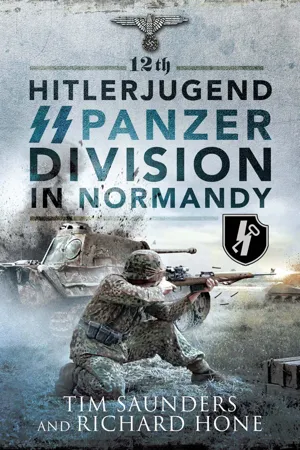
- 320 pages
- English
- ePUB (mobile friendly)
- Available on iOS & Android
eBook - ePub
12th Hitlerjugend SS Panzer Division in Normandy
About this book
Information
Print ISBN
9781399013024
Subtopic
European HistoryChapter One
Raising and Training the Division
There was and is, of course, nothing particularly new or unusual about the employment of young soldiers; it has happened in virtually all armies and in all ages. Indeed, Germany had in 1914 raised divisions of pre-conscription-age volunteer youths and students, which were officered by reservists whose service was many years out of date. These hastily ‘trained’ formations were committed to battle at Ypres in late October where they came up against hard-bitten British regular army soldiers in the fields north of Langemarck and suffered heavy casualties in what became known as the Kindermort or ‘Massacre of the Innocents’.
Later in the war the 238th Division, for example, was raised in early 1917 at Lockstedt Kasserne north of Hamburg. Young soldiers, conscripts from the 1898 and 1899 class, were provided with a handful of officers and NCOs returning from convalescence. This division was subsequently committed to battle on the Western Front with the majority of its soldiers still only aged between 17 and 19. As we will see, memory of these and other incidents had an impact on the formation of the Hitlerjugend Division thirty years later.
By early 1943 the tide of the war was turning against the Third Reich, with the disaster at Stalingrad where Feldmarschall Paulus surrendered the remaining 91,000 men of his Sixth Army casting a long shadow over the German war effort. Consequently, the Nazi leadership adopted a total war command economy,1 with the realization that not only were replacements for losses necessary, but also an expansion of the Wehrmacht to cope with the burgeoning Allied military strength. In addition, there was a need to match Allied war production. The German solution to this was an increased use of youth service and slave labour based on Albert Speer’s industrial genius.
Origins of the Hitlerjugend Division
The original idea for the formation of the Hitlerjugend Division emanated from SS-Gruppenführer Berger, head of the SS Central Office. The idea to create a division of 17-year-olds was quickly taken up for development by Stabsführer Mönckel and Artur Axmann of the Reich’s Youth Directorate. During the second week of February 1943 Hitler gave his authorization to recruit the division from the Hitlerjugend movement. A staff officer wrote:
I have submitted to the Führer your offer, on behalf of the youths born in 1926, to form a division of volunteers for the Waffen-SS, and of the same value as the Leibstandarte. I have also informed him of your desire and request that this division be identified in a manner which would clearly emphasize its origins and its simultaneous membership in the HJ. The Führer was highly pleased and has directed me to convey to you that you should immediately begin the recruiting of volunteers.2
The Hitlerjugend (HJ) from which the volunteers for the division would be drawn came into existence in 1922 alongside the National Socialist movement and by 1926 was formally a part of the Nazi Party structure with the title of Hitler Youth, League of German Worker Youth. As the Nazi Party expanded, so did the HJ, along with junior and girls’ equivalents.
When the Nazis came to power in 1933, a family’s membership of the party and the HJ for their children became an increasingly important feature of life in the totalitarian state, especially if one sought advancement. In 1936, as the Nazi grip on the state tightened, with its membership standing at 5 million, all Aryan youths were required to join the HJ and in 1939, with war clouds rising, service in the organization became compulsory for all Germans on their 14th birthday.
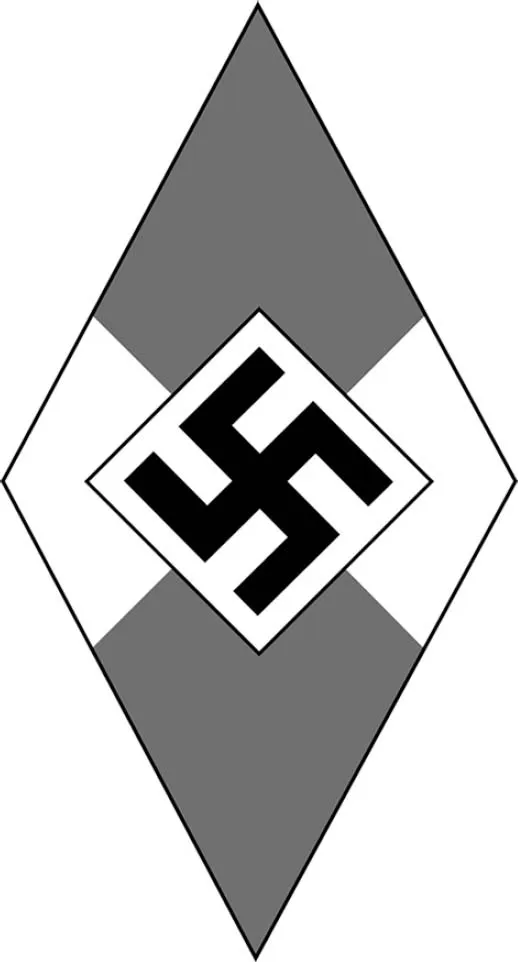
The badge of the Hitlerjugend youth movement.
The Deutsches Jungvolk and the Hitlerjugend with its compulsory membership for 10- to 18-year-olds was always both political and military in nature and aims. It was a preparation for military service based on fostering a group identity and physical fitness but also focusing on political indoctrination, self-sacrifice to the party and nation. Before the war a Western reporter commenting on the results of the way German youth was being politically exploited wrote: ‘These boys frighten me, much more so than their adult counterparts.’
The militaristic aspects were a considerable advantage to the Wehrmacht as a whole and to the formation of the new SS division. Boys from the age of 10 were not only indoctrinated, with many expressing a wish to die for their country, but had taken part in field day/games based on military skills, toughening up and obedience. Older members of the Hitlerjugend continued physical development through sport and activities designed to toughen them up and, finally, there was weapon and tactical training. A US intelligence officer pointed out that ‘The Hitler Youth is not a Boy Scout or Girl Guide organization. It is in no respect comparable to any organization for young people known to the Western World.’3
To raise a division’s worth of young men and to train and equip them against a background of Soviet offensives and further disasters such as ‘Tunisgrad’ in North Africa, where the last 250,000 Axis soldiers surrendered, was always going to be difficult, not least because the Waffen-SS and no lesser person than General Heinz Guderian would rather have replacements for existing divisions than raise a formation with a distinct political aim.4 The HJ Division’s formation would, however, be conducted in phases with the recruitment target being 30,000 youths, from which the 20,000 for the division would be selected. The replacements required for the wider Waffen-SS was a further 35,000.

Hitlerjugend youths training on the K98 Mauser rifle during early 1943.

Many recruits reported for duty in their Hitlerjugend uniforms and began their training in them.
To assist in reaching the target of 30,000, boys born in early 1926 were exempt from National Labour Service, with the first 2,000 being released in April and ordered to report to one of twenty Nazi establishments for six weeks of premilitary training at Wehrertüchtigungslager der Hitlerjugend (Hitlerjugend Military Instruction Camps) or WEL.5 They were to be followed by a further 6,000 a month later. This training was to take place at camps such as the one at Vogelsang in the Eifel region on the border with Belgium, which was turned over from educating the children of the Nazi elite to pre-military training. One commentator wrote of the WEL training, which
proved to be a successful innovation in terms of meeting what the Nazis felt to be necessary psychological conditioning for military combat. In a way, they were ideologically-charged basic training camps, less pragmatic, technical, and brutal than such camps for older draftees usually are, but more effective in fostering the attitudes that make military service more than a tolerable endurance test.6
The Waffen-SS: The Fighting SS
When Hitler became Chancellor of Germany in 1933, Sepp Dietrich, his longtime political supporter and early member of his personal Schutzstaffel or ‘Protection Squad’ during the turbulent early days of National Socialism in Munich, raised Sonderkommando Berlin. The first 120 men selected from the complex ranks nationwide of the SS quickly swelled to 800 and the title was changed through several iterations to Leibstandarte SS Adolf Hitler to reflect the dual role of Nazi ceremonial and the protection of the Führer; they were in essence his paramilitary lifeguard regiment.
In September 1934, the Führer ordered the formation of a wider Nazi paramilitary force, the SS-Verfügungstruppe (SS-VT). Three regiments, the Leibstandarte, Deutschland and the Germania standarten, were political enforcers for internal security under Hitler’s direct command. A fourth standarte, Der Führer, was raised in Austria following the Anschluss. The SS-VT were disliked by the army and derided as ‘Asphaldtsoldaten’ or ‘tarmac soldiers’ for their ceremonial role. They were trained and equipped by the army as the lowest priority.
During the campaign in Poland in 1939, Hitler ordered the Deutschland, Germania and Der Führer standarten to be expanded to full divisions known as SS-Verfügungs-Divisions. Through this measure the SS-VT became the Waffen-SS. The Leibstandarte had, however, remained a standarte but with the addition of support companies it became a fully motorized infantry regiment. In addition, two new Waffen-SS divisions were raised: the Totenkopf Division was formed from concentration camp guards and other SS organizations, while the Polizei Division was formed from the ranks of ...
Table of contents
- Cover
- Title
- Copyright
- Contents
- Introduction
- Acknowledgements
- 1. Raising and Training the Division
- 2. The Invasion
- 3. The Hitlerjugend in Action
- 4. Attack and Defence
- 5. Fighting EPSOM
- 6. The Battle for Caen
- 7. Operations South of Caen
- 8. Operation TOTALIZE
- 9. Endgame in Normandy
- Appendix I: German Recruit Training in 1943
- Appendix II: SS Ranks and Allied Equivalents
- Notes
Trusted by 375,005 students
Access to over 1.5 million titles for a fair monthly price.
Study more efficiently using our study tools.
Frequently asked questions
Yes, you can cancel anytime from the Subscription tab in your account settings on the Perlego website. Your subscription will stay active until the end of your current billing period. Learn how to cancel your subscription
No, books cannot be downloaded as external files, such as PDFs, for use outside of Perlego. However, you can download books within the Perlego app for offline reading on mobile or tablet. Learn how to download books offline
Perlego offers two plans: Essential and Complete
- Essential is ideal for learners and professionals who enjoy exploring a wide range of subjects. Access the Essential Library with 800,000+ trusted titles and best-sellers across business, personal growth, and the humanities. Includes unlimited reading time and Standard Read Aloud voice.
- Complete: Perfect for advanced learners and researchers needing full, unrestricted access. Unlock 1.5M+ books across hundreds of subjects, including academic and specialized titles. The Complete Plan also includes advanced features like Premium Read Aloud and Research Assistant.
We are an online textbook subscription service, where you can get access to an entire online library for less than the price of a single book per month. With over 1.5 million books across 990+ topics, we’ve got you covered! Learn about our mission
Look out for the read-aloud symbol on your next book to see if you can listen to it. The read-aloud tool reads text aloud for you, highlighting the text as it is being read. You can pause it, speed it up and slow it down. Learn more about Read Aloud
Yes! You can use the Perlego app on both iOS and Android devices to read anytime, anywhere — even offline. Perfect for commutes or when you’re on the go.
Please note we cannot support devices running on iOS 13 and Android 7 or earlier. Learn more about using the app
Please note we cannot support devices running on iOS 13 and Android 7 or earlier. Learn more about using the app
Yes, you can access 12th Hitlerjugend SS Panzer Division in Normandy by Tim Saunders,Richard Hone in PDF and/or ePUB format. We have over 1.5 million books available in our catalogue for you to explore.