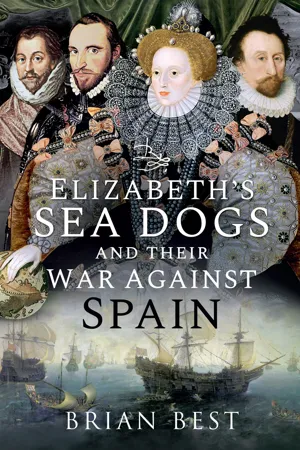
This maritime history recounts the exploits of sixteenth century English privateers in conflict with the Spanish Empire.
The Sea Dogs were seafaring merchants who originally traded mainly with Holland and France. During Queen Elizabeth's reign, however, they began sailing further afield, spreading the reach of English exploration and plundering. At that time, England was a relatively impoverished country. But it soon found a new source of wealth in the Caribbean—a region that had been the colonial domain of wealthy Catholic Spain.
The first man to trade with the Spanish Main was John Hawkins, who traveled to West Africa, captured the natives and transported them to the Caribbean. There he sold them to plantation owners in exchange for goods such as pearls, hides, and spices. His backers included the Queen herself, who encouraged the Sea Dogs to seek greater riches. This led to conflict with Spanish ships that would spark the Anglo-Spanish War.
The main thorn in the Spanish side was Francis Drake. Despite efforts to kill or capture him, he continued to plunder the high seas, bringing back Spanish riches to England. This allowed Elizabeth to flourish. It was thanks in main to the privateering exploits of the Sea Dogs that England became so wealthy, paving the way for the Renaissance that followed.
- 176 pages
- English
- ePUB (mobile friendly)
- Available on iOS & Android
eBook - ePub
Elizabeth's Sea Dogs and their War Against Spain
About this book
Information
Chapter One
Spain’s Early Raiders
The treaty of Tordesillas, confirmed by Spain and Portugal on 7 June 1494, stated that all lands lying west of the Cape Verde Islands (off the west coast of Africa) belonged to these two countries. It also excluded those heretical countries including Huguenot France, the Netherlands and England, who took a while to realise that Spain and Portugal were importing vast wealth from the New World. It was not until 1521 that French Huguenot privateers became aware of the trade in treasure, with which Spain hoped to convert the rest of Europe to Catholicism. In 1522 Jean Fleury, the captain of a fleet belonging to Jean Angelo of Dieppe, captured two Spanish galleons carrying Hernan Cortes’ Aztec treasure from Mexico to Spain. Fleury also captured another treasure ship sailing from Santo Domingo, and over the years such successes encouraged the Dutch ‘Sea Beggars’ and other corsairs to join in the attacks on the treasure ships, seizing them with comparative ease.
The reasons for the attacks were probably largely mercenary but there was also a religious element involved as the Protestant French and Dutch regarded their raids as striking a blow against Catholic Spain and Portugal. It was not until the death of Mary Tudor in 1558 that the English, once again Protestant, joined the piracy or privateering against Europe’s dominant country, Spain.
The Huguenots were the real thorn in the Spanish side, sending their nimbler vessels to capture ships and ports. Between 1536 and 1568 no fewer than 152 ships were captured in the Caribbean and another thirty-seven between Spain, the Canary Islands and the Azores. The Huguenots attacked not only ships on the high seas but also coastal ports and towns on the Spanish Main. In 1544 the Colombian city of Cartagena was plundered by five ships and a thousand men under the command of Jean- Francois Roberval. Taking advantage of the fact that Cartagena’s walls had yet to be erected, the Huguenots attacked and took the city, forcing a ransom to be paid. In 1553 the French laid waste the settlements on the northern coast of Hispaniola (today’s Dominican Republic), all but forcing the Spanish colonists to abandon the island.
On 10 July 1555 one of the most devastating raids took place on Cuba when Jacques de Sores of La Rochelle led his men in the sacking of Santiago de Cuba. The governor and population fled inland, leaving a small number of soldiers to put up a token resistance. Finding little in the way of riches, de Sores’ men desecrated churches and killed those who had remained. They then advanced into the surrounding countryside to seek out and kill the colonists, but were rebuffed by the Spanish soldiers. Withdrawing his forces, de Sores then ordered the town to be burned.
The following year de Sores returned to attack Santa Maria, an island off the mainland, with similar raids on Campeche in Mexico and Trujillo in Honduras. In the same year, together with Francois de Clerc, de Sores seized Havana. De Clerc, known as ‘Jambe de Bois’ (Peg Leg), had been granted the first official privateer’s licence allowing him to capture Spanish vessels in the Americas. This gave him carte blanche to raid where he liked in the Caribbean. During one raid de Clerc discovered and seized a huge cache of treasure, bringing the flow of Spanish treasure ships to a standstill for nearly seven years.
The Huguenots’ piratical range extended from Calais to Spain and even as far as the Azores. By 1574 there were sixty privateering ships sailing in this area, coming mainly from La Rochelle. This was also the base for the activities of the Dutch privateers (zelandais) in the service of Willem, Prince van Oranje. He greatly appreciated and supported the Huguenots’ contribution in attacking the Spanish ships and depriving the Spanish troops in Spanish Burgundy of supplies and money. The Huguenots used their light vessels for two purposes: cod fishing on the Grand Banks near Canada and, with added ordnance, raiding the Spanish ships. The main organiser of the Huguenots’ privateering war was Admiral Gaspard de Coligny, who became involved in the founding of colonies in the Americas and sought to eventually defeat the Spanish by attacking her vessels from the closer American ports. He had some influence over young King Charles IX and proposed a combined army of French Catholics and Huguenots to join the Dutch in their fight against the Spanish in the Netherlands.
In 1572 de Coligny was in Paris to attend the wedding of the Protestant Margaret, sister of Henry III of Navarre, and the Catholic Charles IX. This led to the St Bartholomew’s Day Massacre in which a huge number of Protestants were killed: reports of the death toll varied from 3,000 to 30,000. During the fighting de Coligny was fired upon, but he survived this attempted assassination – but not for long. Taken to rest in a nearby house, he was grabbed from his bed by some French Catholics and flung from the upstairs window before being beheaded. This notorious day of blood-letting proved to be the death-blow for the Huguenot movement.
The Dutch ‘Sea Beggars’ (Watergeuzen) were members of the irregular Dutch rebel forces. From 1569 Willem van Oranje issued ‘letters of marque’ to the Sea Beggars, turning criminal pirates into official privateers, and making them into an effective and organised fighting force against Spain under the command of a succession of daring and reckless leaders. The Eighty Years’ War (fought for Dutch liberation from Spain) was a complicated conflict. It was a war of independence, but also a religious and civil war in which economic and political factors played major roles. Both sides often committed pointless atrocities. The Watergeuzen and the northern Protestant insurgents regarded all Spaniards and Catholic Dutchmen as their enemies. They attacked churches, monasteries and Catholic villages and towns, killing priests, monks and representatives of the Spanish crown, as well as Catholic citizens. In return, the Spanish army – mostly mercenaries from Germany and Switzerland – took delight in sacking Protestant towns and murdering innocent victims.
During the Dutch revolt – secretly supported by England and the Huguenots – any plunder the Watergeuzen took from the Spanish was carried to French and English ports. For several years their bases of operations included Emden, La Rochelle and Dover. Then in 1572, under pressure from Spain, England denied the Dutch access to her ports, but this only lasted a short time. Although the Sea Beggars primarily fought for their independence, they also tied up the occupying army in the Spanish Netherlands, which added to King Philip’s woes. The Burgundian province was in the most dangerous part of Europe, being at the narrow end of the English Channel and subject to continuous harassment by Protestant France, Holland and England.
In 1585 Willem, Baron de Lumey, supported by Willem van Oranje and the Dutch government, captured several more low-lying coastal towns. These were promptly besieged by the Spanish, but the Dutch countered by opening the sluices and flooding the surrounding countryside. The siege-works became submerged, as did the Spanish soldiers, and in this way the Dutch controlled the country north of the river Scheldt. By 1585 the Spanish army was laying siege to the important rebel-held port of Antwerp. The Duke of Parma encircled the town so that the Dutch could not use the rivers and waterways leading to the sea, his siege works linked by an 800-yard-long pontoon bridge built across the river Scheldt. In April, however, the Sea Beggars launched a daring attack against the bridge with explosives and fire-ships (known as ‘hell-burners’). The ebb-tide carried the fire-ships towards the pontoon bridge, blowing apart the protective boom before setting the bridge ablaze. Despite losing some 800 men, the Duke of Parma’s men repulsed the Dutch and Antwerp eventually fell to the Spanish in August. After this episode, the role of the Watergeuzen decreased. From their decline sprang the Dutch navy under the command of Willem van Oranje and his general staff, who issued letters of marque with the following instructions:
The Sea Beggars had to conform to the Articles of War. Each commander was to maintain a minister aboard his ship. All Prizes were to be divided and distributed by a prescribed rule. Command functions should be occupied by native Dutchmen unless expressly commissioned by the Prince van Oranje. No persons were to be received on board, either sailors or soldiers, save folk of good name and fame.
By 1585 Queen Elizabeth was openly siding with the Dutch rebels and she encouraged her own Sea Dogs to aid in their fight. Francis Drake attacked the coast of Spain, inflicting considerable damage, while Walter Raleigh attacked the Spanish fishing fleets on the Grand Banks. Previously she had sent Sir John Norreys, the most acclaimed soldier of his day, to aid the Dutch resistance. During Elizabeth’s reign Norreys had taken part in the Wars of Religion in France, the Eighty Years’ War, the Anglo-Spanish War and the brutal suppression of Ireland in the 1570s. In 1578 he helped defeat the Spanish at the Battle of Rijmenam, during which he had three horses shot from under him.
Christopher Carleill, an English military and naval commander, went to support the Dutch resistance as early as 1572. He was present at the sieges of Middelburg, Steenwijk and the fortress at Zwarte Sluis. Following his service with the Dutch, he travelled to Russia and then, from 1584 to 1588, he served in Ireland. Another noteworthy soldier sent to help the Dutch was Francis Vere, a 25-year-old who joined the Earl of Leicester with some 3,000 men. Leicester failed to support Vere at Sluys and was relieved of his command. Having spent two years fighting, Vere returned to England for the winter, during which he was acclaimed by the public as the country’s pre-eminent soldier. Not yet 30 years old, he was elevated to the rank of Sergeant-Major-General and appointed second-in-command of all the English forces in the Netherlands. After years of fighting, in 1609 the Dutch Republic was finally recognised by Spain and other European countries. Even so, the Eighty Years War rumbled on until 1648, when the Netherlands was definitively recognised as an independent country and no longer a part of the Holy Roman Empire.
Chapter Two
The Rise of the Sea Dogs
One gets the impression that Spain was solely involved in fighting the English Sea Dogs in the Caribbean. In 1556 Philip II had inherited a vast empire which he was incapable of ruling; it included the seventeen provinces of the Burgundian Netherlands, thus bringing the devoutly Catholic Spanish closer to England. This also gave the English Catholics a base from where they could hatch their plots against Elizabeth when she ascended the throne in 1558. Following in the footsteps of her father Henry VIII, she was pragmatic in her attitude to religion. Despite her support for science and the arts, the author Neil Hanson described her court in his book, The Confident Hope of a Miracle, as ‘a snake-pit of favourites and sycophants – a glittering misery, full of malice and spite’ and her government as ‘venal and corrupt’.
Compared with Spain, England was second-class and impoverished. Elizabeth needed to fill the country’s coffers and her eyes were drawn to the treasures that Spain was bringing from the New World. To this end, in 1560 she formed a small discreet maritime group named the ‘Sea Dogs’. Their ships were well armed, comparatively nimble and perfectly capable of raiding the Spanish Main. They were captained by experienced men, mostly from the West Country, with navigational ability, determination and leadership skills. They infuriated the Spanish and Portuguese, who regarded them as being pirates, although the English preferred the term privateer. Piracy was a common calling, not highly respected but widely tolerated and easily accepted. In these early years the English Sea Dogs often allied themselves with the French Huguenots and the Flemish Dutch, both Protestant and fiercely anti-Catholic.
In 1522 the French captain Jean Fleury led the first raids against three Spanish treasure ships en route from Cuba to Seville. For the first time other European nations became aware of the vast wealth Spain was transporting from her New World colonies. The French Huguenots saw it as an open invitation to plunder the Spanish colonies, which they did for some thirty years with the blessing of their king. This ended in September 1572 with the St Bartholomew’s Day Massacre (see Chapter One) when between 3,000 and 30,000 Huguenots were massacred in Paris by a large Spanish force. Many Huguenots fled from France to Protestant countries like England, the Netherlands, Sweden and Denmark. The French made a point of dismissing the Huguenots from establishing a colony in America.
After Henry VIII’s break with Rome, there was a loosening of English ties with Spain. Until then, they had been closely allied in their opposition to France. When Mary Tudor died, a new age opened for England and her seamen. Elizabeth’s succession to the throne in 1558 inevitably caused a religious and political split with Catholic Spain and gave birth to a new age of English exploration, trade and, above all, raiding. A government licence was passed granting English ships privateering commissions to seize the cargo of enemy ships. The only problem was that England was not at war with Spain. The Sea Dogs got around this snag by carrying ‘Letters of Marque’, a legal licence that allowed them to capture merchant ships and bring their cargos before a court. Essentially, a privateer was a privately owned merchant ship armed with cannon and small-arms, which was given free rein to take or plunder enemy vessels. The crews of privateers received no wages but took a share of the captured booty. Also, very discreetly, Elizabeth herself shared in the spoils, which helped to boost the exchequer. Unless operating directly under the orders of the queen, most expeditions were speculative and were financed by backers hoping for a healthy profit.
The term Sea Dogs came into use in 1560 as a way of bridging the gap between the navies of Spain and England. The Sea Dogs were a quasi-military branch of the navy authorised by Elizabeth to attack and loot Spanish ships under the flimsy justification provided by the Letters of Marque. Also covered by English law were Letters of Reprisal, related to Spanish impounding of English cargoes, which gave the English another reason to attack Spanish vessels. The Sea Dogs were referred to as privateers, but the Spanish regarded them as little better than pirates. Men like Hawkins and Drake would, if captured, be swiftly executed. To the English of the Elizabethan era, trade and plunder were one and the same. Whether it was carried out by smugglers, pirates or the nobility, looting Spanish treasure ships was regarded as a patriotic act in the struggle against Catholicism. There was a fine line between privateers and pirates: privateers attack their country’s enemies, while pirates attack anybody, irrespective of nationality. But even this tentative line was often overstepped, the authorities turning a conveniently blind eye to acts of piracy.
At the heart of the Sea Dogs’ activities lay neither patriotism nor Prot- estantism, but enrichment. Investors and speculators formed consortia to back men like John Hawkins and Francis Drake, who would hopefully return from their trans-Atlantic expeditions to the New World laden with treasure. The Spanish sent their annual ‘treasure fleet’ (flota) from Seville south to the Cape Verde Islands, where the ships would catch a fair wind to take them to the Caribbean. Once there, they would split up, with the smaller vessels sailing to ports like Nombre de Dios and Rio Hacha to collect treasure transported by mule train from Peru, the Pearl Islands and Columbia. Several raids by the privateers on these smaller ports persuaded the Spanish to build forts and shore batteries to defend them against the raiding privateers, but it was not enough. All ideas had to be laboriously submitted for approval by King Philip, who relished the huge amount of paperwork that crossed his desk at the El Escorial. But in the process many good ideas were lost in the welter of paper.
To the Spanish, these attacks by the English Sea Dogs amounted to piracy but to Queen Elizabeth and her subjects they were a sturdy bulwark against the reimposition of Roman Catholicism. Queen Elizabeth during her long reign professed to be unaware of her marauding seamen and gave innocent answers to her Spanish rival. With the support of the West Country gentry and authorities, the pirates were at least partially legitimised. Small-scale piracy, mostly in the English Channel, continued throughout the early part of Elizabeth’s reign, with only a half-hearted attempt to suppress it. Major figures like the mayors of Southampton and Dartmouth regularly released captured pirates, and the latter incumbent was even fined – but he was not dismissed. The problem was that the Protestant officials who could have ended piracy often stood to gain from it, and in practice had little incentive to clamp down on it.
The typical English ship of that period was a three-masted vessel with square canvas sails on the bowsprit, fore and mainmasts, and a lateen sail on the mizzenmast towards the stern. This design engendered a manoeuvrability that was unavailable to two-masted or one-masted rigs. For such a maritime nation, it is remarkable that England imported timber, canvas, pitch, tar, hemp, cordage and other materials from Danzig and other ports on the Baltic. The retired pirate Sir Henry Mainwaring, not a supporter of English shipbuilding techniques, rated Mediterranean cables the best, followed by Flemish and Russian, with the English coming last.
Various types of ship were common during the Elizabethan era. The galleon was a large transport ship weighing around 500–800 tons, which carried the treasures amassed in the New World. Principally merchant ships, galleons could also be fitted with cannon and were regarded as powerful vessels. They became known as the ‘battleships’ of their day. The race-built galleon was the brain-child of John Hawkins, an experienced sailor who was elevated to the Royal Navy. These vessels had a longer hull length to beam ratio, giving them a more streamlined profile. They also reduced the towering superstructures favoured by the Spanish and were far more nimble. Galleys and galleasses were used mostly in the Mediterranean Sea, with prisoners chained to their oars. The usual length of sentence was twelve years, after which they were put in prison, where they would invariably die. These vessels were unsuited for the Atlantic Ocean or the Caribbean, but some did take part in the 1588 Armada. Carracks were three-masted ships with square sails, and were the standard merchant ships of the period. Caravels were unarmed three-masted merchant vessels, weighing between 100 and 200 tons. Hulks or urcas (a term which nowadays means an abandoned wreck) were used by...
Table of contents
- Cover
- Title
- Copyright
- Contents
- Introduction
- 1. Spain’s Early Raiders
- 2. The Rise of the Sea Dogs
- 3. John Hawkins
- 4. The Captives
- 5. Francis Drake
- 6. Drake’s Circumnavigation (1): the Doughty Incident
- 7. Drake’s Circumnavigation (2): Drake’s Fortune
- 8. Drake’s Circumnavigation (3): The East Indies and Home
- 9. Thomas Cavendish
- 10. The Military Elizabethans
- 11. The Execution of Mary Queen of Scots
- 12. Cadiz
- 13. The Spanish Armada
- 14. Ireland and Scotland
- 15. The Deaths of the Sea Dogs
- 16. The Capture of Cadiz
- 17. The End of an Era
- Bibliography
- Plate section
Trusted by 375,005 students
Access to over 1.5 million titles for a fair monthly price.
Study more efficiently using our study tools.
Frequently asked questions
Yes, you can cancel anytime from the Subscription tab in your account settings on the Perlego website. Your subscription will stay active until the end of your current billing period. Learn how to cancel your subscription
No, books cannot be downloaded as external files, such as PDFs, for use outside of Perlego. However, you can download books within the Perlego app for offline reading on mobile or tablet. Learn how to download books offline
Perlego offers two plans: Essential and Complete
- Essential is ideal for learners and professionals who enjoy exploring a wide range of subjects. Access the Essential Library with 800,000+ trusted titles and best-sellers across business, personal growth, and the humanities. Includes unlimited reading time and Standard Read Aloud voice.
- Complete: Perfect for advanced learners and researchers needing full, unrestricted access. Unlock 1.5M+ books across hundreds of subjects, including academic and specialized titles. The Complete Plan also includes advanced features like Premium Read Aloud and Research Assistant.
We are an online textbook subscription service, where you can get access to an entire online library for less than the price of a single book per month. With over 1.5 million books across 990+ topics, we’ve got you covered! Learn about our mission
Look out for the read-aloud symbol on your next book to see if you can listen to it. The read-aloud tool reads text aloud for you, highlighting the text as it is being read. You can pause it, speed it up and slow it down. Learn more about Read Aloud
Yes! You can use the Perlego app on both iOS and Android devices to read anytime, anywhere — even offline. Perfect for commutes or when you’re on the go.
Please note we cannot support devices running on iOS 13 and Android 7 or earlier. Learn more about using the app
Please note we cannot support devices running on iOS 13 and Android 7 or earlier. Learn more about using the app
Yes, you can access Elizabeth's Sea Dogs and their War Against Spain by Brian Best in PDF and/or ePUB format, as well as other popular books in History & British History. We have over 1.5 million books available in our catalogue for you to explore.