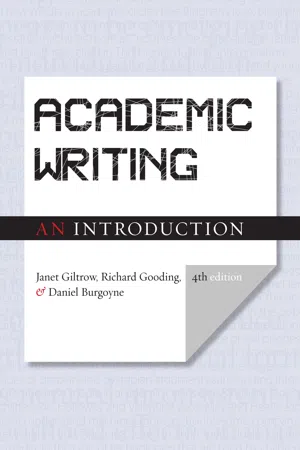
Academic Writing has been widely acclaimed in all its editions as a superb textbook—and an important contribution to the pedagogy of introducing students to the conventions of academic writing. The book seeks to introduce student readers to the lively community of research and writing beyond the classroom, with its complex interactions, values, and goals. It presents writing from a range of disciplines in the humanities, social sciences, and natural sciences, cultivating students' awareness of the subtle differences in genre.
eBook - ePub
Academic Writing: An Introduction - Fourth Edition
- English
- ePUB (mobile friendly)
- Available on iOS & Android
eBook - ePub
Academic Writing: An Introduction - Fourth Edition
About this book
Key takeaways
AI-Generated Insights
Insight 1
Analyze the conventions of academic genres across various disciplines and adapt writing strategies to meet the expectations of scholarly readers.
Insight 2
Synthesize information from diverse sources, employing effective citation and summary techniques to orchestrate scholarly voices within an argument.
Insight 3
Apply specific academic stylistic choices, including nominal style and visual rhetoric, to effectively communicate research findings and contribute to the ongoing production of knowledge.
Information
Edition
41
Introducing Genre
1A Hearing Voices
THE SEVEN PASSAGES below are in English. The observation that they are all written in English may be less important than the grounds on which they differ. As you read them, think about what they have in common and how they differ from one another. Issuing from decidedly different moments in North American life, each passage voices a different cultural situation. No one could say which of these passages is “best,” or which is proper English and which is not. But we can think about how each voice—each style of expression—serves the situation from which it arises.
PASSAGE 1
Coronavirus disease 2019 (COVID-19), caused by novel enveloped single stranded RNA corona-virus (SARS-CoV-2), is responsible for an ongoing global pandemic. While other countries deployed widespread testing as an early mitigation strategy, the U.S. experienced delays in development and deployment of organism identification assays. As such, there is uncertainty surrounding disease burden and community spread, severely hampering containment efforts. COVID-19 illuminates the need for a tiered diagnostic approach to rapidly identify clinically significant infections and reduce disease spread. Without the ability to efficiently screen patients, hospitals are overwhelmed, potentially delaying treatment for other emergencies. A multi-tiered, diagnostic strategy incorporating a rapid host immune response assay as a screening test, molecular confirmatory testing and rapid IgM/IgG testing to assess benefit from quarantine/further testing and provide information on population exposure/herd immunity would efficiently evaluate potential COVID-19 patients.
Pulia et al. (2020): 207.
PASSAGE 2
The new coronavirus is real.
The response to the coronavirus is hyped. And in time, this hype will be revealed as politically hoaxed.
In fact, COVID-19 will go down as one of the political world’s biggest, most shamefully overblown, overhyped, overly and irrationally inflated and outright deceptively flawed responses to a health matter in American history, one that was carried largely on the lips of medical professionals who have no business running a national economy or government.
The facts are this: COVID-19 is a real disease that sickens some, proves fatal to others, mostly the elderly—and does nothing to the vast majority.
That’s it.
That, in a nutshell, is it.
Chumley (2020).
PASSAGE 3
My name is Jersey and I am only 15 weeks old. My mom is Amy and she is just 1 year old. My mom and I are best buds and are always found together! Why won’t people adopt us together? Please don’t make us be adopted separately, we want to stay together!! Come meet us and you’ll see! We are both awesome and you’ll have endless entertainment … mom sometimes likes to talk so maybe she’ll tell you a story? We are currently hangin with VOKRA so please go to the site and fill out an adoption application if you are interested in us….
PASSAGE 4
In this article, I argue that these narratives of justice that divert attention away from systemic and structural racism to emphasize black criminality are a central component of a sociolinguistic process Schiff and Hooker (2019) call justicecraft. Extrapolating from Fields’ and Fields’ (2012) theory of racecraft, a process akin to witchcraft through which racism conjures the notion of race, Schiff and Hooker propose that in justicecraft, the notion of justice is imbued with oppression and domination, and undermines restorative practices. They conceive of the term in the context of their call to examine the language and narratives about justice in restorative practices, and to consider whether and how new language that affirms the dignity and humanity of participants can be created.
Giles (2019): 258.
PASSAGE 5
Executive living in this LIKE NEW, upgraded, spacious 1 bdrm & den (could be 2nd bdrm), 2 full baths home in a boutique complex. Absolutely fantastic water & mountain views. Just steps to the seawall, marina, parks, restaurants and shopping. Featuring stunning Brazilian tiger wood H/W flrs, upgraded doors, mouldings & baseboards. Upgraded appliances incl 5-Star gas range, Fisher & Pakel fridge, Asko top of the line dishwasher & Panasonic Genius microwave, Caesar Stone counters & breakfast bar with California glass tile backsplash. Bathrms with travertine floors & walls, granite accents & counters, Kohler sinks & Grohe trims. Plush carpet, custom lighting built-in custom storage & closet. $879,000.
PASSAGE 6
1.2 Unless otherwise agreed in writing with Google, your agreement with Google will always include, at a minimum, the terms and conditions set out in this document. These are referred to below as the “Universal Terms.” Open source software licenses for Google Chrome source code constitute separate written agreements. To the limited extent that the open source software licenses expressly supersede these Universal Terms, the open source licenses govern your agreement with Google for the use of Google Chrome or specific included components of Google Chrome.
PASSAGE 7
Varsity Football 3,4: J.V. Football 2; Freshman Football 1; Varsity Basketball 3, 4 (Captain) Frosh Basketball (Captain); J.V. Basketball (Captain); Varsity Spring Track 3; Little Hoya 3, 4*** Landon Rocks and bowling Alley Assault – What a Night; Georgetown vs. Louisville – Who Won That Game Anyway?; Extinguisher; Summer of ’82 – Total Spins (Rehobeth 10, 9 …); Orioles vs. Red Sox – Who Won, Anyway?; Keg City Club (Treasurer) –100 Kegs or Bust; Anne Daughterty’s – I Survived the FFFFFFFourth of July; Renate Alumnius; Malibu Fan Club; Ow, Neatness 2, 3; Devil’s Triangle; Down Geezer, Easy, Spike, How ya’ doin’, Errr Ah; Rehobeth Police Fan Cub (with Shorty); St. Michael’s … This is a Whack; Wendy Whitney Fan Club; Judge – Have you Boofed Yet?; Beach Week Ralph Club – Biggest Contributor; Maureen – Tainted Whack; George Hyman; Beach Week 3-107th Street; Those Prep Guys are the Biggest …; GONZAGA YOU’RE LUCKY.
EXERCISE 1
Name the types of writing exemplified in Passages 1–7. Can you identify the distinct occasion or cultural situation that each one serves? A cultural situation connects writers and intended readers, so begin by trying to identify the writer and implied reader for each passage. How does this situation shape the writer’s choices?
1B Hearing Genres
The passages above not only serve the cultural situations in which they arise; they also embody them. They represent distinct occasions in our culture; at the same time, people recognize and respond to them in ways that can be recognized as typical. So when we hear these different voices, we also “hear” the setting in which they operate. The sounds of these passages indicate typical moments that culture has produced: occasions of professional publication, online debate, or legal agreement. In each case, the situation has left its mark on, or imprinted, English. It has pressed into the general shape of the language features—for example, patterns of word choice and sentence construction—that mark it for use in particular contexts. The imprint makes language characteristic: something we recognize as typical of how people communicate with one another in particular circumstances.
To name the types and situations for each of these passages, you have to call upon your knowledge of North American culture. Perhaps Passage 3 escaped you: your life experience may not have included contact with the situation that has produced this particular kind of pet-adoption advertisement. Or you may never have encountered highly condensed yearbook profiles of the kind that appears in Passage 7, an infamous (and usually redacted) example that came back to haunt an American Supreme Court nominee in 2018. Hearing and speaking, reading and writing, we enact our experience of the world as that experience has been shaped by culture.
As the diversity of the seven passages shows, language is sensitive to situation. Moreover, how we use language changes as new situations arise. For example, new technologies have given rise to new situations and new ways of using language, such as texting. In this situation, instead of using conventional spelling and full sentences, we often use single letters, numbers, and emojis; and our friends recognize this way of writing as a typical and appropriate, not incorrect, use of English. In recent years, this sensitivity to situation has been captured and studied in new ways of thinking about genre. This book takes advantage of these recent developments.
Before sketching new ideas about genre, let us glance at old ones. Chances are that when you hear the word “genre,” you think of music or movies. For example, you may think of the difference between hip hop and technopop, or between slasher movies and psychological thrillers. Or you heard the word in the high-school classroom in connection with literary studies. Genre was, for instance, a way of saying that poems, novels, and plays are different. So the notion of genre helped school boards make their curriculum orderly. Now at university, some of your English courses may be organized according to genre: one course is about poems, another is about novels. For these purposes, genre has been a useful concept, tending toward traditional descriptions of literary form.
But then, at the end of the twentieth century, more and more scholars began to think about the social and political contexts of knowledge. Scholars considered the ways in which the characteristics of statements about the world depended on who was making the statement and who was being addressed. Alert to new opportunities, genre offered itself as a way of thinking about the context-dependency of language—the ways in which language depends upon and responds to the social and political contexts that produce it.
While old ideas of genre had slipped into regarding only form, the new ideas insisted that it was not form alone that constituted genre, but situation and form:
situation + form = genre
Or, to put it another way, the situations that writers find themselves in give rise to genres.
This new understanding of genre gave researchers a way of talking about similarities of form not as rules but as signs of common ground among communities of readers and writers: shared attitudes, practices and habits, positions in the world. Forms of speaking are connected to social contexts where people do things—like buying an apartment or finding a pet. Different routines of social behaviour—habits of acting in the world—create different genres of speech and writing.
In this light, consider the thank-you note as a genre. People who know this genre not only know how to compose the note—what to mention, how much to say, how to begin, how to conclude, what kind of writing materials to use—but also when to do all this: soon after receipt of a certain type of gift from a person in a certain relation to the recipient. (So, in all probability, you would not send a thank-you note to your parents for the gift of a laptop computer or to the Students’ Union for the daily planner you were handed as you walked across campus on the first day of classes. And if you delay sending a thank-you note where one is called for, you will feel—consciously or unconsciously—that you are failing to comply with the genre’s norms, no matter how perfectly you compose the note itself.) The thank-you note genre is made up not only of a characteristic type of written expression but also of the situation in which it occurs. It is a way of acting in the world. People with know-how in this genre understand not only its form but also its situation. We could even say that, at some deep, perhaps unconscious level, these people also share an understanding of the role of the genre in larger social or cultural situations—systems of relationship amongst family and friends, symbolized by the exchange of gifts and expressions of recognition and gratitude.
Once scholars began to consider genre outside traditional literary studies, it became clear that English classes weren’t its only, or even its best, place of work. Increasingly, other kinds of writing began to be thought of in terms of genre: auditors’ reports, news accounts of violent crime, case reports in publications in veterinary medicine, architects’ proposals, primary school show-and-tell sessions, and—most important to our interests—academic writing. At all these sites, genre was a means of investigating similarities in documents occurring in similar situations.
Genre theory gave researchers a way of talking about these similarities not as rules but as signs of common ground among communities of readers and writers: shared attitudes, practices and habits, positions in the world. So the style of Passage 5, the real estate ad, comes about not because somebody followed rules, but because it embodies a widely recognized situation—property transaction in a market economy—through its typical, list-like naming of qualities that the users of this genre recognize as valued and translatable into dollars. Views are good, and so is proximity to the city’s seawall and marina. The document assumes that readers recognize the value of custom-built storage and the prestige associated with various brand names. It trusts that readers will interpret the wide array of materials—tiger wood, granite, travertine, and glass—as indicators of luxury and taste rather than as revealing a haphazard approach to construction. It also assumes that readers are familiar with the customary practice of buying and selling a dwelling—contacting a broker specializing in this kind of transaction. Note that such knowledge is not universal but cultural. In another culture, where people inherit their homes from their parents, or share them with co-workers, such a genre would not exist at all. Or some culture, somewhere, might value a home not for its b...
Table of contents
- Cover
- Title Page
- Copyright
- Contents
- Preface
- 1 Introducing Genre
- 2 Citation and Summary
- 3 Summary
- 4 Challenging Situations for Summarizers
- 5 Think-Aloud Protocols in the Writing Classroom
- 6 Orchestrating Voices
- 7 Definition
- 8 Introductions
- 9 Scholarly Readers
- 10 Scholarly Styles I: Nominal Style
- 11 Scholarly Styles II: Messages About the Argument
- 12 Scholarly Styles III: Visual Rhetoric
- 13 Making AND Maintaining Knowledge I
- 14 Making and Maintaining Knowledge II
- 15 Conclusions and the Moral Compass of the Disciplines
- Glossary
- References
Trusted by 375,005 students
Access to over 1.5 million titles for a fair monthly price.
Study more efficiently using our study tools.