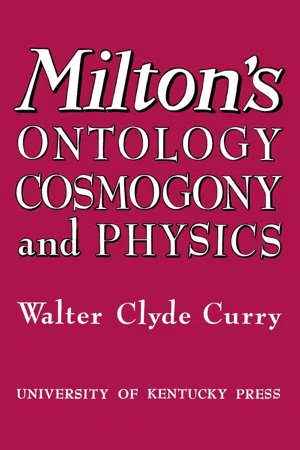
Walter Clyde Curry, a well-known student of Milton, analyzes the origins and unique construction of the grand stage upon which Milton presents the drama of human destiny in Paradise Lost. Through close examination of four entities—Heaven of Heavens, Hell, chaos, and the World—a greatly expanded view is provided of the poet's concept of space and God's relation to total creation. In facing structural and philosophical problems Milton is shown to be neither a materialist, nor an eclectic, nor a pantheist, as many scholars have insisted; he emerges rather as a master syncretist of widely divergent materials and as a devout theopantist. Curry has established a firm basis for a better understanding of the poet's methodology and for a clearer insight into his artistic accomplishments
- 242 pages
- English
- ePUB (mobile friendly)
- Available on iOS & Android
eBook - ePub
Milton's Ontology, Cosmogony, and Physics
About this book
Information
Topic
LiteraturaSubtopic
Crítica literaria inglesaChapter 1
MILTON’S DUAL CONCEPT OF GOD AS RELATED TO CREATION
THE PURPOSE OF THIS CHAPTER IS TO DISENGAGE MILton’s philosophy of the divine nature from narrow theological or sectarian controversy and to show how consistently his dual concept of the Deity in relation to the world is developed in the Christian Doctrine and embodied in Paradise Lost.
In the Christian Doctrine1 Milton approaches his consideration of God with due reverence and humility, confessing readily that it is “impossible to comprehend accurately under any form of definition the ‘divine nature’ ” (XIV, 39). Still, “the Deity has imprinted upon the human mind so many unquestionable tokens of himself, and so many traces of him are apparent throughout the whole of nature,” that one may arrive at some imperfect concept of him by intuition and the exercise of reason (XIV, 25). Milton does not himself intuit God in the mystic union of the human intelligence with the superintellectual principle, as Plotinus and others do.2 But he does depend largely upon reports of those who, in the Sacred Scriptures, have had visions and revelations granted them by Christ in various ages concerning the nature of Deity. And these disclosures the philosopher interprets with no inconsiderable originality by the exercise of reason in the application of metaphysical principles. He finds by diligent searching of the Scriptures that God’s nature may be partially apprehended by reference to descriptions of his revealed attributes. And in arranging the order of these properties he is cognizant of the fact that the Deity may be considered in two ways: namely, (1) in the mode of his metaphysical subsistence, and (2) in the mode of his operational existence, or as the Efficient Cause of all concrete effects.
I
From the metaphysical point of view God is said to be an “ens in the abstract” (XIV, 43) or the “primary ens of all” (XIV, 221). That is to say, he is a Being (ontos), that which is, that which is in itself and through itself, and as such it is one of the transcendentals and cannot be defined. Milton notes three names which seem to intimate this most recondite nature of Deity: Jehovah, “ ‘he who is,’ or ‘which is, and which was, and which is to come’ ”; Jah, a sort of contraction of Jehovah having the same significance; and Ehie, “ ‘I am that I am,’ or ‘will be’ ” (XIV, 39, 41). Now in order to comprehend the attributes of this Being, it is necessary to consider his essence, or the essence of the abstract Ens. Essence has been defined as “something primary in the thing and the root of all its properties; that which is conceived first in the thing without which the thing cannot be . . . ; the essence is conceived in the concept of the thing and stated in its definition.”3 Or as St. Thomas Aquinas has it, “Essence is what is expressed by the definition.”4 Since God’s essence is, according to definition, the root of all his properties, Milton proceeds to define God, considered in his essential nature, as a Spirit. He continues:
Whence it is evident that the essence of God, being in itself most simple, can admit no compound quality; so that the term hypostasis Heb. i. 3. which is differently translated substance, or subsistence, or person, can be nothing else but that most perfect essence by which God subsists by himself, in himself, and through himself. For neither substance nor subsistence makes any addition to what is already a most perfect essence; and the word person in its later acceptation signifies any individual thing gifted with intelligence, whereas hypostasis denotes not the ens itself, but the essence of the ens in the abstract. Hypostasis, therefore, is clearly the same as essence, and thus many of the Latin commentators render it in the passage already quoted. Therefore, as God is a most simple essence, so is he also a most simple subsistence (XIV, 41, 43).
Having established that the most simple essence of God is identical with his substance or subsistence or hypostasis, the controversalist finds that “there can be no real difference of meaning between the adverbs essentially and substantially” (XIV, 221). If these terms be applied to God alone, they must also be applied to God the Father alone, “since one substantial essence means nothing else than one hypostasis, and vice versa” (XIV, 221). He continues:
I would therefore ask my adversaries, whether they hold the Father to be an abstract ens or not? Questionless they will reply, the primary ens of all. I answer, therefore, that as he is one hypostasis, so must he have one essence proper to himself, incommunicable in the highest degree, and participated by no one, that is, by no person besides, for he cannot have his own proper hypostasis, without having his own proper essence. For it is impossible for any ens to retain its own essence in common with any other thing whatever, since by this essence it is what it is, and is numerically distinguished from all others (XIV, 221).
This conclusion is further supported by reference to another property rooted in God’s simple essence: namely, his unity. All evidence from the Sacred Scriptures indicates that there subsists “numerically one God and one Spirit, in the common acceptation of numerical unity” (XIV, 51). Aristotle had pointed out that “ ‘to be one’ means ‘to be indivisible’ (being essentially a particular thing, distinct and separate in place or form or thought), or ‘to be whole and indivisible.’”5 St. Thomas agrees that “the reason why any singular thing is this particular thing is because it cannot be communicated to many” and argues that because of God’s simplicity he is one.6 And Ralph Cudworth declares: “From the idea of God . . . it evidently appears that there can be but one such thing, and that . . . unity, oneliness, or singularity is essential to it.”7 And Milton emphasizes that “nothing can be said of the one God, which is inconsistent with his unity, and which assigns to him at the same time attributes of unity and plurality” (XIV, 51).
Other attributes of the Deity are truth, immensity, infinity, and as a consequence of his infinity, his omnipresence (XIV, 41, 43, 47). His eternity implies that he has neither beginning nor end; and related to his eternity are his immutability and incorruptibility (XIV, 43, 47). Such are the attributes which describe the nature of God in the mode of his metaphysical subsistence. And considered in this manner he is indeed incomprehensible.
For here is represented an extremely recondite Abstraction, an Ens so mysterious that it is beyond definition; one can only say that it exists in itself and through itself. Its essence is defined in such abstract terms that the human mind can scarcely comprehend their full significance. Here is God, the ineffable Spirit, eternal, infinite, immutable, and incorruptible locked securely, as it were, within an impenetrable numerical unity. He has some recognizable affinity with Aristotle’s First Principle, which is impartible, impassive, unalterable, eternal, and immovable.8 Milton’s God is above or beyond the category of relation (except perhaps in respect to his omnipresence), wrapped within himself in a sort of “frozen passivity” or eternal rest, resembling in some sense the Absolute of the Neoplatonists.9 No man has seen God; even to Moses was revealed only the Eternal’s “hinder parts.” The flagging thought of man must fall back upon the sublime symbol, “God is Light.” So Milton is at great pains to defend the inviolability and the incommunicability of God’s essence. And thus he seems to precipitate himself into a philosophical dilemma and Deity into a metaphysical plight. For God is said to have generated a Son, and it is an article of faith that he created, among other things, a visible universe. How can this be?
II
Now when we come to consider God in his divine power and excellence as the Efficient Cause of all possible effects, an entirely different group of attributes must be formulated. For here are involved multifarious and complicated relationships of both an internal and an external nature. Here God’s vitality is emphasized; he is the “living God” who is therefore the source of all life (XIV, 55). He is not merely an abstract Person or substance; he is or has intelligence, by means of which he knows all thoughts of the children of men and searches all hearts. His omniscience is universal (XIV, 55). And, perhaps most important of all, as regards the will of God, he is infinitely pure and holy, most gracious, merciful and long-suffering, abounding in goodness and truth, infinitely wise, faithful, and just in his judgments (XIV, 57, 59). God is love. “From all these attributes springs that infinite excellence which constitutes the true perfection of God, and causes him to abound in glory, and to be most deservedly and justly the supreme Lord of all things” (XIV, 61). Thus God is a Monarch who, provided with vitality, intelligence, and will, produces and rules all things. He must, therefore, be styled by us wonderful.
Though the essence of God is impartible and immovable, nevertheless as Efficient Cause he exercises intelligence and will in the employment of infinite power to produce multifarious effects. His decrees, internal and external, are entirely independent of external agency. Whatever he has decreed from all eternity of his own most free and wise purpose, precludes the possibility of his being in any sense controlled by necessity (XIV, 63, 65). Among his special decrees, we are here concerned primarily with that which has to do with his generation of a Son, whence is derived his name of Father. And the generation of the Son, representing the execution of a decree, must be considered as an example of his external efficiency, since the Father and Son are different persons, each possessing his own individual essence (XIV, 179, 181). Then just precisely how does God produce the Son?
This question, Milton confesses, is naturally a great mystery and very obscure. His theological adversaries argue that there is a certain emanation, or procession, spiration, or issuing of the Son from the Father (XIV, 181), but he himself is not too certain of the problem’s solution. Indeed, he finds very few texts in Sacred Scriptures relating to the Son’s generation or production. At any rate, he will have nothing to do with the celebrated “homoousian,” or the concept of three hypostases rooted in a single essence;10 distinctions involved in the orthodox conception of the Trinity are mere verbal quibbles, “founded on the use of synonymous words, and cunningly dressed up in terms borrowed from the Greek to dazzle the eyes of novices” (XIV, 221). He will rather hold strenuously to his own views: namely, the essence of the Father cannot be communicated to another person; the Son is distinguished also in his own essence; and “since a numerical difference originates in difference of essence, those who are two numerically, must be also two essentially” (XIV, 203). The Son, therefore, cannot possibly be coessential with God the Father: he is clearly a subordinate and independent essence produced as an effect by the will of God, from whom all things proceed. Moreover, the Son is not coeternal with the Father. No physical necessity impelled the generation of the Son; but since he is the consequence of a freewill decree, he was begotten within the limits of time (XIV, 187). Without employing too much metaphysical “trifling,” one must recognize that he was originally in the bosom of the Father and proceeded from him (XIV, 253), which implies a certain potentiality in God; and “if he was originally in the Father, but now exists separately, he has undergone a certain change at some time or other, and is therefore mutable” (XIV, 309).
Milton now proceeds to inquire how or in what sense God the Father can have begotten such a Son. He finds that this point can be “easily explained” by reference to the Scriptures; for when the Only Begotten is called “the first born of every creature, and the beginning of the creation of God,” it is clearly evident that “God of his own will created, or generated, or produced the Son before all things, endued with the divine nature.” He continues:
The generation of the divine nature is described by no one with more sublimity and copiousness than by the apostle in Hebrews, i. 2, 3. “whom he hath appointed heir of all things, by whom also he made the worlds; who being the brightness of his glory, and the express image of his person,” &c. It must be understood from this, that God imparted to the Son as much as he pleased of the divine nature, nay of the divine substance itself, care being taken not to confound the substance with the whole essence, which would imply, that the Father had given to the Son what he retained numerically the same himself; which would be a contradiction of terms instead of a mode of generation. This is the whole that is revealed concerning the generation of the Son of God (XIV, 193).
This passage needs to be scanned carefully and in some detail. Milton’s whole theory appears in danger of disintegration. In the production of the Son’s metaphysical entity or essence or quiddity, the Father is said to have imparted to the “express image of his person” as much of his “divine substance” as pleased him, though not his “whole essence.” The enthusiastic controversialist has already explained that in reference to God the terms substance and essence (hence substantiality and essentiality) have precisely the same meaning and that God’s essence (and so his substance) is indivisible and incommunicable to any other person. But it here appears that God does communicate as much of his substance as pleases him; and the term whole (tota) would seem to imply that he imparts at least some of his essence, at the same time retaining his numerical unity himself. The solution of this paradox is not easily discoverable. But Milton is no doubt familiar with Aristotle and the Scholastic philosophers and is fully aware that the term substance may have at least two different meanings. As Aristotle says, “Thus it follows that ‘substance’ has two senses: the ultimate subject, which cannot be further predicated of something else; and whatever has an individual and separate existence.”11 And St. Thomas develops this idea in detail: “In one sense it [substance] means the quiddity of a thing, signified by its definition, and thus we say that the definition means the substance of a thing; in which sense substance is called by the Greeks ousia, which we may call essence.” Milton understands substance in this sense when he says that God’s substance and essence mean the same thing. St. Thomas continues in the same passage: “In another sense substance means a subject or suppositum, which subsists in a genus of substance. To this, taken in a general sense, can be applied a name expressive of an intention; and thus it is called the suppositum.”12 In other words, as I understand it, when we come to consider how the multifarious essences of individual things flow as effects from the First and Efficient Cause, the cognoscitive faculty must establish by supposition or premise an underlying principle or “substance” which is subject to change. As McKeon says, “It is the property of substance that, remaining the same in number itself, it may undergo contraries; it is not itself susceptible of a contrary, nor of more or less, although it is the subject of both in change or mutation.”13 Just as, according to the principle of the so-called “solidarity” of the human race, the whole of human nature is present in each individual man,14 so we must suppose that the divine nature of God (substance in the second sense) is imparted to the Son. Milton no doubt has this sense of substance in mind when he speaks of Christ’s having “received his fulness from God” or all the “fulness of the Godhead bodily”; for, says he, “the term ‘bodily,’ which is subjoined . . . means ‘substantially’ ” (XIV, 339). Thus the Father has generated in the Son an express image of his person—even as man i...
Table of contents
- Cover
- Half title
- Title
- Copyright
- Preface
- Contents
- Confessions of the Author
- Chapter One: Milton’s Dual Concept of God as Related to Creation
- Chapter Two: Milton’s Chaos and Old Night
- Chapter Three: The Consistence and Qualities of Chaos
- Chapter Four: The Genesis of Milton’s World
- Chapter Five: The Lordship of Milton’s Sun
- Chapter Six: Some Travels of Satan and the Road to Hell
- Chapter Seven: Milton’s Scale of Nature
- Epilogue
- Appendix: Milton’s Light Exhaling from Darkness: A Study in Symbols
- Notes
Trusted by 375,005 students
Access to over 1.5 million titles for a fair monthly price.
Study more efficiently using our study tools.
Frequently asked questions
Yes, you can cancel anytime from the Subscription tab in your account settings on the Perlego website. Your subscription will stay active until the end of your current billing period. Learn how to cancel your subscription
No, books cannot be downloaded as external files, such as PDFs, for use outside of Perlego. However, you can download books within the Perlego app for offline reading on mobile or tablet. Learn how to download books offline
Perlego offers two plans: Essential and Complete
- Essential is ideal for learners and professionals who enjoy exploring a wide range of subjects. Access the Essential Library with 800,000+ trusted titles and best-sellers across business, personal growth, and the humanities. Includes unlimited reading time and Standard Read Aloud voice.
- Complete: Perfect for advanced learners and researchers needing full, unrestricted access. Unlock 1.5M+ books across hundreds of subjects, including academic and specialized titles. The Complete Plan also includes advanced features like Premium Read Aloud and Research Assistant.
We are an online textbook subscription service, where you can get access to an entire online library for less than the price of a single book per month. With over 1.5 million books across 990+ topics, we’ve got you covered! Learn about our mission
Look out for the read-aloud symbol on your next book to see if you can listen to it. The read-aloud tool reads text aloud for you, highlighting the text as it is being read. You can pause it, speed it up and slow it down. Learn more about Read Aloud
Yes! You can use the Perlego app on both iOS and Android devices to read anytime, anywhere — even offline. Perfect for commutes or when you’re on the go.
Please note we cannot support devices running on iOS 13 and Android 7 or earlier. Learn more about using the app
Please note we cannot support devices running on iOS 13 and Android 7 or earlier. Learn more about using the app
Yes, you can access Milton's Ontology, Cosmogony, and Physics by Walter Clyde Curry in PDF and/or ePUB format, as well as other popular books in Literatura & Crítica literaria inglesa. We have over 1.5 million books available in our catalogue for you to explore.