From a leading art historian, a provocative exploration of the intersection of art, politics, and history in 1960s Italy
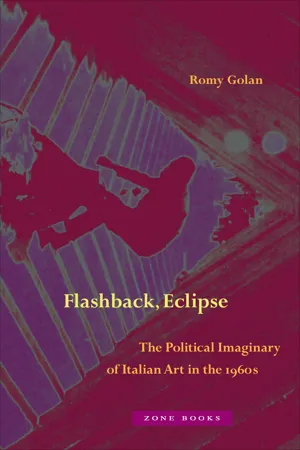
Flashback, Eclipse is a groundbreaking study of 1960s Italian art and its troubled but also resourceful relation to the history and politics of the first part of the twentieth century and the aftermath of World War II. Most analyses have treated the 1960s in Italy as the decade of "presentism" par excellence, a political decade but one liberated from history. Romy Golan, however, makes the counterargument that 1960s Italian artists did not forget Italian and European history but rather reimagined it in oblique form. Her book identifies and explores this imaginary through two forms of nonlinear and decidedly nonpresentist forms of temporality—the flashback and the eclipse. In view of the photographic and filmic nature of these two concepts, the book's analysis is largely mediated by black-and-white images culled from art, design, and architecture magazines, photo books, film stills, and exhibition documentation.
The book begins in Turin with Michelangelo Pistoletto's Mirror Paintings; moves on to Campo urbano, a one-day event in the city of Como; and ends with the Vitalità del Negativo exhibition in Rome. What is being recalled and at other moments occluded are not only episodes of Italian nationalism and Fascism but also various liberatory moments of political and cultural resistance. The book's main protagonists are, in order of appearance, artists Michelangelo Pistoletto and Giosetta Fioroni, photographer Ugo Mulas, Ettore Sottsass (as critic rather than designer), graphic designer Bruno Munari, curators Luciano Caramel and Achille Bonito Oliva, architect Piero Sartogo, Carla Lonzi (as artist as much as critic), filmmakers Michelangelo Antonioni and Bernardo Bertolucci, and, in flashback among the departed, painter Felice Casorati, writer Massimo Bontempelli, art historian Aby Warburg, architect Giuseppe Terragni, and Renaissance friar-philosopher-mathematician Giordano Bruno (as patron saint of the sixty-eighters).
- 304 pages
- English
- ePUB (mobile friendly)
- Available on iOS & Android
eBook - ePub
About this book
Information
Topic
ArtSubtopic
Art & PoliticsIndex
- ABATE, CLAUDIO, 200, 288 n.77.
- Absence, 32, 65, 256 n11.
- Abstraction, 16–17, 251 n.8. See also Informale painting.
- Accademia di Belle Arti (Venice), 212.
- Accardi, Carla, 239.
- Accornero, Aris, 265 n.75.
- Acocella, Alessandra, Avanguardia diffusa, 23.
- Actions, 23, 109, 111–12, 134, 135, 145, 200, 271 n.14. See also Artistic interventions; Campo urbano.
- AD (Architectural Design), 169, 172–73, 280 n.120.
- Adorno, Theodor, 115, 208.
- Agamben, Giorgio, “Warburg and the Nameless Science,” 150–51.
- Aggiornamento (catching up), 18, 188.
- Agnetti, Vincenzo, 281 n.1; Il deserto con Apocalisse (1970), 182; La macchina drogata (1969), 182–85.
- Albers, Josef, 200.
- Albini, Franco, 212.
- Al di là della pittura (San Benedetto del Tronto, 1969), 23, 112, 135, 203.
- Alfano, Carlo, 197, 281 n.1; Distanze (1969), 182, 200, 227.
- Alfieri, Bruno, 45, 258–59 n.25.
- Alienation effect, 236, 291 n.119.
- All-American Men at War (comic book), 79, 264–65 n.69.
- Alpini, 76, 77.
- Alpini, Edilio. See Tempo libero.
- Alviani, Getulio, 197, 239, 251 n.8, 281 n.1; Interpretazione speculare (1965), 192; Rilievo a riflessione ortogonale (1970), 230.
- Amalfi, 112, 271 n.16; Arsenali exhibit space, 193–97. See also Arte povera + azioni povere.
- Ambience, 208, 266 n.91.
- American art collectors and curators, 41, 259 n.28.
- American culture; Mirror Paintings and, 19–20; Pop and, 19. See also Pop.
- Amore mio (Montepulciano, 1970): aim of exhibition, 197; artists and works, 197, 199–203, 239; Bonito Oliva and, 197, 199, 239; catalogue, 29, 199, 239–41, 244, 245, 247; desolidarization and betrayal at, 238–47; forum at town hall,...
Table of contents
- Cover Page
- Title Page
- Copyright Page
- Dedication
- Contents
- Introduction
- I. Inside/Outside: Michelangelo Pistoletto’s Mirror Paintings
- II. Campo urbano: A Late Summer Festival
- III. Vitalità Del Negativo: The Exhibition as Palimpsest
- Color Plates
- Acknowledgments
- Notes
- Index
Trusted by 375,005 students
Access to over 1.5 million titles for a fair monthly price.
Study more efficiently using our study tools.
Frequently asked questions
Yes, you can cancel anytime from the Subscription tab in your account settings on the Perlego website. Your subscription will stay active until the end of your current billing period. Learn how to cancel your subscription
No, books cannot be downloaded as external files, such as PDFs, for use outside of Perlego. However, you can download books within the Perlego app for offline reading on mobile or tablet. Learn how to download books offline
Perlego offers two plans: Essential and Complete
- Essential is ideal for learners and professionals who enjoy exploring a wide range of subjects. Access the Essential Library with 800,000+ trusted titles and best-sellers across business, personal growth, and the humanities. Includes unlimited reading time and Standard Read Aloud voice.
- Complete: Perfect for advanced learners and researchers needing full, unrestricted access. Unlock 1.5M+ books across hundreds of subjects, including academic and specialized titles. The Complete Plan also includes advanced features like Premium Read Aloud and Research Assistant.
We are an online textbook subscription service, where you can get access to an entire online library for less than the price of a single book per month. With over 1.5 million books across 990+ topics, we’ve got you covered! Learn about our mission
Look out for the read-aloud symbol on your next book to see if you can listen to it. The read-aloud tool reads text aloud for you, highlighting the text as it is being read. You can pause it, speed it up and slow it down. Learn more about Read Aloud
Yes! You can use the Perlego app on both iOS and Android devices to read anytime, anywhere — even offline. Perfect for commutes or when you’re on the go.
Please note we cannot support devices running on iOS 13 and Android 7 or earlier. Learn more about using the app
Please note we cannot support devices running on iOS 13 and Android 7 or earlier. Learn more about using the app
Yes, you can access Flashback, Eclipse by Romy Golan in PDF and/or ePUB format, as well as other popular books in Art & Art & Politics. We have over 1.5 million books available in our catalogue for you to explore.