This book sheds new light on the relationship between religion and state in early modern Japan, and demonstrates the growing awareness of Shinto in both the political and the intellectual elite of Tokugawa Japan, even though Buddhism remained the privileged means of stately religious control.
The first part analyses how the Tokugawa government aimed to control the populace via Buddhism and at the same time submitted Buddhism to the sacralization of the Tokugawa dynasty. The second part focuses on the religious protests throughout the entire period, with chapters on the suppression of Christians, heterodox Buddhist sects, and unwanted folk practitioners. The third part tackles the question of why early Tokugawa Confucianism was particularly interested in "Shinto" as an alternative to Buddhism and what "Shinto" actually meant from a Confucian stance.
The final part of the book explores attempts to curtail the institutional power of Buddhism by reforming Shinto shrines, an important step in the so called "Shintoization of shrines" including the development of a self-contained Shinto clergy.
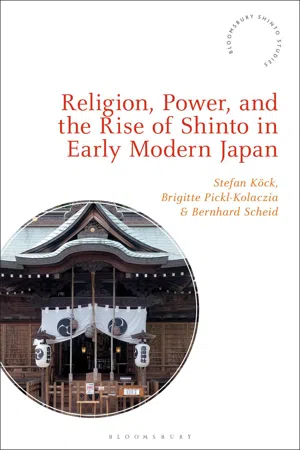
eBook - PDF
Religion, Power, and the Rise of Shinto in Early Modern Japan
- 305 pages
- English
- PDF
- Available on iOS & Android
eBook - PDF
Religion, Power, and the Rise of Shinto in Early Modern Japan
About this book
Information
Table of contents
- Cover page
- Halftitle page
- Series page
- Title page
- Copyright page
- Contents
- Illustrations
- Preface
- Editorial Conventions
- Introduction Tokugawa Religious Orthopraxy and the Phenomenon of Domain Shinto
- Part One Tokugawa Orthopraxy
- Part Two Unwanted Religious Groups
- Part Three Intellectual Challenges
- Part Four Institutional Challenges
- Notes
- References
- Contributors
- Index
Trusted by 375,005 students
Access to over 1.5 million titles for a fair monthly price.
Study more efficiently using our study tools.
Frequently asked questions
Yes, you can cancel anytime from the Subscription tab in your account settings on the Perlego website. Your subscription will stay active until the end of your current billing period. Learn how to cancel your subscription
No, books cannot be downloaded as external files, such as PDFs, for use outside of Perlego. However, you can download books within the Perlego app for offline reading on mobile or tablet. Learn how to download books offline
Perlego offers two plans: Essential and Complete
- Essential is ideal for learners and professionals who enjoy exploring a wide range of subjects. Access the Essential Library with 800,000+ trusted titles and best-sellers across business, personal growth, and the humanities. Includes unlimited reading time and Standard Read Aloud voice.
- Complete: Perfect for advanced learners and researchers needing full, unrestricted access. Unlock 1.5M+ books across hundreds of subjects, including academic and specialized titles. The Complete Plan also includes advanced features like Premium Read Aloud and Research Assistant.
We are an online textbook subscription service, where you can get access to an entire online library for less than the price of a single book per month. With over 1.5 million books across 990+ topics, we’ve got you covered! Learn about our mission
Look out for the read-aloud symbol on your next book to see if you can listen to it. The read-aloud tool reads text aloud for you, highlighting the text as it is being read. You can pause it, speed it up and slow it down. Learn more about Read Aloud
Yes! You can use the Perlego app on both iOS and Android devices to read anytime, anywhere — even offline. Perfect for commutes or when you’re on the go.
Please note we cannot support devices running on iOS 13 and Android 7 or earlier. Learn more about using the app
Please note we cannot support devices running on iOS 13 and Android 7 or earlier. Learn more about using the app
Yes, you can access Religion, Power, and the Rise of Shinto in Early Modern Japan by Stefan Köck, Brigitte Pickl-Kolaczia, Bernhard Scheid, Stefan Köck,Brigitte Pickl-Kolaczia,Bernhard Scheid in PDF and/or ePUB format, as well as other popular books in Teologia e religione & Politica asiatica. We have over 1.5 million books available in our catalogue for you to explore.