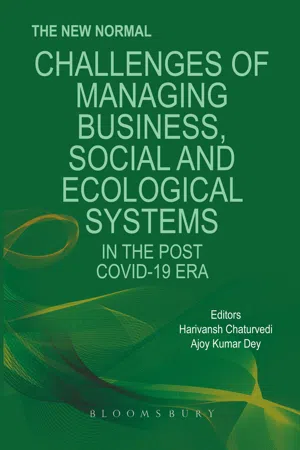
When the COVID-19 pandemic hit, the world was caught unprepared. We had faced several disruptions including pandemic but not at this level. It brought everything to a grinding halt as nationwide lockdowns were imposed to stop
the spread of infection. Businesses struggled, and then rose to the occasion to manage their work by redefining their business structure, work culture and strategies. This book has a collection of articles that are not just opinions and
projections about future but phenomenon-based articles explored through theoretical lens and are not just limited to business and economy but ecological changes as well.
The authors who have shared their knowledge and research hail from Bangladesh, New Zealand, Pakistan, Sri Lanka, UK, USA and Vietnam beside India. The diverse background of authors that include University Vice Chancellors, Directors, Distinguished Professors, and Senior Executives from the industry brings their unique perspective and insights in the articles.
The 27 articles in this book are divided in 5 sections namely Higher Education Rebuilding Itself, Surviving the Crisis, Evolving Business Models and Organizational Strategies, Way Forward for the Economy, Impact on the Ecosystem and Society. Each article demystifies the multidimensional impact that the pandemic has had on the professional and personal spheres of the human lives. We hope that it will serve as true companion of a researcher.
eBook - ePub
The New Normal
Challenges of Managing Business, Social and Ecological Systems in the Post COVID 19 Era
- 438 pages
- English
- ePUB (mobile friendly)
- Available on iOS & Android
eBook - ePub
The New Normal
Challenges of Managing Business, Social and Ecological Systems in the Post COVID 19 Era
About this book
Trusted by 375,005 students
Access to over 1.5 million titles for a fair monthly price.
Study more efficiently using our study tools.
Information
Akshaya Patra’s Food Assistance during the COVID-19 Pandemic: No One Shall Go Hungry
Ajay Kavishwar1 and Abhijit Naik*2
Abstract: The COVID-19 pandemic triggered an unprecedented food security crisis—directly, with the containment measures affecting the supply chains, and indirectly, with its economic implications affecting people’s food consumption habits. Humanitarian efforts were promptly initiated, with various organisations coming forward to aid the Government’s relief efforts to help the people from vulnerable communities. The Akshaya Patra Foundation aided these efforts by undertaking relief feeding in multiple locations across eighteen states and two union territories. The Foundation leveraged the robust infrastructure it has established and valuable partnerships it has forged over the years to distribute ‘Essential Grocery Kits’ and serve cooked meals, thus ensuring food availability for vulnerable communities across the country during the crisis. It engaged its extensive and efficient network of kitchens, highly trained and dedicated workforce, and organised infrastructure to execute this food relief effort in collaboration with the Government, donors, partners, and volunteers. Akshaya Patra’s relations with the administration and suppliers helped in navigating the challenges during the endeavour, especially in the initial stages marked by a lot of uncertainties. The initiative effectively demonstrated that Public-Private Partnerships (PPP) can maximise the impact of humanitarian efforts and made a strong case for the need for such collaborations in the development sector in the post-COVID world.
Keywords: Pandemic, Food Insecurity, Humanitarian Efforts, Food Assistance
Introduction
A Non-governmental Organisation (NGO) that began as a school feeding initiative, The Akshaya Patra Foundation has grown from feeding 1,500 children in 2000 to reaching 1.8 million children in 19,039 government and aided schools in fifty-one locations across twelve states and two union territories, as of 2020.[1]
In the course of its journey, the organisation has established, nurtured, and sustained partnerships with the Government, donors, and corporates, creating an effective Public-Private Partnership (PPP) model. By leveraging its partnerships and technology, Akshaya Patra has increased its reach not only within the school feeding programme but also extended its feeding operations to reach several underserved sections of society and established an efficient response system to assist the Government’s relief efforts during times of distress such as natural calamities, across various locations.
As the COVID-19 pandemic first began to show its presence in India, the country went into a national lockdown in March 2020.[2] Days after this first nationwide lockdown was announced to contain the spread of the COVID-19 virus, the Foundation took the initiative to set up packaging centres for food relief kits and use its kitchens for cooking meals to bring relief to those worst affected by the containment measures. Vulnerable communities – daily-wage earners, construction labourers, industrial workers, domestic helpers, and rough sleepers – who suddenly lost their livelihoods, were left with no option but to migrate to their home states. These communities were, therefore, highly susceptible to hunger. Akshaya Patra’s food relief initiative during this time has primarily revolved around bringing respite to these underserved communities.
Addressing the need of the hour, Akshaya Patra, through its vast network of kitchens, dedicated workforce, organised infrastructure, and an efficient logistics and delivery model spanning the country, has carried out relief feeding operations for over 6 months, to bring some respite to the vulnerable communities across the country.
As an organisation that has assisted the Government’s relief work time and again, Akshaya Patra was able to quickly collaborate with various State Governments, Union Territories Administrations, and local authorities to get the food relief initiative off the ground and negotiate any challenges that the organisation faced, especially in the initial days of the operation. Timely permissions, an efficient supplier network, and tremendous support from its donors, partners, and volunteers allowed their initiative to maximise its reach to those most in need.
Through all of its endeavours, Akshaya Patra has always strived to maintain the highest standards of food safety. Understanding the severity of the COVID-19 pandemic and its mode of transmission, the organisation has taken several additional measures to ensure the highest levels of safety not only in the relief food packaging and distribution work but also for the school feeding programme, when it is set to resume.
Like the school feeding programme, Akshaya Patra’s food assistance endeavour is also designed to contribute towards the United Nations Sustainable Development Goals (SDGs), particularly SDG 2 (Zero Hunger).
The COVID-19 pandemic has invariably affected all aspects of life for people around the world. Akshaya Patra stands committed to contribute towards finding sustainable solutions for the recovery and progress that is to be made soon and utilise its capabilities to keep itself in-line with the changing situations.
Akshaya Patra: A Background
The Akshaya Patra Foundation began by feeding 1,500 children in five schools of Bengaluru, Karnataka, in 2000.[3] The objective was to address classroom hunger by providing children a safe, freshly cooked, nutritious, and tasty school lunch. When the Government of India’s flagship school feeding programme, the Mid-Day Meal (MDM) Scheme was launched, Akshaya Patra collaborated with the Ministry of Human Resource Development (MHRD), Government of India, and State Governments to implement the programme.[4] With the signing of a Memorandum of Understanding (MoU) with the Government of Karnataka for Akshara Dasoha in 2003, it became the first organisation to establish a PPP with the Government in the Indian school feeding space.
Over the years, Akshaya Patra has forged new partnerships, collaborating with more states, corporate partners, and philanthropists, and leveraged technology to widen its reach and serve more children across the country. As of 2020, it reaches out to over 1.8 million children in 19,039 government and aided schools in fifty-one locations across twelve states and two union territories every school day. The scale and operational efficiency of the Foundation’s centralised kitchens enable it to reach out to children across various geographies and maximising the impact of the MDM Programme. In locations where it is difficult to set up a centralised kitchen as a result of difficult terrain and lack of connectivity, it has adopted the decentralised system. In this system, the kitchens are small, typically catering to one or two schools, and the meals are cooked by women’s Self-help Groups (SHGs) under the Foundation’s supervision.
In addition to the school feeding programme, Akshaya Patra is continuously striving to utilise its capabilities to serve more people across all spectrums of society. Other initiatives of the organisation include feeding women who are in the early stages of motherhood and children up to 6 years of age through the Integrated Child Development Services (ICDS) Anganwadi feeding programme,[5] providing meals to the people from low-income groups at very nominal prices through the Government’s subsidised meal programmes, breakfast initiative in schools, and food assistance as a part of disaster relief efforts.
Akshaya Patra is aware of the critical role of food assistance in humanitarian efforts during natural disasters. Since its inception, the Foundation has come forward on numerous occasions to aid the Governments relief efforts during crises characterised by disruption of food supply chains. Effectively using its well-established kitchen infrastructure across the country, its partner network, and other resources, it has strived to provide food and nutrition support to people and ensure their health during these times. Akshaya Patra has undertaken food relief in various parts of the country, including Karnataka, Kerala,[6] Uttar Pradesh,[7] Gujarat, Odisha, Assam, and more recently, Bihar.
In keeping with its resolve to bring respite to those in need during difficult times, Akshaya Patra, along with its supporting organisations, initiated its food assistance efforts within a few days of the announcement of the first national lockdown. As of 28 September 2020, the organisation has served over 8.7 crore meals in multiple locations across eighteen states and two union territories of India, providing food and nutrition support to the most vulnerable communities by distributing ‘Essential Grocery Kits’ and serving cooked meals.
Akshaya Patra strives to continue serving as a food safety net, to ensure adequate food and nutrition availability and accessibility through a socially inclusive approach.
The COVID-19 Outbreak in India and its Consequences
The novel coronavirus has shown the potential to be life-threatening on a massive scale. It has been called the most crucial global health crisis of the twenty-first century and one of the worst pandemics that the world has experienced in the past century. The rapid rate with which the virus spread, has posed a considerable threat to global health and consequentially, the global economy.
COVID-19 was first identified in the markets of Wuhan district in the People’s Republic of China in December of 2019.[8] As the World Health Organization (WHO) declared COVID-19 to be a ‘public health emergency”’ on 30 January 2020, India experienced its first case in Thrissur, situated in the southern state of Kerala.[9]
With the rapid rate with which the virus proliferated, nations entered into periods of lockdown, characterised by minimal to no human contact and a stay-at-home policy, to curb its spread. These containment measures were taken to flatten the curve; however, several communities, including the daily-wage earners, construction labourers, industrial workers, domestic helpers, and rough sleepers were direly affected as they were faced with a sudden loss of livelihood, and consequently, migration to their home states. These measures also resulted in sudden and severe limitations to food access primarily for these communities, exposing them to hunger and starvation.
The COVID-19 outbreak affected people from all socio-economic backgrounds. However, vulnerable populations, especially people from the socio-economically weaker sections of society, who were already struggling for sustenance, were affected the most. People who were living from hand-to-mouth were more susceptible to food insecurity during this outbreak. The loss of livelihoods in a matter of a few days left large sections of the population vulnerable to health-related issues and acute hunger. The condition of vulnerable populations is worsened, forcing them to reduce food consumption to overcome the economic burden. Such compromises prove to be highly detrimental to their well-being and make them further susceptible during such testing times.
To combat some of these concerns, Prime Minister Modi announced a 20 lakh crore (USD 307.65 billion) stimulus package to revive the shrinking economy and provide relief to the most affected populations.[10] The Atmanirbhar Bharatiya Abhiyaan package, accounting for roughly 10 per cent of the nation’s Gross Domestic Product (GDP), focused on relieving the stress placed on four critical aspects of the economy, namely, land, labour, liquidity, and laws, and sought to aid various sections including cottage industry, Micro, Small, and Medium Enterprises (MSMEs), labourers, and the middle-income group of India.
The Pradhan Mantri Garib Kalyan Package (PMGKP) of about 1.7 lakh crore was also announced, to provide free foodgrains and monetary resources to women and elderly who fell below the poverty line as well as free wheat/rice and pulses to the poor for 3 months, till June.[11] An additional 12 lakh crore would be pumped into the economy to prevent recession owing to mass unemployment and business closures. The PM Cares Fund, a public contributory fund, was created for which funds were raised through individual contributions to provide relief aid to those combatting the detrimental effects of COVID-19, while also ensuring that hospitals, beds, and Personal Protective Equipment (PPE) equipment are furnished to those in need.
‘Make in India’ policies to boost domestic production, privatisation of power, an extension of Government contracts, insolvency measures, relaxations for contributions to provident fund, and revised tax policy were also announced to aid the citizens in the face of this worldwide pandemic.
Akshaya Patra’s Initiative to Bring Food Relief
The COVID-19 pandemic has posed several new challenges for countries across the world simultaneously, making these times not only difficult to navigate, but also unprecedented because of the sheer magnitude of the people affected by the virus across the globe. As a result, enterprises of all kinds have been forced to innovate and find new ways to survive and sustain.
The need for and relevance of the NGO sector has never been more vital. The Akshaya Patra Foundation has always strived to be an organisation that adapts to the need of the hour alongside carrying out its responsibilities as an implementing partner of the Government’s Mid-Day Meal Programme. Demonstrating this dynamic aspect of its services, the Foundation came forward to provide food assistance when food access was disrupted for the marginalised communities as a consequence of the pandemic and subsequent containment measures.
Akshaya Patra advocates a cultur...
Table of contents
- Cover
- Half Title
- Title Page
- Copyright
- Contents
- Foreword
- Education, Business, Social and Ecological Systems in the Post COVID-19 Era
- About the Editors
- About the Sub-Editors
- Contributors
- Higher Education Rebuilding Itself
- Surviving The Crisis
- Evolving Business Models and Organizational Strategies
- Way Forward for the Economy
- Impact On the Ecosystem and Society
Frequently asked questions
Yes, you can cancel anytime from the Subscription tab in your account settings on the Perlego website. Your subscription will stay active until the end of your current billing period. Learn how to cancel your subscription
No, books cannot be downloaded as external files, such as PDFs, for use outside of Perlego. However, you can download books within the Perlego app for offline reading on mobile or tablet. Learn how to download books offline
We are an online textbook subscription service, where you can get access to an entire online library for less than the price of a single book per month. With over 1.5 million books across 990+ topics, we’ve got you covered! Learn about our mission
Look out for the read-aloud symbol on your next book to see if you can listen to it. The read-aloud tool reads text aloud for you, highlighting the text as it is being read. You can pause it, speed it up and slow it down. Learn more about Read Aloud
Yes! You can use the Perlego app on both iOS and Android devices to read anytime, anywhere — even offline. Perfect for commutes or when you’re on the go.
Please note we cannot support devices running on iOS 13 and Android 7 or earlier. Learn more about using the app
Please note we cannot support devices running on iOS 13 and Android 7 or earlier. Learn more about using the app
Yes, you can access The New Normal by H Chaturvedi,Ajoy Kumar Dey in PDF and/or ePUB format, as well as other popular books in Business & Business Strategy. We have over 1.5 million books available in our catalogue for you to explore.