Each article in the book demystifies the multidimensional impact that the pandemic has had on the professional and personal spheres of the human lives. The authors who have shared their knowledge and research hail from Austria, Bangladesh, France, India, Indonesia, Malaysia and USA. Further, the fact that the authors include University Vice Chancellors, Directors, and Distinguished Professors, suggests that the insights provided in the articles are unparalleled, diverse, boundaryless and unique.
The 23 articles in this book are divided in 5 sections namely Families Disconnecting or Reconnecting, Disrupted Lives During Pandemic, Reflecting on Professional Life, Revisiting Organizational Culture and Well-being, and Business and Academia Surviving the Crisis.
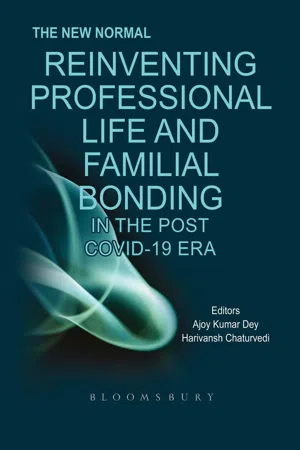
eBook - ePub
The New Normal
Reinventing Professional Life and Familial Bonding in the Post COVID 19 Era
- 362 pages
- English
- ePUB (mobile friendly)
- Available on iOS & Android
eBook - ePub
The New Normal
Reinventing Professional Life and Familial Bonding in the Post COVID 19 Era
About this book
Trusted by 375,005 students
Access to over 1.5 million titles for a fair monthly price.
Study more efficiently using our study tools.
Information
Ensuring Well-being of Employees in the Wake of the New Normal: Some Insights into the Manufacturing and Service Industries
Archana Choudhary*1 and Manoj Gour Chintaluri2
Abstract: The COVID-19 pandemic has brought about disruption at the workplace which no one could have anticipated. Working from offices always created an environment of focus, alignment of goals, enhanced collaborative effort, and also gave the necessary boost through social bonding. The pandemic has given rise to profound physical, socio-psychological, and technical implications for employees as they attempt to work according to the “new norms”. The fundamental ethos of working in offices has shaken.
The COVID-19 pandemic has brought new practices in the organizations like strict hygiene norms, social distancing and work from home. Prior to the onset of pandemic, employees who opted to work from home considered it as a perquisite and contributed whole heartedly for the effective functioning of the organizations, but when it was imposed on them for a longer period of time, they started to feel the brunt of it.
This chapter discusses the emergence of new work norms, how some progressive organisations are addressing it to mitigate the impact of stress and alleviate the work-family conflict of employees to maintain their well-being in the drastically altered work environments. The study dwells upon the interactions with the people from the industry, especially the manufacturing and service sectors. These insights would help us in understanding the types of organisational support required to sustain employee well-being in one of the most difficult times mankind has ever experienced.
Keywords: COVID-19, Employee Well-being, New Normal, Work from Home, Services, Manufacturing, Organisational Support
Introduction
As the saying goes, “familiarity breeds contempt” in a world that is marred by delicate relationships, governed by the intrusion of the Internet, multiple mobile ownerships in the same house, and relatively lesser communication between the members of families in comparison to what it was 20 years ago. Will the annals of history recognise another B.C, not before Christ, but before COVID-19?
The pandemic has instilled fear for life in the minds of people, forced us to stay indoors in the form of lockdowns, resulted in declining gross domestic product (GDP) and interest rates, displacement of people from jobs and more importantly, defined a new norm around the world in all aspects of life. Life has come to a standstill and businesses around the world have crumbled like nine-pins—an opportunity to leverage for some, but many have just collapsed. The new norm is dispelling organisational behaviour theories, psychological constructs, and affecting social behaviours. The pandemic has extended the scope of working from home as one of the requirements of the “New Norm”. How has this “New Norm” of Work from Home (WFH) impacted the stakeholders of organisations? The pandemic has resulted in revenue cuts, employee layoffs, and social cut off from all forms of physical meets, and led to the overt presence of family members at home.
All the members of a household have adapted to a new way of living. Children who enjoyed playing in the playgrounds and bonding with friends are now confined to the four walls of their homes. Employees who could take out some individual time for themselves during the day for reflection, rest, and re-energise are now swarmed 24X7 by family members. The household of an employee is going through a myriad of emotional and physical challenges. Is the new norm redefining “Work-Life balance”?
The pandemic is bringing about a disruption which no one would have anticipated at the workplace. Working from offices always created an environment of focus, alignment of goals, enhanced collaborative effort, and also giving the necessary boost through social bonding. The pandemic has given rise to profound physical, socio-psychological, and technical implications for employees as they attempt to work in the “new norm”. The fundamental ethos of working in offices which revolved around office environs, seating, facilities, design and motivation for working has shaken.
The authors felt that to assess the scenario of familial impact during the pandemic, a view from the horse’s mouth would be the best to identify the sensitive topic of familial bonding in the trying times, how it is causing stress to the employees and what the organisations are doing or can do to alleviate the stress while working from home.
Working From Home: The “New Norm”
While the larger part of the world is adopting a new work model primarily built as a contingency to ensure business continuity which consists of work from home (WFH) it has been an accepted norm in the IT/ITES industry on a large scale wherein clients of those companies have been flexible enough to accept their workforce login systems from remote locations. At a managerial level, though WFH was widely prevalent across a majority of industries, it was offered on a need basis. Over the past twenty years, organisations, irrespective of their size/scale, have started giving laptops to the managerial force with the intent of enabling round-the-clock access and response.
The pandemic, which came as a ‘bolt from the blue’, caught everyone by surprise and has affected all strata of the population, sizes of businesses, professions and countries, and is still rapidly spreading. The impact has been felt across all countries in terms of an annual shrink in the world GDP in 2019 at 3.2 per cent as compared to –4.6 per cent in June 2020. (Global Economic Outlook, 2020)
From an Indian perspective, by mid of March 2020, the first lockdown was announced, a lot of people believed that there was a solution in mind that would put an end to their woes until the next lockdown was announced. Reality dawned as the subsequent lockdowns continued.
These lockdowns, along with a scare of infection, made people confine themselves within the walls of their homes. Organisations started frantically connecting with their employees trying to understand what was happening and also establishing a channel of communication. Zoom, Google Meets and Hangouts became the buzzwords, people who were always averse to doing business with the help of technology tools, demonstrated amazing agility on learning and adaptability, the same which was taking years of penetration at the workplace in terms of technology habits.
The pandemic also brought about changes/challenges for a working employee in the following forms:
• Confines of home now becoming their new workplace.
• It was easy to focus on work while working from office vis a vis working from home. Creating a mental focus on work from home was left to the employee, unlike a workplace where one had a focus only on work.
• The lockdown has also necessitated the creation of a workplace for the spouse (in case of a working partner), a classroom for the kids, and a chat room for the elders at home.
• Disproportionate time at disposal with families.
• End of defined working hours, i.e. blurring of the boundaries between work time and time with family and self.
Keeping the earlier-mentioned observations in mind, it was felt that work from home emerged as the most prominent new work norm, and since it has an important bearing on the overall work-life balance of employees relating to their physical, social, and psychological well-being, it was felt that interacting with the working professionals in both the manufacturing and service sectors will help us in understanding the impact of the new work norms on familial bonding.
Research says that family time is a significant part of the human developmental process and an important force in developing healthy relationships between the family members comprising of parents, children, and their grandparents. Family bonding tends to create healthy connections with others in the society. It promotes happiness within the individuals and their entire households.
In countries which have a strong family value system, it is observed that individuals had lower exposure to victimisation, explaining why some individuals were victimised to a greater extent than their counterparts in other countries (Posick and Rocque, 2014). Strong familial bonding results in positive behaviour, reduces stress, promotes a healthy lifestyle, and creates positive memories. The lockdown, which is a result of the pandemic, has provided working people with an opportunity to spend quality time their spouses, children, and ageing parents.
Literature Review
Employee well-being has gained prominence and is of utmost importance in the context of the COVID-19 pandemic. On one side, there are frontline employees, who deliver “essential services” and are exposed to health risks like infection, mental health illness, and stress due to erratic and long working hours (Sim, 2020), and, on the other, there are employees who had to start work from home and remain deprived of socialisation causing mental illnesses like loneliness, anxiety, and depression (Staglin, 2020; Braverman, 2020). This might be leading to enhanced substance abuse and suicides (Higgins-Dunn, 2020). Cassidy (2020) also opines that organisations that do not give due importance to employee well-being tarnish their image in front of the stakeholders.
Well-being as a concept has a multidimensional perspective (Ryan and Deci, 2009). Broader dimensions of well-being include: physiological (physical and physiological wellness), social (interpersonal relationships), and psychological (subjective happiness and satisfaction), (Ponting, 2020; Grant et al., 2007). Given the horrifying impact of COVID-19 on the employee’s mindset, we consider the physical, psychological and social dimensions of well-being for our study.
Working remotely can seem like a dream come true for many employees. However, it can present its own set of challenges. Loneliness, time management, and digital miscommunication are just some of the issues one may face if he/she works from home or has another remote work arrangement.
The literature also suggests that if there is an imbalance between work and non-work activities, it leads to reduced physical and psychological well-being (Frone et al., 1997; Sparks et al., 1997; Thomas and Ganster, 1995; Martens et al., 1999; Felstead et al., 2002). A study conducted in the UK (Hyman et al., 2003) inferred that imposition of work encroaches into an employee’s personal life and leads to increased stress and emotional exhaustion for employees. Furthermore, employees also perceived that interference of work commitments into their personal lives affected their health negatively (Hyman et al., 2003).
Work from home opportunity enhances the work-life balance and an organisation offering such practices will have employees showing enhanced affective commitment and decreased turnover intentions (Chiu and Ng, 1999; Wood and de Menezes, 2008).
We take the help of social exchange theory (Blau, 1964) in explaining this further. When employees are shown favourable consideration by the organisation, they feel obliged to reciprocate through a positive approach or behaviour towards the organisation. Using the facility of work from home as a pointer of favourable treatment as it leads to better work-life balance, employees may respond in ways favourable to the organisation, i.e. they will show increased commitment, job satisfaction, and citizenship behaviours. The accessibility of work practices designed to help employees with handling their responsibilities at home will also increase employee’s perception of organisational support, especially if these work-life balance practices are viewed as being beneficial (Lambert, 2000). Perceived organisational support can also be used as an initiative towards favourable action, prompting reciprocal positive actions from employees.
The study was qualitative in nature. Working professionals from the manufacturing and service sectors who were working from home were interviewed and the findings were used to build this chapter. Random sampling was taken to study their perceptions on the following: whether issues related to well-being were sources of concern and needed attention from the organisations or not. Interviews were conducted to explore participants’ experiences on certain issues. Therefore, interviews enabled the identification of participants’ views, elaboration on the meaning that interviewees attached to various issues and situations (Easterby-Smith et al., 1991), and the further exploration of the points that interviewees made (Saunders et al., 2003). The interviews were semi-structured. This ensured consistency of themes across participants but also allowed the elaboration of interviewees’ accounts. The questions were developed to extract information and enable conclusions on the three points of interest stated earlier, namely:
• Whether the issues related to working from home were of concern to interviewees during these COVID times or not;
• The impact of work from home on organisations, and
• The impact of work from home on employees’ personal lives and their well-being
Discussion
The interview revealed a lot of pros and cons of...
Table of contents
- Cover
- Half Title
- Title Page
- Copyright
- Contents
- Foreword
- Navigating Through Professional and Personal Lives During COVID-19
- About the Editors
- About the Sub-editors
- Contributors
- FAMILIES RECONNECTING OR DISCONNECTING
- DISRUPTED LIVES DURING PANDEMIC
- REFLECTING ON PROFESSIONAL LIFE
- REVISITING ORGANIZATIONAL CULTURE AND WELL-BEING
- BUSINESS AND ACADEMIA SURVIVING THE CRISIS
Frequently asked questions
Yes, you can cancel anytime from the Subscription tab in your account settings on the Perlego website. Your subscription will stay active until the end of your current billing period. Learn how to cancel your subscription
No, books cannot be downloaded as external files, such as PDFs, for use outside of Perlego. However, you can download books within the Perlego app for offline reading on mobile or tablet. Learn how to download books offline
Perlego offers two plans: Essential and Complete
- Essential is ideal for learners and professionals who enjoy exploring a wide range of subjects. Access the Essential Library with 800,000+ trusted titles and best-sellers across business, personal growth, and the humanities. Includes unlimited reading time and Standard Read Aloud voice.
- Complete: Perfect for advanced learners and researchers needing full, unrestricted access. Unlock 1.5M+ books across hundreds of subjects, including academic and specialized titles. The Complete Plan also includes advanced features like Premium Read Aloud and Research Assistant.
We are an online textbook subscription service, where you can get access to an entire online library for less than the price of a single book per month. With over 1.5 million books across 990+ topics, we’ve got you covered! Learn about our mission
Look out for the read-aloud symbol on your next book to see if you can listen to it. The read-aloud tool reads text aloud for you, highlighting the text as it is being read. You can pause it, speed it up and slow it down. Learn more about Read Aloud
Yes! You can use the Perlego app on both iOS and Android devices to read anytime, anywhere — even offline. Perfect for commutes or when you’re on the go.
Please note we cannot support devices running on iOS 13 and Android 7 or earlier. Learn more about using the app
Please note we cannot support devices running on iOS 13 and Android 7 or earlier. Learn more about using the app
Yes, you can access The New Normal by H Chaturvedi,Ajoy Kumar Dey in PDF and/or ePUB format, as well as other popular books in Business & Gestione delle risorse umane. We have over 1.5 million books available in our catalogue for you to explore.