eBook - ePub
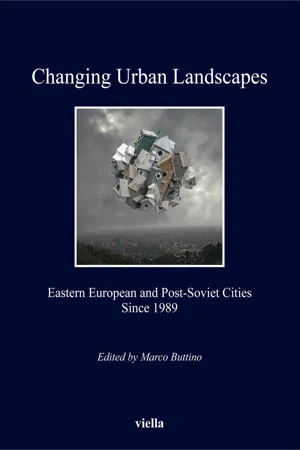
Changing Urban Landscapes
Eastern European and Post-Soviet Cities Since 1989
- 217 pages
- English
- ePUB (mobile friendly)
- Available on iOS & Android
eBook - ePub
About this book
The vast territory from Asia to Eastern Europe that was part of or under the influence of the Soviet Union comprised cities, which have undergone profound changes in the last twenty years. The opening of borders combined with the affirmation of market dynamics, privatization and concentration of wealth, and the emergence of nationalist discourses have upset ways of life and value systems leaving deep marks on the urban landscape and organization of living space.
These essays take an in-depth look at specific cases – Samarkand, Sarajevo, Berlin, Almaty, and others – to offer a complex picture of the transformations affecting the post-communist city.
Information
Subtopic
Storia russaGiulia Panicciari
Almaty as a New Kazakh City:
Kazakhisation of Urban Spaces After Independence1*
Kazakhisation of Urban Spaces After Independence1*
Like other ex-Soviet republics, Kazakhstan has undergone a process of profound economic, political, and social transformation, which has seen the introduction of a market economy; in addition, as we shall see, to the introduction of a new political discourse focused on legitimisation of a new power system and efforts to build a cohesive society in a context where ethnicity has become a way to translate concepts of citizenship.
The factors influencing the formation of a new society out of the remains of the former Soviet society can be observed in the ex-capital Almaty, a major pole of attraction for the citizens of the republic, for both cultural and economic reasons. Using Almaty as an example, I will show how social issues are at times interpreted as “the rights of the Kazakhs” by a part of the community which re-uses the ambiguous official rhetoric on Kazakh culture as the central, constitutive element of the identity of the new independent state. Such rhetoric is visible in this post-Soviet city, especially in the re-organisation of its monumental patrimony, where Soviet monuments, still central to the collective imagination, have been placed side by side with new symbols representing Kazakhness. I argue that Almaty has no cohesive community, not only because of persistent social and economic inequalities, but because the role of Kazakhness fails to create new civic and universal values.2 The boundaries that develop inside urban space are characterised by a socio-cultural division between those citizens who are Russian-speakers and more integrated in the globalising economic system, and those who are Kazakh speakers and who feel excluded. Consequently, at times social tensions are interpreted as “a Kazakh question” and are discussed by national government institutions in such terms.
Brubaker notes that everyday experience is connected much more with concerns about employment and strategies for self-advancement. Only occasionally are such concerns seen in terms of ethnicity.3 He shows how “[…] state policies, political struggles, organisational practices, social movements, and cultural discourses significantly shape everyday categorisation processes and practices.”4 This insight sheds light on the effects of a post-Soviet discourse in which majorities and minorities are re-positioned and re-imagined.
Since the ratification of the constitution in 1995, we can monitor how the president and the media have promoted an ideal Kazakh nation – often referred to as “the titular nation” – and, at the same time, a Kazakhstani one, where “Kazakhstani” includes all former Soviet citizens (regardless of the ethnic affiliation) who were accorded full citizenship soon after independence.5 Therefore, the question of developing a new independent nation has turned into a question of defining the role of Kazakhs and minorities living in Kazakhstan. By creating new prototypes and myths, the State emphasises the common past of Kazakh and non-Kazakh peoples, placing the legend of the natural peaceful character of the former, whose main quality is their tolerance towards the historical minorities living in Kazakhstan, at the centre of the national discourse, and thus promoting a discourse of inclusive nationalism.6 In doing so, the State legitimises the main role played by Kazakhness as a sort of guarantor of civic values over any other understanding of “citizenship.” My own fieldwork has shown that this discourse is re-interpreted on the local street level in the creation of new sources of confrontation, though not necessarily between Kazakhs and non-Kazakhs. Indeed, in my case study of post-Soviet Almaty, growing social inequalities connected with access to education and employment have led to tensions between those citizens living in the centre and those living in the periphery of the city where the ethnic, linguistic, and cultural background is very different. Assuming that these tensions are primarily social and then reinterpreted in an ethnic language, our primary question is: what effect does the new nationalism have on the urban community at large and on the Kazakhs in particular? Therefore, in surveying the historical background of the post-Soviet, I have structured my paper as follows: firstly, we will consider official discourse on Kazakh/Kazakhstani identity as applied to the constructed memory of the city (architectural and monumental patrimony and re-appropriation of public spaces,) along with the view “from the street,” where inhabitants perceive, use or do not use those spaces. I will then investigate in more depth the social and economic background of the inhabitants sheds more light on their experience of the city. Lastly, I will conclude my analysis with observations on how a new neighbourhood, Shanyrak, situated on the peripher...
Table of contents
- Copertina
- Occhiello
- Frontespizio
- Colophon
- Introduction
- Giulia Panicciari
- Marco Buttino
- Liza Candidi T.C.
- Pietro Cingolani
- Francesco Vietti
- Zaira Tiziana Lofranco
- Contributors
- Quarta di copertina
Trusted by 375,005 students
Access to over 1.5 million titles for a fair monthly price.
Study more efficiently using our study tools.
Frequently asked questions
Yes, you can cancel anytime from the Subscription tab in your account settings on the Perlego website. Your subscription will stay active until the end of your current billing period. Learn how to cancel your subscription
No, books cannot be downloaded as external files, such as PDFs, for use outside of Perlego. However, you can download books within the Perlego app for offline reading on mobile or tablet. Learn how to download books offline
Perlego offers two plans: Essential and Complete
- Essential is ideal for learners and professionals who enjoy exploring a wide range of subjects. Access the Essential Library with 800,000+ trusted titles and best-sellers across business, personal growth, and the humanities. Includes unlimited reading time and Standard Read Aloud voice.
- Complete: Perfect for advanced learners and researchers needing full, unrestricted access. Unlock 1.5M+ books across hundreds of subjects, including academic and specialized titles. The Complete Plan also includes advanced features like Premium Read Aloud and Research Assistant.
We are an online textbook subscription service, where you can get access to an entire online library for less than the price of a single book per month. With over 1.5 million books across 990+ topics, we’ve got you covered! Learn about our mission
Look out for the read-aloud symbol on your next book to see if you can listen to it. The read-aloud tool reads text aloud for you, highlighting the text as it is being read. You can pause it, speed it up and slow it down. Learn more about Read Aloud
Yes! You can use the Perlego app on both iOS and Android devices to read anytime, anywhere — even offline. Perfect for commutes or when you’re on the go.
Please note we cannot support devices running on iOS 13 and Android 7 or earlier. Learn more about using the app
Please note we cannot support devices running on iOS 13 and Android 7 or earlier. Learn more about using the app
Yes, you can access Changing Urban Landscapes by AA. VV., Marco Buttino in PDF and/or ePUB format. We have over 1.5 million books available in our catalogue for you to explore.