- English
- ePUB (mobile friendly)
- Available on iOS & Android
eBook - ePub
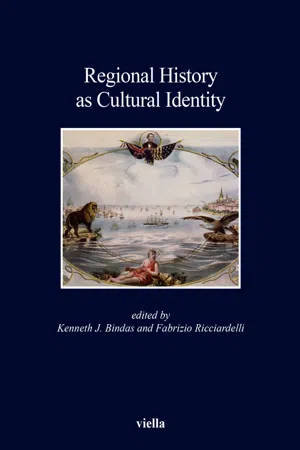
Regional History as Cultural Identity
About this book
This book brings together scholars to reflect upon the significance and meaning of local and regional history, focusing on how these histories impact people's cultural identity through traditions, culture, language, and politics. Scholars from all over the world analyze the process of communal identity construction ? the feeling of belonging to one state or nation regardless of one's legal citizenship status ? by focusing on case studies from North America, South America, Africa, and Europe. By analyzing the cultural and social aspects of community formation through language, religion, symbols, politics, race, and blood ties, these papers reveal that national identity, rather than being an inborn trait, is more often a result of the presence of common elements in the daily lives of individuals.
Information
Subtopic
European HistoryIndex
HistoryII
Role of Governmen
Fabrizio Ricciardelli
Late Medieval City-States and the Origins of Modern Democracy
Our form of government does not enter into rivalry with the institutions of others. We do not copy our neighbours, but are an example to them. It is true that we are called a democracy, for the administration is in the hands of the many and not of the few. But while the law secures equal justice to all alike in their private disputes, the claim of excellence is also recognized; and when a citizen is in any way distinguished, he is preferred to the public service, not as a matter of privilege, but as the reward of merit. Neither is poverty a bar, but a man may benefit his country whatever be the obscurity of his condition.153
Towards the end of the eleventh century, some communes of north and central Italy bypassed the authority of the Pope and the sovereignty of the Emperor and began appointing their own consuls, giving them final authority in judicial matters. This happened in Pisa in the early 1080s, in Milan, Genoa, and Arezzo before the year 1100, and in Bologna, Padua, and Siena from 1140 onward. During the second half of the twelfth century, the majority of Italian cities was governed by consuls, gradually replaced by forms of government led by podestà, who were foreign officials called to exercise potestas, that is to say executive and judiciary power. This system was adopted in Padua starting in the 1170s, in Milan from 1180, and in Florence, Pisa, Siena, and Arezzo from the end of the twelfth century. By the middle of the thirteenth century many communes in Lombardy and Tuscany had achieved the status of independent city-states, with written constitutions that guaranteed forms of self-government based on elections.154
While the majority of the countries of central Europe continued to have feudal and monarchic political structures, many cities of north and central Italy promoted republican forms of government, in contrast to monarchic governments which were held to be legitimate because they were thought to have come from God straight into the hands of men. The German cities remained for a long time subjected to the control of the bishop, and this fact, as opposed to the case in Italy, hindered the development of autonomous forms of government. In the course of the twelfth century the weakening of the bishop’s power brought the cities into the orbit of the great ducal dynasties, which were growing stronger at the emperor’s expense. In France as in Germany, in short, the cities came into conflict with the ambitions of superior powers (kings, princes, great territorial lords) who in that same period were attempting in their own right to build new, more solid structures of power. Finally, the French and German cities were much more socially homogeneous than those in Italy, being made up essentially of merchants and craftsmen, while in Italy the rural signori remained rooted in their country domains and had no role in city government. The principle that distinguishes the Italian city-republics from the rest of the European monarchies lies in the implementation of a basic principle of contemporary democracies: that all political offices must be elective and held for limited periods of time. Naturally, this does not mean that in these forms of government regular democratic elections were held, because the right to vote was the privilege of a few, limited to male heads of households, who were required to demonstrate ownership of substantial property in the city and to have been born in the city where they were participating in political life. To establish the composition of the city councils, the city was divided into electoral districts, or in some cases, contradas, within which the citizens were allowed to vote to decide whom to seat on the city councils and whom to elect as podestà.155
The move from a commune of consuls who belonged to families with a military tradition to one with a sole executive at the top to the commune governed by an outsider as podestà drawing a salary from the community came about between the twelfth and thirteenth centuries. The passage from consular government to one headed by a podestà initiated a process of progressive complication of the system. The councils increased, as did the government offices, and a system was established based on districts and contradas through which, by electing candidates, one reached the government. Naturally, the political system involved only those who enjoyed full citizenship and had sufficient financial resources. The podestà was the centre of the political structure; his primary objective was to love the entire citizenry, never making distinctions between the various social ranks but always promoting, as the Oculus pastoralis states, the honor, greatness, and well-being of the community.156
In the first half of the thirteenth century, a political culture with original characteristics took shape around the figure of the podestà, whose protagonists were at first rhetoricians and notaries, and later notaries and judges. This culture was expressed in a composite collection of writings, made up of letters, collections of speeches for the use of the podestà, prologues to charters and collections of documents, treatises on rhetoric and ethics, and instructions for the governors of cities. The leading authors of this new literary wave were Boncompagno da Signa, Guido Faba, and Bene da Firenze, followed by a series of judges and notaries ranging from Albertano da Brescia, who wrote between 1238 and 1250, to Giovanni da Viterbo, joined in the 1250s by figures like Brunetto Latini (c. 1220-c. 1294) and Bono Giamboni (dead after 1292).157
In the first half of the thirteenth century the citizens excluded from public office began gathering together in distinct groups and electing their own councils and captains as a reaction to the jurisdictions promoted by the podestà. These associations, or societates, obtained official recognition in Bologna from 1220, in Pisa from 1230, and in Florence, Padua and Arezzo before 1250.158 The emergence of popular societates conditioned the life of Italian cities for a good part of the thirteenth century and part of the following century, as is demonstrated by the example of the Capulets and Montagues, the two rival families who competed for power in the commune of Verona during the thirteenth century. Dante’s descriptions in the Divine Comedy159 and Shakespeare’s in Romeo and Juliet bring the struggle between the two families into the sphere of the opposition between Guelphs and Ghibellines: The Capulets were originally from Brescia and moved to Verona, becoming the main proponents of the Guelph faction that joined together the most ancient nobility of that city; the Montagues represented Verona’s Ghibelline nobility who, as was the case in other cities, Florence first and foremost, aimed by their actions to gain popular consent.160
Giovanni da Viterbo writes laconically in his Liber de regimine civitatum, composed presumably in 1234, that during the thirteenth century practically every city was divided internally, with the result that the effects of good government were no longer felt.161 At times, as in the case of Venice, factional strife was fairly well contained, but in the majority of instances the frictions led to political depletion, and thus to the failure of the city-state.162 With the beginning of the fourteenth century, many Italian communes witnessed the progressive transformation of their political systems into seigneurial forms of government, whose success was due to their ability to ensure peace and social unity to the population devastated by factional conflicts.163 In 1277 the Visconti became lords of Milan, in 1337 the Pepoli emerged in Bologna, and in 1339 the Carraresi became the new lords of Padua. Even if rather late, even Florence in 1532 fell to Medici rule, and in 1569, ...
Table of contents
- Cover page
- Series page
- Title page
- Copyright page
- Contents
- I. Transference of Law and Culture
- II. Role of Government
- III. Meaning of Regional Identity
- Contributors
Trusted by 375,005 students
Access to over 1.5 million titles for a fair monthly price.
Study more efficiently using our study tools.
Frequently asked questions
Yes, you can cancel anytime from the Subscription tab in your account settings on the Perlego website. Your subscription will stay active until the end of your current billing period. Learn how to cancel your subscription
No, books cannot be downloaded as external files, such as PDFs, for use outside of Perlego. However, you can download books within the Perlego app for offline reading on mobile or tablet. Learn how to download books offline
Perlego offers two plans: Essential and Complete
- Essential is ideal for learners and professionals who enjoy exploring a wide range of subjects. Access the Essential Library with 800,000+ trusted titles and best-sellers across business, personal growth, and the humanities. Includes unlimited reading time and Standard Read Aloud voice.
- Complete: Perfect for advanced learners and researchers needing full, unrestricted access. Unlock 1.5M+ books across hundreds of subjects, including academic and specialized titles. The Complete Plan also includes advanced features like Premium Read Aloud and Research Assistant.
We are an online textbook subscription service, where you can get access to an entire online library for less than the price of a single book per month. With over 1.5 million books across 990+ topics, we’ve got you covered! Learn about our mission
Look out for the read-aloud symbol on your next book to see if you can listen to it. The read-aloud tool reads text aloud for you, highlighting the text as it is being read. You can pause it, speed it up and slow it down. Learn more about Read Aloud
Yes! You can use the Perlego app on both iOS and Android devices to read anytime, anywhere — even offline. Perfect for commutes or when you’re on the go.
Please note we cannot support devices running on iOS 13 and Android 7 or earlier. Learn more about using the app
Please note we cannot support devices running on iOS 13 and Android 7 or earlier. Learn more about using the app
Yes, you can access Regional History as Cultural Identity by Kenneth J. Bindas,Fabrizio Ricciardelli in PDF and/or ePUB format, as well as other popular books in History & European History. We have over 1.5 million books available in our catalogue for you to explore.